

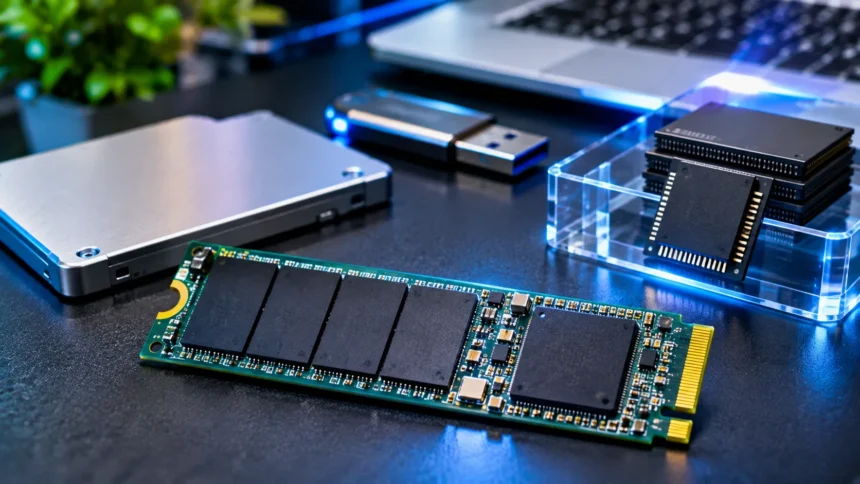
NAND flash is one of the most important technologies behind modern digital storage. It powers solid-state drives, smartphones, memory cards, USB flash drives, and many other electronic devices. Unlike traditional hard drives, NAND flash stores information electronically without relying on moving mechanical parts. This makes it possible to create compact, fast, and energy-efficient storage solutions for everyday technology.
Understanding NAND flash can help you learn how modern storage devices save, access, and manage digital information. This technology uses specialized memory cells to retain data even when a device is switched off. Different NAND flash types offer different combinations of storage capacity, performance, cost, and durability.
This guide explains how NAND flash memory works, its main types, benefits, limitations, and practical applications. You will also discover how storage controllers manage data and why modern devices use advanced 3D NAND technology. Whether you are learning about computer hardware or choosing a storage device, these concepts will help you understand modern digital storage.
What Is NAND Flash Memory?
NAND flash is a type of non-volatile semiconductor memory that stores digital information without requiring continuous electrical power. It uses memory cells to represent data through different electrical states. Unlike volatile RAM, which loses stored information when power is removed, NAND flash retains data after shutdown. This makes it suitable for long-term storage in electronic devices.
The name NAND comes from the logic arrangement associated with its original memory architecture. Modern NAND flash uses complex semiconductor structures and specialized circuits to store information efficiently. Memory cells are organized into pages and blocks that support data operations. This arrangement helps manufacturers create storage devices with high capacity in relatively small physical spaces.
NAND flash is widely used because it offers a practical balance between performance, size, and manufacturing cost. Solid-state drives use it to store operating systems, applications, and personal files. Smartphones rely on it for photos, videos, and installed software. Its versatility has made NAND flash a foundation of modern digital storage technology.
How Does NAND Flash Work?
NAND flash stores information by controlling electrical charge within specialized memory cells. These cells typically use floating-gate or charge-trap technologies to retain charge. The amount of stored charge influences the cell’s threshold voltage, which can be measured electronically. Different voltage ranges represent the digital information stored inside the memory.
When data is written, electrical signals change the charge state of selected memory cells. During reading, the storage system measures cell behavior to determine the stored values. This process happens through electronic circuits rather than mechanical movement. As a result, flash-based storage can access information quickly without moving read-and-write heads across spinning disks.
NAND flash cells are grouped into larger structures that allow the system to manage information efficiently. A storage controller coordinates access to these cells and translates requests from the operating system. It also handles error correction and other management tasks. These additional functions are important because individual memory cells have physical limitations.
How NAND Flash Reads, Writes, and Erases Data
Reading information from NAND flash involves measuring the electrical state of memory cells. The system uses reference voltage levels to determine which values the cells represent. Reading is generally faster and less demanding than writing or erasing data. However, actual read performance depends on the memory design, storage controller, and device interface.
Writing data requires programming memory cells into appropriate electrical states. NAND flash usually programs information in pages rather than individual bytes. Before previously programmed areas can be reused, the system must erase the relevant blocks. This difference between writing and erasing creates important challenges for storage management.
Erasing NAND flash resets an entire erase block, which contains multiple pages. A controller cannot simply overwrite arbitrary existing data as it would in some other memory technologies. Instead, it manages available pages and reorganizes information when necessary. This process explains why flash storage requires specialized controllers and background maintenance operations.
Different Types of NAND Flash Memory
NAND flash is commonly classified according to how many bits each memory cell stores. Single-Level Cell, or SLC, stores one bit per cell and offers strong endurance and performance characteristics. Multi-Level Cell, commonly called MLC, generally stores two bits per cell. These technologies prioritize different combinations of reliability, capacity, and manufacturing efficiency.
Triple-Level Cell, or TLC, stores three bits per cell and is widely used in consumer solid-state drives. It provides greater storage density than SLC or traditional two-bit MLC. Quad-Level Cell, known as QLC, stores four bits per cell and increases capacity further. Higher density generally reduces cost per stored bit but creates additional performance and endurance challenges.
Different NAND types are suitable for different applications. SLC is useful in demanding environments where endurance and predictable performance are important. TLC offers a practical balance for many everyday computing devices. QLC can be attractive for capacity-focused storage, although sustained write performance and endurance requirements deserve careful consideration.
What Is 3D NAND Flash Technology?
3D NAND is a modern memory architecture that stacks storage cells vertically rather than arranging them only across a flat semiconductor surface. This design allows manufacturers to increase storage density without depending entirely on smaller horizontal dimensions. Multiple memory layers are built into a single chip. The result is greater capacity within a compact physical design.
Traditional planar NAND placed memory cells in a primarily two-dimensional arrangement. As manufacturers reduced cell dimensions, maintaining reliable electrical behavior became increasingly challenging. Vertical stacking provided another way to increase density while addressing several scaling limitations. Modern 3D NAND designs use advanced structures that continue evolving across manufacturing generations.
Higher layer counts can help manufacturers produce memory chips with greater storage capacity. However, performance and reliability also depend on cell design, manufacturing quality, and controller technology. More layers do not automatically make every storage device faster. Buyers should evaluate complete product specifications rather than assuming that layer count alone determines quality.
The Role of NAND Flash Controllers
A NAND flash controller manages communication between the storage device and the system using it. It translates logical data requests into physical operations across memory cells. Because NAND cannot freely overwrite existing pages, the controller must carefully organize where information is stored. This process helps the device operate like a conventional storage drive.
One important controller function is wear leveling, which distributes write and erase operations across available memory blocks. Without this process, frequently used areas could wear out much faster than others. Controllers also perform error correction to detect and repair certain data errors. These functions improve reliability and extend practical device lifespan.
Garbage collection is another essential controller responsibility. It identifies blocks containing outdated information and prepares suitable space for future writes. Some devices also use spare storage capacity to improve management efficiency. A capable controller can significantly influence performance consistency, endurance, and the overall experience of using flash-based storage.
NAND Flash Speed and Storage Performance
NAND flash provides fast electronic access to stored information, making it well suited for modern computing devices. Compared with mechanical hard drives, flash-based solid-state drives generally offer much faster random access. This can improve operating system startup, application loading, and everyday responsiveness. Actual performance depends on several components working together.
The storage interface plays an important role in determining how quickly information moves between a drive and computer. SATA solid-state drives use a different communication system from modern NVMe drives connected through PCI Express. NVMe drives can achieve substantially higher transfer speeds when supported by suitable hardware. However, both may use NAND flash as their underlying storage medium.
NAND type, controller quality, firmware, and caching also influence performance. Some drives use faster caching areas to improve short bursts of writing activity. When these caches become full, sustained write speeds may decrease. This is why real-world testing is more informative than relying entirely on advertised maximum transfer rates.
NAND Flash Endurance and Lifespan
NAND flash memory has a limited number of program and erase cycles. Repeated electrical operations gradually affect the physical characteristics of memory cells. Over time, cells become less reliable at storing information within their intended voltage ranges. However, modern storage devices use management technologies to make this limitation practical for everyday use.
Manufacturers often describe SSD endurance using terabytes written, commonly abbreviated as TBW. This figure indicates a specified amount of data writing associated with the drive’s endurance rating. Some enterprise products use drive writes per day to express similar expectations. These ratings help buyers compare devices designed for different workloads.
A drive’s actual lifespan depends on usage, operating conditions, controller behavior, and manufacturing quality. Most ordinary users do not continuously write enormous amounts of data. However, demanding applications such as intensive logging or large-scale database operations may require higher-endurance storage. Maintaining backups remains important regardless of a device’s expected lifespan.
Advantages and Limitations of NAND Flash
One major advantage of NAND flash is that it stores information without moving mechanical components. This supports compact storage designs and reduces mechanical wear compared with traditional hard drives. Flash-based devices also offer excellent random access performance and can be highly energy efficient. These characteristics make them useful in portable electronics and computers.
Another advantage is scalability across different storage capacities and product categories. Manufacturers can use NAND flash in tiny memory cards or high-capacity enterprise drives. Modern 3D NAND technology further increases storage density. However, these benefits depend on suitable manufacturing processes and effective controller design.
NAND flash also has limitations involving write endurance, data retention, and erase requirements. Performance may decline during sustained writing, particularly on certain high-density devices. Stored data can become less reliable after long periods without power, especially under unfavorable conditions. These limitations explain why backups and proper storage management remain necessary.
NAND Flash vs. NOR Flash and Hard Drives
NAND flash and NOR flash are both non-volatile semiconductor memory technologies, but they serve different purposes. NAND generally offers high storage density and efficient bulk data storage. NOR is commonly used for firmware and applications requiring direct random access to stored instructions. The best technology depends on how the information must be accessed.
Traditional hard disk drives store information magnetically on rotating platters. They usually provide lower storage costs per gigabyte at high capacities than many solid-state alternatives. However, mechanical movement increases access latency and introduces physical components that can wear or suffer damage. NAND-based SSDs generally provide faster random access and quieter operation.
Neither technology is universally superior for every storage requirement. Hard drives remain useful for large backups, media archives, and capacity-focused systems. NAND flash is particularly attractive when speed, compact size, and low mechanical complexity matter. NOR flash continues to support specialized embedded applications where its access characteristics are valuable.
Common Applications of NAND Flash Storage
NAND flash is widely used in solid-state drives found in desktops, laptops, and data centers. These drives store operating systems, business applications, games, and personal information. Their fast access times support responsive computing experiences. Enterprise environments also use flash storage for workloads that require frequent access to large amounts of information.
Smartphones and tablets rely on NAND flash for internal storage. Photos, videos, applications, and operating system files remain saved even when these devices are switched off. USB flash drives and memory cards use similar underlying technology. These products demonstrate how NAND can support different capacities and physical designs.
NAND flash also appears in cameras, gaming consoles, embedded devices, and industrial equipment. Each application has different requirements involving temperature, endurance, capacity, and performance. Industrial systems may prioritize reliability under demanding conditions, while consumer electronics often emphasize affordability and compact size. Storage design must reflect these specific requirements.
How to Choose the Right NAND Flash Storage
Choosing NAND-based storage begins with understanding how the device will be used. Everyday computing, gaming, video editing, and professional data processing place different demands on storage hardware. Capacity is important, but performance and endurance also matter. Buyers should consider their workload rather than selecting a drive based only on price.
For many ordinary users, a reliable TLC-based SSD provides a useful combination of performance, capacity, and endurance. QLC-based drives may suit capacity-focused workloads with relatively moderate writing demands. More demanding applications may benefit from higher-endurance products. The controller, firmware, warranty, and independent performance testing also deserve attention.
Compatibility is another essential consideration when purchasing storage. Check whether your computer supports the required physical format, interface, and connection standard. Review endurance ratings and evaluate replacement or upgrade requirements. Choosing a dependable product from a manufacturer with clear specifications can help ensure suitable performance and long-term value.
Conclusion
NAND flash is a fundamental technology behind modern digital storage. It stores information electronically, retains data without constant power, and supports compact devices with fast access to information. From smartphones and memory cards to high-performance solid-state drives, NAND flash plays an essential role in everyday computing.
Different NAND technologies provide different balances of speed, capacity, cost, and endurance. SLC, MLC, TLC, and QLC represent different storage densities, while 3D NAND increases capacity through vertical stacking. Advanced controllers improve practical reliability by managing writes, correcting errors, and distributing wear across memory cells.
Understanding how NAND flash works makes it easier to compare storage devices and recognize their limitations. Consider storage capacity, performance requirements, endurance ratings, and compatibility before choosing a product. With appropriate hardware and reliable backups, NAND-based storage can provide efficient and dependable performance for many modern applications.
Frequently Asked Questions
What is NAND flash used for?
NAND flash is used in solid-state drives, smartphones, USB drives, memory cards, and embedded devices. It stores digital information without continuous power and supports compact, fast, and efficient storage solutions.
Is NAND flash the same as an SSD?
No, NAND flash is the memory technology used inside many SSDs. An SSD is a complete storage device containing NAND chips, a controller, firmware, and an interface for communicating with computers.
What is the difference between TLC and QLC NAND?
TLC stores three bits per memory cell, while QLC stores four. QLC offers higher storage density, but TLC generally provides better endurance and more consistent sustained writing performance under comparable conditions.
How long does NAND flash memory last?
NAND flash lifespan depends on write activity, memory type, controller design, and operating conditions. Modern SSDs include endurance ratings and wear-management features, but users should maintain backups because all storage devices can fail.
Is 3D NAND better than traditional NAND?
3D NAND offers higher storage density by stacking memory cells vertically. It addresses several limitations of older planar designs, although actual speed, endurance, and reliability depend on the complete memory and controller architecture.