

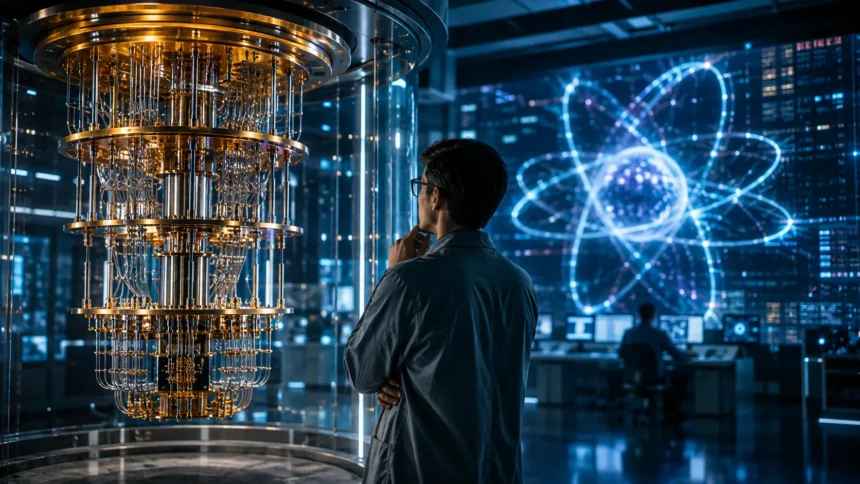
Is Quantum Computing the Future? What Comes Next
Quantum computing has spent years moving between scientific breakthrough, business excitement, and ambitious predictions about how computers could change. Unlike conventional computers, which process information using bits represented as zeros and ones, quantum computers use quantum bits, or qubits, that behave according to principles of quantum mechanics. This different approach could eventually make certain calculations possible that would be impractical for even extremely powerful classical computers. However, quantum computing is not simply a faster replacement for every laptop, server, or supercomputer. Its strongest future is more likely to involve specialized problems where quantum algorithms offer a meaningful advantage. Understanding that distinction is essential for separating genuine technological progress from exaggerated expectations.
The future of quantum computing also depends on solving difficult engineering problems that remain active research areas. Today’s quantum processors are still vulnerable to noise, imperfect operations, environmental interference, and loss of quantum information. Researchers are therefore working on better qubits, quantum error correction, logical qubits, modular hardware, control systems, algorithms, and hybrid computing architectures. Progress has become increasingly focused on useful computation rather than merely announcing larger physical-qubit numbers. At the same time, governments and businesses are preparing for cybersecurity changes that powerful future quantum computers could create. This guide explains where quantum computing stands, what it could realistically do, what obstacles remain, which industries may benefit, and what comes next as the technology moves toward fault-tolerant systems.
What Is Quantum Computing and Why Is It Different?
Quantum computing is a form of computation that uses controlled quantum-mechanical behavior to process information. Traditional computers store information in bits that normally represent either a zero or a one at a particular moment. Quantum computers instead use qubits, which can be prepared in quantum states that involve combinations of computational possibilities. This characteristic is commonly discussed through the concept of superposition, although superposition alone does not explain why a quantum algorithm can be useful. Quantum computation also depends on interference, measurement, and carefully designed operations that manipulate probability amplitudes. These properties allow certain algorithms to explore mathematical structures in ways that do not have a straightforward equivalent in conventional computing.
Entanglement is another important feature because quantum systems can develop correlations that cannot be described using ordinary independent classical variables. When an algorithm creates and manipulates entangled qubits correctly, the resulting quantum state can represent relationships across many computational possibilities. This does not mean that a quantum computer literally tests every possible answer simultaneously and instantly reveals the correct one. Measurement returns limited classical information, so algorithms must be designed to strengthen useful outcomes through quantum interference. Poorly designed quantum computations provide no magical shortcut. The challenge is finding problems whose mathematical structure can be exploited by quantum operations in a way that produces a genuine computational advantage.
Several physical technologies are being developed to create reliable qubits. Superconducting circuits use extremely cold electrical systems and are among the most visible approaches used by major quantum computing companies. Trapped-ion computers manipulate electrically charged atoms using electromagnetic fields and lasers, while neutral-atom systems arrange uncharged atoms into controlled arrays. Photonic quantum computing uses particles of light, and other researchers are exploring semiconductor spins and topological approaches. Each platform has different strengths involving gate speed, connectivity, coherence, manufacturing, control, and scalability. No universal hardware architecture has yet emerged as the equivalent of the transistor architecture that came to dominate conventional digital computing.
Quantum computers also require substantial classical technology around the quantum processor itself. Control electronics generate precise signals, classical processors coordinate operations, software compiles algorithms into hardware instructions, and error-correction systems interpret measurements. Many quantum systems require highly specialized environments, including cryogenic refrigeration or carefully controlled lasers and vacuum systems. This makes quantum computing fundamentally different from simply placing a new processor inside an ordinary desktop computer. Future quantum machines are more likely to operate inside research centers, data centers, and cloud computing environments. Users may access quantum resources remotely while ordinary CPUs and GPUs perform most of the surrounding computation.
The most realistic way to understand quantum computing is therefore as a specialized computing resource rather than a universal successor to classical computers. Classical machines are exceptionally efficient at everyday workloads such as databases, web applications, email, video processing, spreadsheets, and business software. There is little reason to replace them with quantum systems for these tasks. Quantum processors are instead being developed for certain scientific and mathematical problems where their unusual computational structure may become valuable. Future computing environments are likely to combine CPUs, GPUs, AI accelerators, and quantum processors. The important question is not whether quantum computers replace ordinary computers, but where they add capabilities that classical systems cannot provide efficiently.
Where Quantum Computing Stands Today
Quantum computing has progressed significantly beyond the earliest laboratory demonstrations, but the industry has not yet reached general-purpose, large-scale fault-tolerant computing. Today’s processors can contain substantial numbers of physical qubits, yet the usefulness of a machine cannot be judged simply by counting those qubits. A processor with many unreliable qubits may perform less useful computation than a smaller system with better gate accuracy, connectivity, and control. Researchers increasingly focus on circuit depth, fidelity, error rates, execution quality, and logical performance rather than celebrating qubit count alone. This shift is healthy because useful quantum computing requires reliable operations. Scale without sufficient accuracy does not automatically create meaningful computational power.
One of the most important developments is progress in quantum error correction. Quantum information is extremely fragile because interactions with the surrounding environment and imperfect gates introduce errors into computations. Classical computers can correct errors by copying information, but unknown quantum states cannot simply be duplicated in the same way. Quantum error correction instead encodes one logical qubit across multiple physical qubits and repeatedly measures information that reveals errors without directly destroying the protected quantum data. The goal is to make logical error rates decrease as additional error-correction resources are used. Demonstrating this behavior represents an important step toward systems capable of performing much longer reliable calculations.
Logical qubits are therefore becoming more meaningful than raw physical-qubit totals when discussing the future of quantum computing. A logical qubit is an error-corrected computational unit built from multiple physical qubits and supporting control infrastructure. Useful fault-tolerant applications could require many logical qubits capable of performing very large numbers of operations with extremely low overall failure probability. The exact number of physical qubits required per logical qubit depends on hardware quality, error-correction codes, architecture, and the reliability demanded by the application. Improving physical error rates can dramatically reduce this overhead. For that reason, better qubits and better error-correction codes can matter as much as building physically larger processors.
Cloud access has also changed quantum computing by allowing researchers, developers, students, and businesses to experiment without owning highly specialized hardware. Several technology companies now provide remote access to quantum processors, simulators, programming environments, and development frameworks. This has created a growing ecosystem of quantum software engineers and researchers who can test algorithms against real hardware. However, experimentation should not be confused with widespread commercial advantage. Many current workloads remain research exercises, proofs of concept, or benchmarks designed to understand where quantum hardware performs well. Organizations experimenting today are often building expertise rather than expecting immediate financial returns from running production processes on quantum computers.
The current phase can best be described as a transition from noisy experimental systems toward increasingly error-controlled and eventually fault-tolerant machines. Researchers are testing whether quantum processors can perform selected scientific calculations beyond practical classical techniques while simultaneously improving the engineering stack required for larger systems. Competition between hardware approaches remains active, and different architectures may succeed for different applications. Timelines are still uncertain because major breakthroughs and unexpected engineering problems can accelerate or delay progress. Nevertheless, the direction is becoming clearer: the industry is moving from demonstrations of quantum phenomena toward reliable logical computation. That transition will determine whether quantum computing becomes a transformative technology or remains limited to narrower scientific roles.
Why Quantum Computing Could Become an Important Future Technology
The strongest argument for quantum computing is that nature itself behaves quantum mechanically. Molecules, electrons, chemical bonds, and materials involve quantum interactions that become extremely difficult to simulate exactly as systems grow larger. Classical computers can use powerful approximations, and those techniques have achieved extraordinary scientific results, but certain quantum systems create computational complexity that rises rapidly. A sufficiently capable quantum computer could represent some of those systems more naturally. This makes quantum simulation one of the most promising long-term applications of quantum technology. Better simulation could eventually help researchers understand chemical reactions and materials before spending years physically producing and testing every possible candidate.
This potential could influence materials science by helping researchers investigate substances with useful electronic, magnetic, structural, or chemical properties. Future quantum simulations might contribute to better catalysts, advanced batteries, superconducting materials, industrial chemicals, or energy technologies. These possibilities remain research goals rather than guaranteed commercial outcomes, and classical simulation will continue improving alongside quantum hardware. The greatest value may come from combining the two approaches. Classical computers can handle much of the surrounding modeling while quantum processors tackle portions that are especially difficult because of quantum interactions. Such hybrid scientific computing could become one of the earliest areas where quantum machines contribute meaningful value beyond laboratory demonstrations.
Drug and molecular research is another widely discussed opportunity, although claims need to remain realistic. Pharmaceutical discovery involves much more than calculating molecular energy, including biological targets, toxicity, clinical testing, manufacturing, regulation, and patient response. Quantum computers will not eliminate those stages or instantly discover cures. They may eventually improve selected chemistry calculations that support molecular understanding or candidate screening. Even incremental improvements in difficult molecular calculations could be valuable when combined with AI, laboratory automation, and conventional computational chemistry. The future impact of quantum computing in healthcare will therefore depend on how well quantum methods integrate into broader scientific workflows rather than on one machine independently designing finished medicines.
Certain mathematical algorithms provide a stronger theoretical reason to expect quantum computers to matter. Shor’s algorithm showed that a sufficiently large fault-tolerant quantum computer could factor large integers and solve related mathematical problems much more efficiently than known classical approaches. This has major implications because widely used public-key cryptography depends partly on mathematical problems that conventional computers find extremely difficult. Quantum computers capable of breaking today’s commonly used public-key systems do not yet exist at the required scale. Nevertheless, the theoretical threat is credible enough that organizations are already transitioning toward post-quantum cryptography. A technology can therefore shape the future even before its most powerful hardware becomes available.
Quantum algorithms may eventually provide advantages in other areas, including selected optimization, linear algebra, search, and sampling problems, but these applications require careful evaluation. Many optimization problems already have excellent classical algorithms, and a theoretical quantum speedup does not guarantee a practical business advantage after hardware overhead is considered. Quantum machine learning faces similar uncertainty because classical AI systems continue improving extremely rapidly. The strongest future applications will probably emerge where quantum algorithms, hardware capabilities, and valuable real-world problems align simultaneously. Some of those uses may be different from today’s most popular predictions. Early computing history repeatedly showed that transformative applications often became obvious only after hardware matured enough for people to experiment creatively.
What Problems Could Quantum Computers Eventually Solve?
Quantum chemistry is frequently considered one of the strongest candidates for useful quantum computing because molecular behavior is fundamentally quantum mechanical. Calculating the electronic structure of molecules can become extremely demanding as the number of interacting particles increases. Classical approximation methods work very well for many practical systems, but some strongly correlated problems remain challenging. Fault-tolerant quantum algorithms could eventually provide more accurate calculations for selected molecules and reaction pathways. This could support research into catalysts, industrial chemistry, energy storage, and new materials. The impact would probably appear first in specialized scientific environments where improved accuracy justifies expensive computing resources rather than as a consumer application running directly on personal devices.
Materials discovery could benefit for similar reasons. Designing a better battery, catalyst, semiconductor, fertilizer process, or energy material often requires understanding complicated interactions at atomic and electronic scales. Researchers currently combine experiments, classical simulation, machine learning, and decades of scientific knowledge to search enormous design spaces. Quantum computing could add another tool for solving selected models that are particularly difficult for conventional methods. It would not replace physical experiments because a theoretically promising material still needs to be manufactured and tested. The practical value would come from narrowing possibilities or improving scientific understanding. Even moderate improvements in high-value industrial research could justify significant investment if they lead to better technologies.
Optimization is often promoted as another major quantum application because companies face difficult scheduling, logistics, portfolio, manufacturing, and routing problems. However, this area requires more caution than many marketing claims suggest. Classical optimization software is extremely sophisticated and frequently produces excellent approximate solutions even when finding a mathematically perfect answer would be expensive. Quantum optimization must therefore beat not an unsolved problem, but highly developed classical methods operating on rapidly improving hardware. Hybrid algorithms may eventually find useful niches where quantum processors explore parts of a search space while classical systems coordinate the overall workflow. Real advantage will need to be measured through cost, solution quality, reliability, and speed rather than theoretical elegance alone.
Finance is another industry investigating quantum techniques for risk analysis, portfolio modeling, derivatives, optimization, and simulation. Financial institutions already operate large classical computing environments, so any quantum method would need to provide a clear improvement over established approaches. Some theoretical quantum algorithms suggest speedups for particular numerical operations, including certain sampling and estimation tasks. Translating those theoretical advantages into production workloads requires fault-tolerant hardware and significant algorithmic engineering. Regulations, explainability, latency, and integration with existing financial infrastructure will also matter. Consequently, finance may become an important quantum customer without replacing its conventional computing systems. Quantum processors would likely function as specialized accelerators inside larger analytical environments.
Scientific discovery may ultimately be more important than any single commercial use case. Quantum computers could provide researchers with new ways to investigate physical systems that are currently too difficult to model accurately. Those capabilities could influence areas that are hard to predict today, just as early classical computers eventually enabled weather modeling, genomic analysis, digital media, and artificial intelligence applications that were not obvious when electronic computing began. The most important quantum breakthrough may therefore come from a problem that is not currently receiving the most marketing attention. Building capable hardware and accessible software creates an environment in which scientists can discover those opportunities. The future value of quantum computing may be measured as much by new knowledge as by direct computational speed.
What Is Still Holding Quantum Computing Back?
Noise remains one of the central obstacles because qubits must maintain delicate quantum states while being controlled with extremely high precision. Environmental interference, control imperfections, material defects, measurement errors, and unwanted interactions can all damage the computation. The longer and more complicated a quantum circuit becomes, the more opportunities exist for errors to accumulate. Today’s noisy processors can therefore execute only limited workloads reliably before errors overwhelm the useful result. Researchers use error mitigation to improve certain calculations, but mitigation is not equivalent to full quantum error correction. Large-scale useful computing will require systems that can detect and correct faults continuously while algorithms run for far longer than today’s experimental circuits.
Quantum error correction introduces substantial hardware and computational overhead. Instead of using one physical qubit directly as one reliable computational unit, many physical resources may be needed to create and maintain a logical qubit. Additional measurements, control operations, classical decoding, and fault-tolerant protocols must run continuously. If physical qubits have high error rates, this overhead can become enormous. Improving qubit quality therefore has a multiplying effect because better hardware can reduce the number of resources required for error correction. Researchers are also developing more efficient codes and decoding techniques. The challenge is not merely proving that error correction works, but engineering it into a system that can scale economically and reliably.
Manufacturing presents another obstacle because future systems may require extremely large numbers of consistently high-quality components. Fabricating one excellent experimental qubit is very different from producing thousands or millions of components that behave predictably. Wiring, calibration, packaging, signal delivery, refrigeration, lasers, vacuum hardware, and control electronics must scale alongside the quantum processor. Systems also need maintenance procedures because individual components may fail or drift over time. Classical semiconductor manufacturing required decades of industrial development before billions of reliable transistors could be produced economically. Quantum computing may face a similarly long engineering journey even if the underlying scientific principles are already well understood.
Software and algorithms are also incomplete pieces of the puzzle. A powerful fault-tolerant machine would not automatically create business value if developers lacked algorithms capable of using it effectively. Some famous quantum algorithms require machines far beyond today’s capabilities, while other near-term algorithms have not consistently demonstrated advantages over leading classical approaches. Researchers therefore need better compilers, resource estimation, algorithm design, libraries, benchmarking, and hybrid programming frameworks. Quantum developers must also understand the cost of error correction and communication between quantum and classical components. Software abstraction will gradually make the technology easier to use, but sophisticated applications will still require deep mathematical and domain expertise for some time.
Economics may become the final test even after technical success. Quantum computers can be expensive to build and operate because of specialized equipment, research-intensive manufacturing, and demanding environmental requirements. A quantum algorithm must therefore solve a sufficiently valuable problem to justify using those resources rather than a classical supercomputer or AI accelerator. Improvements in classical hardware can also move the target because conventional computing does not remain stationary while quantum systems improve. A claimed quantum advantage must be compared against the best available classical techniques at the time. Quantum computing will succeed commercially where its unique capabilities provide enough value to outweigh complexity and cost, not simply because quantum technology is scientifically impressive.
Will Quantum Computers Replace Classical Computers?
Quantum computers are extremely unlikely to replace classical computers for ordinary computing tasks. Sending email, processing payroll, browsing websites, storing records, rendering user interfaces, streaming video, and managing databases do not naturally require quantum computation. Conventional processors perform these jobs efficiently, reliably, and cheaply using mature technology. Replacing them with quantum hardware would add enormous complexity without providing a useful benefit. Even advanced future quantum systems will require classical computers for operating systems, data preparation, control, error decoding, networking, and user interaction. Quantum processors should therefore be compared more closely with specialized accelerators than with complete replacements for conventional computing infrastructure.
The future is more likely to involve hybrid quantum-classical computing. In this model, a classical system breaks a larger problem into components and sends selected calculations to a quantum processor when quantum methods offer an advantage. The quantum result is then returned to classical software for further processing, validation, or integration into the broader workflow. This resembles the way GPUs currently accelerate particular workloads while CPUs handle general-purpose computation. Modern AI applications already combine CPUs, GPUs, networking, storage, and specialized accelerators inside one computing environment. Quantum processing units could eventually become another resource in that heterogeneous architecture rather than forming an entirely separate computing world.
High-performance computing centers may become especially important because many potential quantum applications already rely on supercomputers. Scientific simulations frequently require large amounts of classical preprocessing and post-processing around the most difficult calculation. Connecting quantum processors closely with HPC infrastructure can therefore reduce the friction involved in hybrid workloads. Classical machines may also perform real-time decoding for quantum error correction, making them an essential component of fault-tolerant systems themselves. Advances in GPUs and other accelerators could further improve this partnership. Instead of viewing classical and quantum computing as competitors, researchers increasingly treat them as technologies that can solve different pieces of the same scientific problem.
Cloud delivery may make this hybrid model practical for most organizations. Few businesses are likely to install dilution refrigerators or specialized quantum hardware inside ordinary corporate server rooms. Instead, they may access quantum processors through cloud platforms when a workload needs them, just as companies currently rent GPUs or large clusters temporarily. Cloud access also allows quantum providers to upgrade hardware without requiring customers to replace physical systems. Developers can write hybrid applications that choose between local classical resources and remote quantum services. This model could make powerful quantum computing widely accessible while keeping the complicated physical infrastructure concentrated in facilities designed specifically to operate it.
Personal devices are therefore unlikely to contain general-purpose quantum processors in the foreseeable future. A smartphone does not need thousands of cryogenic qubits to run messaging applications or take photographs. Consumers could nevertheless benefit indirectly when cloud-based quantum systems improve materials, logistics, medicines, energy technologies, or other products. The relationship may resemble supercomputers today: most people never directly operate one, yet research performed on supercomputers influences weather forecasting, science, engineering, and technology. Quantum computing can become highly significant without becoming visible inside every household. Its future should be measured by the problems it enables society to solve, not by whether it replaces the conventional processors people already use successfully.
Quantum Computing and the Future of Cybersecurity
Cybersecurity is one area where organizations should prepare for quantum computing before large fault-tolerant machines become available. Several widely used public-key cryptographic systems rely on mathematical problems such as integer factorization or discrete logarithms that are extremely difficult for conventional computers. A sufficiently powerful fault-tolerant quantum computer running the appropriate algorithms could solve these problems much more efficiently. This would threaten cryptographic systems used for digital signatures, secure communications, identity, software updates, and sensitive data protection. Today’s quantum computers cannot perform these attacks at the scale needed to break modern cryptography. Nevertheless, migration takes years, making preparation a current security issue rather than a problem to begin addressing after the hardware arrives.
Post-quantum cryptography provides new cryptographic algorithms designed to resist known attacks from both classical and quantum computers. These algorithms run on conventional computers, meaning organizations do not need quantum hardware to adopt them. The transition requires more than installing one new encryption product because cryptography is embedded throughout applications, networks, devices, certificates, authentication systems, and software supply chains. Organizations first need to identify where vulnerable algorithms are currently used. They can then prioritize systems according to data sensitivity, expected lifespan, and upgrade difficulty. Cryptographic agility, which makes algorithms easier to replace without redesigning entire systems, is becoming an increasingly important security capability.
A particular concern is sometimes described as “harvest now, decrypt later.” An attacker could potentially collect encrypted information today and store it for years, hoping that future quantum computers will eventually make decryption possible. This matters most for information that must remain confidential for long periods, such as government secrets, intellectual property, health information, or strategically important business data. Even if a cryptographically relevant quantum computer remains years away, information stolen now could still have value when that capability appears. Organizations protecting long-lived sensitive data therefore have a stronger reason to begin migration early. The cybersecurity impact of quantum computing is partly about future hardware and partly about the lifespan of information being protected today.
Quantum technology can also support security in other ways, although these capabilities should not be confused with post-quantum cryptography. Quantum key distribution, for example, uses quantum properties to detect certain types of interception during key exchange. It requires specialized physical infrastructure and is not a universal replacement for conventional encryption across the internet. Post-quantum cryptographic algorithms are generally easier to deploy broadly because they run through existing digital systems after necessary software and protocol upgrades. Different security environments may eventually use several approaches together. Businesses should focus on practical risk management rather than adopting every product labeled “quantum secure” without understanding what threat it actually addresses.
The most important cybersecurity lesson is that organizations do not need to predict the exact year a cryptographically powerful quantum computer will arrive. Migration can be justified because cryptographic systems already need modernization and algorithm agility. Inventorying encryption, upgrading outdated infrastructure, understanding data-retention requirements, and adopting approved post-quantum standards can strengthen security regardless of whether quantum progress moves faster or slower than expected. Organizations that wait for a dramatic announcement may discover that their most difficult systems require years to upgrade. Quantum readiness is therefore becoming part of long-term cybersecurity planning. The future threat may be uncertain in timing, but preparing carefully is more practical than assuming today’s encryption will remain sufficient indefinitely.
What Comes Next for Quantum Computing?
The next major milestone is not simply a processor with a larger qubit number. The industry needs increasingly reliable logical qubits capable of performing meaningful computations while error correction actively protects the underlying quantum information. Researchers will continue demonstrating better suppression of logical errors and more efficient methods for running fault-tolerant operations. Small error-corrected modules may then be connected into larger architectures rather than placing every physical qubit on one enormous chip. Modular design could allow systems to grow while keeping manufacturing and control more manageable. Progress should therefore be judged through logical performance, error rates, useful circuit depth, and computational results rather than headline qubit counts alone.
Hardware competition will remain intense because several qubit technologies are still viable. Superconducting systems benefit from substantial engineering investment and fast gate operations, trapped ions offer strong fidelity characteristics, and neutral atoms have demonstrated impressive scaling possibilities. Photonic, semiconductor-spin, and topological approaches continue developing as well. A single architecture could eventually dominate, but it is also possible that different quantum hardware becomes specialized for different workloads. Classical computing itself contains many processor types optimized for different purposes. Quantum computing may evolve similarly, with software platforms choosing hardware according to the structure and accuracy requirements of each calculation.
Quantum software will become increasingly important as hardware moves toward fault tolerance. Developers need programming models that hide unnecessary physical complexity while still allowing advanced users to optimize demanding workloads. Compilers will need to account for hardware topology, error-correction costs, logical operations, and interactions with classical resources. Resource estimation will become more practical as engineers understand exactly how many logical qubits and operations particular algorithms require. Researchers will also continue looking for algorithms with strong real-world value rather than theoretical speedups alone. The companies that succeed may not necessarily be those building the largest processors; software, algorithms, integration, and domain knowledge could become equally important competitive advantages.
Hybrid quantum-centric supercomputing is likely to receive greater attention during this transition. Instead of waiting for an independent quantum machine capable of solving an entire industrial problem, researchers can design workflows combining quantum processors with CPUs, GPUs, and high-performance computing clusters. Each architecture handles the calculations it performs best. This approach could allow useful quantum contributions to appear earlier than a vision based on completely standalone quantum computation. It also matches existing enterprise computing models, making integration more realistic. Scientific institutions may lead early adoption because they already operate complex computational workflows. Commercial adoption could then expand when repeatable advantages become clear enough to justify cost and implementation effort.
The timeline remains uncertain, and responsible forecasts should acknowledge that uncertainty. Some developers have published aggressive roadmaps toward fault-tolerant machines before the end of this decade, while difficult engineering challenges could still cause delays. At the same time, progress in error correction, fabrication, system integration, and quantum algorithms can occasionally move faster than expected. The most useful question is therefore not whether one particular year marks the arrival of “the quantum age.” Quantum computing will probably develop through a sequence of milestones in which more workloads gradually become feasible. The future may arrive application by application rather than through one dramatic moment when quantum computers suddenly replace everything that came before.
So, Is Quantum Computing Really the Future?
Quantum computing is likely to become an important part of the future of computing, but that statement needs qualification. It is not likely to become the default technology for every computational problem, nor will ordinary classical computers suddenly become obsolete. Its potential comes from providing fundamentally different methods for solving selected problems involving quantum simulation, cryptography, mathematical algorithms, and perhaps areas that have not yet been discovered. If fault-tolerant hardware scales successfully, those capabilities could become extremely valuable. The technology should therefore be viewed as an expansion of what computers can do rather than a wholesale replacement of existing machines. That distinction creates a much more realistic picture of its long-term impact.
The biggest uncertainty is whether engineers can reach useful fault tolerance at practical scale and cost. Quantum theory already establishes that certain algorithms can provide significant computational advantages, but turning those algorithms into industrial systems requires massive engineering progress. Physical qubits need lower error rates, error correction must become efficient, control infrastructure must scale, and software must translate valuable problems into executable quantum workloads. Every part of that stack has to work together. Success in only one area will not be enough. The coming years will therefore reveal whether current roadmaps can move from experimental logical qubits toward machines capable of sustained reliable computation.
Businesses should respond with measured preparation rather than panic or exaggerated investment. Organizations in chemistry, materials, finance, pharmaceuticals, logistics, energy, cybersecurity, and advanced computing may benefit from building internal understanding and following relevant research. Companies do not necessarily need dedicated quantum teams if they have no plausible use case. They can begin by identifying computational problems that are genuinely difficult, evaluating whether quantum algorithms are relevant, and monitoring hardware progress. Cybersecurity preparation deserves broader attention because post-quantum migration affects organizations far beyond industries that will directly run quantum workloads. Learning today can reduce rushed decisions later without requiring companies to pretend that commercial quantum advantage is already universal.
Students and technology professionals should take a similarly balanced approach. Quantum computing can create opportunities in physics, mathematics, electrical engineering, computer science, cryogenics, materials engineering, algorithms, cybersecurity, and software development. However, learning strong classical computing, mathematics, and domain knowledge remains valuable because future quantum systems will operate alongside conventional technology. Many quantum roles require interdisciplinary skills rather than quantum knowledge in isolation. A developer who understands chemistry and quantum algorithms, for example, may be more valuable for molecular applications than someone who understands quantum programming but lacks scientific context. The future workforce will probably connect quantum expertise with established engineering and industry disciplines.
Ultimately, quantum computing has a credible path to becoming one of the defining specialized computing technologies of the coming decades, but its success will be determined by results rather than predictions. The next stage is about reliable logical qubits, fault-tolerant operations, scalable hardware, stronger algorithms, and verified advantages on problems people genuinely care about. Some applications may emerge sooner than expected, while others that receive enormous attention today may never outperform classical alternatives. That uncertainty is normal for a technology still moving from research toward industrial maturity. Quantum computing does not need to replace classical computing to change the future. If it allows humanity to solve even a small set of previously inaccessible scientific and mathematical problems, its impact could still be profound.
Frequently Asked Questions
Is quantum computing really the future?
Quantum computing is likely to become an important specialized part of future computing rather than replacing conventional computers. Its greatest potential lies in problems where quantum algorithms can outperform the best practical classical approaches.
When will quantum computers become useful?
Useful quantum computing is likely to emerge gradually rather than on one specific date. Current development is focused heavily on error correction, logical qubits, fault-tolerant systems, and demonstrating meaningful advantages in scientific and industrial workloads.
Will quantum computers replace normal computers?
No, quantum computers are unlikely to replace laptops, phones, servers, CPUs, or GPUs for ordinary tasks. Future computing systems will more likely combine quantum processors with classical hardware through hybrid quantum-classical workflows.
What industries could benefit most from quantum computing?
Potential beneficiaries include chemistry, materials science, pharmaceuticals, energy, advanced manufacturing, finance, cybersecurity, and scientific research. Actual value will depend on whether quantum methods can outperform increasingly powerful classical algorithms for specific workloads.
Can quantum computers break encryption?
A sufficiently large fault-tolerant quantum computer could threaten several important public-key cryptographic systems using known quantum algorithms. Today’s machines are not capable of performing those attacks at practical cryptographic scale, but organizations are already moving toward post-quantum cryptography to prepare for future risk.