
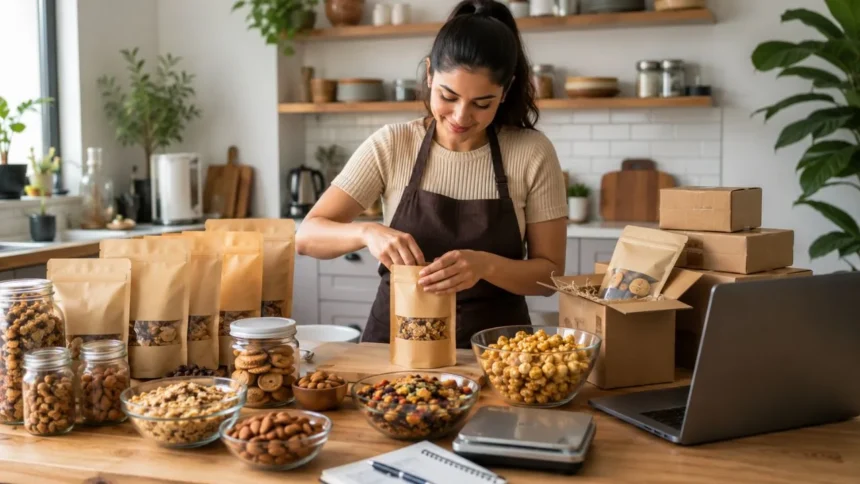
Starting a snack business from home can turn a simple recipe into a flexible source of income. You can begin with limited equipment, test products in small batches, and grow according to customer demand. However, success requires more than making snacks that taste good. You also need safe production, accurate pricing, practical packaging, and a clear marketing plan.
The snack market offers opportunities because people regularly buy convenient foods for work, school, travel, entertainment, and gifting. Homemade cookies, roasted nuts, popcorn, granola, crackers, snack mixes, and baked treats can serve different customer groups. Choosing the correct product is important because not every snack can legally or safely be produced in a domestic kitchen.
A home-based snack business can reduce rent and staffing expenses during the early stages. It also allows you to improve recipes and packaging before investing in a commercial facility. Nevertheless, working from home does not remove your responsibility to follow business, food safety, labelling, and allergen requirements. Treating the operation professionally from the beginning creates a stronger foundation.
This guide explains how to start a snack business from home through manageable steps. You will learn how to select a niche, validate demand, calculate startup costs, price snacks, design packaging, and attract customers. It also covers kitchen organisation, inventory management, online sales, customer retention, and future growth. Each step will help you move from an idea to a sustainable snack brand.
Understand How a Home-Based Snack Business Works
A home-based snack business produces, packages, markets, and sells food from an approved domestic kitchen. Products may be sold directly to local customers, through social media, at markets, or through permitted online channels. The exact business model depends on local regulations and the type of snack. Some locations allow only specific low-risk products to be prepared at home.
Low-risk snacks are generally easier to store and transport than products requiring continuous refrigeration. Examples may include certain cookies, dry cakes, popcorn, granola, crackers, roasted seeds, or snack mixes. However, a product permitted in one location may be restricted in another. Always check the rules applying to your recipe before purchasing large amounts of equipment or packaging.
Your responsibilities may include sourcing ingredients, preparing products, managing orders, answering customers, and arranging delivery. These tasks can become difficult when they are handled without a clear schedule. A successful home snack business therefore needs defined production days, ordering deadlines, inventory checks, and cleaning routines. Organisation prevents the business from taking over the entire household.
The goal is to create a repeatable operation rather than accepting every possible order immediately. Begin with a small product range and realistic weekly capacity. Learn how much you can produce safely and consistently before promising large quantities. Controlled growth protects product quality and reduces stress during the early stages.
Choose a Profitable Snack Business Niche
A snack niche is the specific product category and customer group your business will serve. Instead of offering every type of homemade food, choose a focused range with a clear purpose. You might sell premium popcorn, healthy office snacks, traditional savoury mixes, children’s treats, or gift-ready cookies. Focused positioning makes the business easier to remember and market.
Consider your cooking skills, available equipment, local regulations, storage space, and ingredient access when choosing a product. A snack may look profitable but require machinery, refrigeration, or testing that is unsuitable for a home kitchen. Begin with something you can prepare consistently using your current resources. Simple production can create an important advantage during the startup stage.
Research what customers already buy and where existing products disappoint them. People may want healthier ingredients, stronger flavours, smaller portions, attractive gift packaging, or affordable family sizes. Reviews of competing products can reveal complaints about freshness, value, texture, delivery, and customer service. These gaps can help you create a more relevant offer.
Avoid selecting a niche only because it is trending on social media. A sudden trend may disappear before you recover the cost of launching the product. Look for an ongoing need behind the trend, such as convenience, portion control, cultural flavour, or dietary preference. A lasting customer need provides a more reliable foundation for a snack brand.
Identify Your Ideal Snack Customer
Your ideal customer is the person most likely to value and repeatedly purchase your snacks. Understanding this person will guide your flavours, portions, prices, packaging, and sales channels. Snacks designed for schoolchildren will differ from products created for office workers or premium gift buyers. A specific audience makes your marketing message more persuasive.
Consider the customer’s age, location, income, lifestyle, household size, and shopping habits. Busy professionals may value individually packed snacks delivered to the workplace. Parents may prioritise simple ingredients, appropriate portions, and affordable multipacks. Gift customers may pay more for presentation, customisation, and reliable delivery.
You should also understand the occasion that causes the customer to buy. People purchase snacks for daily hunger, lunchboxes, meetings, travel, parties, movie nights, holidays, and celebrations. Each occasion creates different expectations regarding quantity, packaging, freshness, and price. Building your offer around a clear occasion can improve customer relevance.
Create a simple customer profile describing what the buyer wants and what currently frustrates them. Explain how your snack solves that problem more effectively than available alternatives. Use this profile when deciding which products, content, promotions, and partnerships to develop. Customer-focused decisions are usually stronger than decisions based entirely on personal preference.
Research the Local Snack Market
Market research helps you understand whether enough customers are interested in your snack idea. Begin by examining local bakeries, supermarkets, home-based businesses, online sellers, and food delivery platforms. Record the products they offer, the prices they charge, and the packaging they use. This information shows what customers already expect from the category.
Study customer reviews and social media comments to identify repeated praise and complaints. Buyers may mention stale products, slow delivery, unclear ingredients, poor portion value, or limited flavours. These comments reveal opportunities that competitors may not be addressing. Your product can stand out by solving a problem customers already recognise.
Compare direct and indirect competitors rather than examining only identical snacks. A customer considering your granola may also choose biscuits, fruit, nuts, or another convenient option. Understanding these alternatives helps you explain why your product deserves attention. Your advantage might involve freshness, flavour, ingredients, convenience, packaging, or local delivery.
Market research should continue after the business launches. Customer preferences, ingredient prices, popular flavours, and sales platforms can change over time. Review competitors periodically without copying every new idea they introduce. Use market information to improve your decisions while preserving your brand’s own identity.
Validate Your Snack Idea Before Investing Heavily
Validation means testing whether customers will actually pay for your snacks. Positive comments from friends and family can be encouraging, but they do not prove commercial demand. People may praise a free sample without being willing to buy it regularly. Paid orders provide more reliable evidence that the idea has business potential.
Prepare a small batch and offer it to people who match your ideal customer profile. You can test through preorders, community groups, office samples, local events, or temporary market stalls. Keep the initial test small enough to manage safely. The purpose is to collect information rather than create the appearance of a large launch.
Ask customers about flavour, texture, freshness, portion size, packaging, and value. Specific questions produce more useful feedback than simply asking whether they liked the snack. Observe which flavours sell first and which products receive repeat orders. Customer behaviour often provides more accurate information than stated intentions.
Test the price as well as the product. A snack may receive excellent feedback but fail when customers see the amount required to produce it profitably. Experiment with package sizes, bundles, and product combinations without relying on excessive discounts. Successful validation should demonstrate both customer satisfaction and realistic profit potential.
Check Home Food Business Laws and Licences
Before accepting orders, confirm whether your chosen snacks can legally be produced in your home kitchen. Many places use cottage food laws or similar rules governing home-prepared food. These rules may restrict product types, annual sales, selling locations, or delivery methods. Requirements can vary between countries, states, provinces, cities, and local authorities.
You may need business registration, a food-handler certificate, a kitchen inspection, a home occupation permit, or approval from a health department. Some locations may also require insurance or specific records. Do not assume that a small social media business is exempt from regulation. Selling food creates responsibilities regardless of the number of orders.
Check whether customers are allowed to collect orders from your home and whether delivery or shipping is permitted. Some regulations allow direct local sales but limit retail, wholesale, or interstate distribution. These restrictions can affect your intended business model. Understanding them early prevents you from building a sales strategy that cannot legally operate.
Keep copies of permits, registrations, training certificates, supplier invoices, and inspection records. Review requirements when adding products or entering a new sales channel. A snack allowed at a local market may face different rules when supplied to a retailer. Legal compliance should develop alongside the business rather than being addressed only after a problem occurs.
Build Food Safety into Your Daily Process
Food safety begins with personal hygiene, clean surfaces, reliable ingredients, and appropriate storage. Wash hands properly before handling food and after activities that could cause contamination. Clean and sanitise preparation areas, utensils, equipment, and packaging surfaces according to suitable procedures. A visually clean kitchen is not always a properly sanitised one.
Separate business ingredients and equipment from ordinary household activity where possible. Children, visitors, pets, and unrelated food preparation can introduce contamination risks. Establish production times when the kitchen can be controlled. Clear household rules help protect both the products and the professionalism of the business.
Store ingredients according to supplier instructions and inspect them before every production session. Check packaging condition, dates, smell, texture, and signs of pests or moisture. Label opened ingredients so you know when they entered production. Good storage preserves quality while reducing waste and food safety risks.
Create written cleaning, production, cooling, and storage routines for every snack. These routines will become increasingly important if someone later helps with production. Record important problems and the actions taken to correct them. Consistent food safety procedures protect customers and make the business easier to scale responsibly.
Manage Allergens Carefully and Honestly
Common snack ingredients may include milk, eggs, wheat, peanuts, tree nuts, soy, or sesame. These foods can cause serious reactions in people with allergies. You must know which allergens are present in every ingredient, flavour, topping, and processing aid used. Never guess or rely only on the product’s appearance.
Read supplier labels whenever you purchase ingredients, even when you have used the brand before. Manufacturers may change recipes or facilities without your business noticing immediately. Keep ingredient information organised and update your own labels when something changes. Accurate records reduce the risk of giving customers outdated information.
Allergen cross-contact can occur when the same utensils, surfaces, containers, or equipment are used for different products. Cleaning may reduce the risk but might not make a shared kitchen suitable for every claim. Avoid promising that a product is allergen-free unless you can support that statement. Honest communication is safer than marketing language that creates false confidence.
Train anyone assisting with production or customer service to handle allergen questions carefully. Employees and family members should never provide an answer from memory when they are uncertain. Keep approved product information easily available. Clear allergen procedures protect customers while demonstrating that your snack business takes their concerns seriously.
Standardise Your Snack Recipes
A standardised recipe produces the same taste, texture, appearance, and quantity each time. Record exact ingredient weights rather than using vague measurements such as a handful or a small cup. Include mixing times, temperatures, cooking periods, cooling methods, and expected yield. Written recipes make consistency easier to maintain.
Use a reliable kitchen scale because weight measurements are usually more consistent than volume measurements. Even a small difference in an ingredient can affect flavour, texture, shelf life, and product cost. Measure portions after production as well as before it. Consistent package weights protect both customers and your profit margin.
Test recipes under different temperature and humidity conditions when these factors affect the product. Homemade snacks can change during hot, cold, or wet weather. A recipe that works during one season may require better packaging or storage during another. Repeated testing helps you understand the limits of your product.
Control recipe changes carefully after customers become familiar with the snack. Replacing an ingredient may reduce cost but also change the experience buyers value. Test alternatives in small batches before making them permanent. Record every approved change so all future production follows the same version.
Determine Product Shelf Life
Shelf life is the period during which your snack remains safe and maintains acceptable quality. It can be affected by ingredients, moisture, preparation, packaging, storage temperature, and handling. Do not choose an expiration or best-before period simply by examining similar products. Commercial competitors may use different processes and packaging technology.
Begin by observing sealed samples from the same production batch over a planned period. Check changes in smell, taste, texture, colour, moisture, and packaging condition. Keep clear records rather than relying on memory. However, visual and sensory checks cannot identify every possible safety risk.
Some products may require professional shelf-life or laboratory testing before they can be sold safely or through certain channels. This is especially important when the snack contains moisture, fillings, dairy ingredients, meat, or other higher-risk components. Seek qualified advice when you are uncertain. Guessing about food safety can create serious consequences.
Choose a conservative shelf life while the product is new. It is better to promise a shorter period and deliver strong quality than claim a long life the snack cannot maintain. Provide customers with clear storage instructions. Packaging, production records, and inventory rotation should all support the stated period.
Write a Simple Snack Business Plan
A snack business plan explains what you will sell, who will buy it, and how the operation will earn money. It does not need to be unnecessarily complicated. A practical plan should cover products, customers, competitors, pricing, sales channels, production capacity, and marketing. These elements create direction for your early decisions.
Include your startup budget and expected monthly expenses. Estimate how many packages must be sold to cover costs and begin generating profit. Use realistic sales figures rather than assuming every social media follower will become a buyer. Conservative projections help you prepare for a slower start.
Describe how orders will move from the customer to production and delivery. Set ordering deadlines, minimum quantities, payment methods, and collection or delivery arrangements. Planning these details prevents each transaction from requiring a completely different process. Simple systems save time and reduce order mistakes.
Review the plan after you collect real sales information. Update assumptions about popular products, production time, costs, and customer behaviour. A business plan should guide decisions rather than remain unchanged in a folder. Continuous revision helps the operation respond to what the market actually shows.
Calculate Your Snack Business Startup Costs
Startup costs depend on the snacks you produce and the equipment you already own. Common expenses may include licences, training, ingredients, containers, labels, utensils, storage, photography, and basic marketing. Some businesses also need insurance, testing, or kitchen improvements. List every expected purchase before deciding how much money is required.
Separate essential items from purchases that can wait. Reliable scales, safe storage, approved packaging, and necessary permits are usually more important than expensive branding materials. You can often begin with simple labels and improve presentation after confirming demand. Delaying nonessential purchases protects your starting cash.
Calculate the cost of a small test batch before buying ingredients in bulk. Bulk purchasing may reduce the unit price, but it can also create waste when a product sells slowly. Packaging suppliers may require minimum quantities that exceed early demand. Small initial orders provide flexibility while you learn what customers prefer.
Keep a financial reserve for unexpected expenses such as damaged packaging, equipment failure, or ingredient price increases. Do not spend the entire budget before the first order is delivered. A reserve gives you time to solve problems without compromising quality. Careful cash management is especially important when personal and business income share the same household.
Price Homemade Snacks for Profit
Start by calculating the complete cost of every product. Include ingredients, packaging, labels, direct labour, payment fees, delivery, waste, and a share of overhead expenses. Counting only ingredients will make the snack appear more profitable than it actually is. Accurate product costing prevents you from becoming busy without earning enough money.
Determine how many sellable packages each batch produces. Divide total batch costs by the number of finished units to calculate the basic cost per package. Include normal production losses rather than assuming every gram becomes a saleable product. Small differences can have a meaningful effect across hundreds of orders.
Add a profit margin that supports reinvestment, growth, and fair compensation for your time. Compare your proposed price with competing products, but do not copy them automatically. Their costs, quality, production scale, and business goals may differ from yours. Your price must support your own operation.
Consider offering several sizes or bundles instead of reducing the main product price. Trial packs can attract first-time customers, while family packs can increase average order value. Wholesale prices should be calculated separately because retailers need room for their own margin. Every sales channel should remain financially worthwhile.
Create a Memorable Snack Brand
Your snack brand includes your name, appearance, personality, values, and customer experience. It should help buyers understand what makes your products relevant to them. A clear brand may focus on bold flavours, simple ingredients, traditional recipes, affordability, or premium gifting. Choose a position that you can deliver consistently.
Select a brand name that is easy to pronounce, remember, spell, and search online. Avoid names that limit the business to one flavour unless you plan to sell only that product. Check whether similar food companies, websites, or social media accounts already use the name. Early research can prevent expensive changes later.
Develop a simple visual identity using a consistent logo, colour palette, typography, and photography style. These elements should match the product and target customer. A children’s snack may need a different appearance from a premium corporate gift box. Design should make the intended value easier to recognise.
Keep the brand consistent across labels, social profiles, invoices, order messages, and delivery packaging. Frequent changes make it harder for customers to remember the business. Professional consistency does not require a large design budget. Clear and repeated presentation can make a small home business feel dependable.
Choose Practical Snack Packaging
Packaging should protect the snack from moisture, air, damage, contamination, and loss of freshness. The correct material depends on the product’s texture, fat content, shelf life, and storage conditions. A paper bag may suit one product but fail to protect another. Test packaging with the actual snack before placing a large order.
Consider how packages will be filled, sealed, stored, stacked, transported, and opened. Attractive packaging becomes a problem when it leaks, tears, or requires too much production time. Customers also value convenience after purchase. Resealable or portioned formats may support certain snack occasions.
Your front label should make the brand name, product type, flavour, and package size easy to understand. Customers should not need to study the design before knowing what they are buying. Use readable typography and a clear visual hierarchy. Packaging can look appealing without hiding important information.
Calculate packaging cost as part of the product price. Custom boxes, printed pouches, ribbons, and stickers can quickly reduce profit. Begin with materials that look clean and professional while fitting your budget. Upgrade packaging when higher sales volume or stronger positioning justifies the investment.
Add Accurate Information to Snack Labels
The information required on a snack label depends on local law, product type, business size, and sales channel. Common requirements may include the product name, ingredients, allergen information, net weight, business details, storage directions, and date information. Some products may also require nutrition information. Confirm the exact rules with the relevant authority.
List ingredients accurately and update the label whenever the recipe changes. Ingredients may need to appear in a particular order or format under local rules. Compound ingredients, such as chocolate or seasoning blends, can contain several components. Do not hide them behind a general description when fuller disclosure is required.
Avoid unsupported claims such as healthy, natural, sugar-free, high-protein, or allergen-free. These terms may have specific legal meanings and can influence customer health decisions. Use factual language you can prove through the recipe, supplier documents, or appropriate testing. Trust is more valuable than exaggerated marketing.
Proofread labels carefully before printing a large quantity. Check spelling, weights, contact information, ingredients, allergens, and storage directions. A small error can require every package to be relabelled or discarded. Request a printed sample because colours and text sizes may look different from the digital design.
Organise Your Home Production Space
Create a dedicated area for business ingredients, utensils, packaging, and records where possible. Separation makes inventory easier to control and reduces household interference. Label containers clearly and keep personal items away from business stock. An organised kitchen supports faster production and more reliable cleaning.
Plan the movement of each batch from ingredient preparation to cooking, cooling, portioning, and packaging. Arrange tools so employees or helpers do not repeatedly cross the kitchen. A logical workflow reduces unnecessary movement and contamination risks. It also helps you identify the true production capacity of the space.
Use a production calendar to group similar tasks and products. Preparing several related batches together may reduce cleaning, equipment setup, and ingredient handling time. However, allergen controls must remain part of the schedule. Efficiency should never replace safe separation and sanitation procedures.
Record how long each stage takes instead of estimating production time. Include preparation, cooking, cooling, packaging, cleaning, and order administration. This information supports better pricing and scheduling. It also helps you recognise when the home kitchen has reached its practical limit.
Find Reliable Ingredient and Packaging Suppliers
Good suppliers provide consistent quality, dependable delivery, suitable quantities, and clear product information. The cheapest option is not always the best choice for a growing snack business. Poor ingredients can change flavour, texture, or shelf life. Unreliable deliveries can prevent you from completing customer orders.
Compare prices, minimum orders, delivery charges, payment terms, and storage life. A lower unit cost may not save money when you must purchase more than you can use. Smaller packages can be more suitable during the validation stage. The best purchasing decision considers total cost and waste.
Keep specifications for important ingredients and packaging. Record the preferred brand, size, quality, variety, and acceptable alternatives. This prevents accidental changes when another person purchases supplies. It also helps you evaluate backup suppliers more accurately.
Avoid depending entirely on one source for critical materials. Test alternative ingredients and packaging before an emergency occurs. A sudden shortage should not force you to use an untested substitute. Backup planning protects product consistency and customer commitments.
Control Inventory and Reduce Snack Waste
Inventory management helps you maintain enough stock without tying up unnecessary cash. Record ingredients and packaging when they arrive and when they are used. Regular counts can identify waste, errors, or unexpected changes in production yield. Even inexpensive ingredients can become costly when losses continue across many batches.
Label stock with relevant receiving, opening, or expiration dates. Arrange ingredients so older suitable products are used before newer supplies. Keep storage clean, dry, and organised according to product requirements. Poor rotation can cause ingredients to expire while newly purchased stock is used first.
Record every discarded product and the reason it could not be sold. Waste may result from overproduction, incorrect cooking, damaged packaging, poor storage, or inaccurate portions. Looking at the pattern helps you correct the underlying process. Simply throwing products away hides the financial impact.
Produce according to confirmed orders and realistic sales forecasts during the early stages. Large speculative batches may appear efficient but create waste when demand is uncertain. Preorders can make production easier to plan. As sales history develops, you can maintain limited ready stock for frequently requested items.
Choose Where to Sell Your Snacks
Home snack businesses can sell through direct orders, social media, websites, markets, offices, events, or approved retail partners. The available options depend on local regulations and product characteristics. Begin with one or two manageable channels. Trying to operate everywhere can create inconsistent service and unnecessary complexity.
Direct local orders offer control over pricing, communication, and customer relationships. They also allow you to collect feedback quickly. However, messaging customers individually can become time-consuming as sales increase. Use clear menus, order forms, payment instructions, and collection schedules.
Local markets and pop-up events allow customers to see and sample your products. They can provide immediate information about flavours, packaging, and price. Calculate stall fees, transportation, display materials, unsold stock, and your time before participating. High customer traffic does not always produce high profit.
Wholesale and retail partnerships can create larger orders but usually require lower prices and more consistent supply. Stores may request barcodes, insurance, longer shelf life, or specific packaging. Enter wholesale only when your costs and production capacity support it. Revenue growth should not come at the expense of quality or profit.
Launch Your Snack Business Successfully
Build interest before the official launch by sharing the product-development process. Show flavour testing, ingredient preparation, packaging decisions, and behind-the-scenes production. This content helps potential customers understand the work behind the product. It can also make them feel involved in the journey.
Create a focused launch offer instead of discounting everything. A sample box, introductory bundle, or limited first batch can encourage customers to act. Make sure the offer still covers your costs. The goal is to generate trial and feedback without teaching customers to expect permanent low prices.
Set a clear order limit for the first launch. Selling out a controlled batch is better than accepting more orders than you can produce safely. A limited quantity allows you to test payment, production, packaging, communication, and delivery. Record every issue so the next launch can run more smoothly.
Ask early customers for honest reviews and permission to share their feedback. Photographs and testimonials can create useful social proof for future buyers. Respond professionally to criticism and look for repeated concerns. Early feedback is valuable because the business is still flexible enough to improve quickly.
Market a Home-Based Snack Business
Food marketing should help customers imagine when and why they would enjoy your snacks. Share serving ideas, flavour descriptions, ingredient stories, customer experiences, and suitable occasions. Avoid posting only product prices every day. Useful and entertaining content gives people more reasons to follow the brand.
High-quality photographs are especially important because customers cannot taste the product through a screen. Use clean backgrounds, natural light, and close views that show texture and portion size. Include packaging and serving examples as well as the snack itself. Consistent images make the brand appear more professional.
Use local search terms and clear location information where appropriate. Customers often search for snacks, gift boxes, or food delivery near them. Complete your business profiles and keep contact details accurate. A simple website or order page can make the business easier to discover and trust.
Partner with offices, cafés, event planners, schools where permitted, and complementary local businesses. Offer samples to carefully selected partners rather than sending products to random large accounts. Relevance matters more than follower count. A small local audience can generate strong sales when it closely matches your target customer.
Encourage Repeat Orders and Customer Loyalty
Repeat customers make revenue more predictable and reduce the need to constantly find new buyers. The first requirement is a snack that remains consistent in flavour, freshness, portion, and packaging. Marketing may attract the first purchase, but product satisfaction creates the next one. Protect quality as order volume increases.
Make reordering simple by keeping your menu, prices, order deadlines, and payment details clear. Save customer preferences where appropriate and communicate expected delivery times accurately. Small conveniences can separate your business from competitors. Customers are more likely to return when buying requires little effort.
Use loyalty rewards, subscriptions, multipacks, or recurring office deliveries when they fit customer behaviour. These offers should provide convenience rather than depend on deep discounts. A weekly snack box may create stable demand and easier production planning. Test recurring offers with a small customer group first.
Stay connected through email, messaging lists, or social content without overwhelming customers. Share new flavours, restock notices, gift occasions, and useful serving ideas. Communication should feel helpful rather than desperate. Long-term loyalty develops through reliability, recognition, and respectful customer service.
Scale the Snack Business Carefully
Increase production only after recipes, costs, and customer demand have become reasonably predictable. Higher order volume can expose weaknesses in storage, equipment, staffing, and packaging. Expand one stage at a time and measure the result. Controlled scaling reduces the risk of widespread quality problems.
Document recipes, cleaning routines, packaging steps, and order procedures before hiring help. New employees cannot follow standards that exist only in the founder’s memory. Train them through demonstrations, supervised practice, and written checklists. Consistent training protects the product as the team grows.
Consider using a commercial kitchen when the home space becomes restrictive or regulations require it. A shared facility may provide larger equipment, storage, and approved production conditions without the cost of opening your own unit. Calculate booking fees, transportation, storage, and scheduling before moving production.
Add new products and sales channels gradually. Every flavour, package size, retailer, or delivery area creates additional complexity. Expand around proven products instead of launching many unrelated snacks. Sustainable growth should increase profit and capacity without weakening the experience existing customers value.
Common Home Snack Business Mistakes to Avoid
One common mistake is launching too many products at once. A large menu increases ingredient costs, inventory, preparation steps, and possible waste. Begin with a few strong products that share ingredients or equipment. A focused range is easier to produce, explain, and remember.
Another mistake is pricing products according to ingredients alone. Packaging, labour, utilities, payment fees, waste, marketing, and delivery must also be covered. Underpricing can generate many orders while leaving little money for the owner. Review costs whenever ingredients or operating expenses change.
Ignoring legal, food safety, or allergen requirements can create serious financial and reputational damage. Social media sales are still food sales and may be regulated. Confirm what you can produce, how it must be labelled, and where it may be sold. Compliance should be part of the business plan from the beginning.
Finally, avoid accepting more orders than the home kitchen can handle. Late deliveries and inconsistent products can quickly weaken customer trust. Use order limits and waiting lists when demand exceeds capacity. A controlled customer experience is more valuable than temporary revenue followed by complaints.
Final Thoughts on Starting a Snack Business
Learning how to start a snack business from home begins with choosing a suitable product and confirming genuine demand. Your snack should match your skills, kitchen capacity, target customer, and local rules. Starting with a focused range allows you to improve quality without placing too much money at risk.
Treat the operation like a real business from the first order. Calculate complete costs, document recipes, maintain records, and separate business finances from household spending. These habits help you understand whether sales are producing genuine profit. Professional systems also make future expansion easier.
Food safety, allergen communication, packaging, and customer service should never be treated as minor details. These elements directly influence trust and repeat purchases. A delicious snack can attract attention, but reliable quality builds a sustainable brand. Consistency should remain your priority as demand increases.
Begin small, collect feedback, and improve one part of the business at a time. You do not need expensive equipment or a large product range to prove your idea. You need a safe product, profitable price, clear customer, and dependable ordering process. Those foundations can turn a home recipe into a growing snack business.
Frequently Asked Questions
How much does it cost to start a snack business from home?
Startup costs depend on permits, ingredients, equipment, packaging, and product testing. Beginning with small batches and simple packaging can reduce your initial financial risk.
Which snacks are best for a home business?
Shelf-stable products such as certain cookies, popcorn, granola, crackers, and dry snack mixes may be practical. Your final choice must comply with local home-food regulations.
Do I need a licence to sell homemade snacks?
Requirements depend on your location and the type of food you sell. Contact the relevant local business and food safety authorities before accepting customer orders.
How should I price homemade snacks?
Calculate ingredients, packaging, labour, payment fees, delivery, waste, and overhead. Add a profit margin that supports the business while remaining reasonable for your target customer.
Can I sell homemade snacks online?
Online sales may be permitted, restricted, or limited to certain delivery areas under local rules. Verify production, labelling, shipping, and marketplace requirements before launching.