

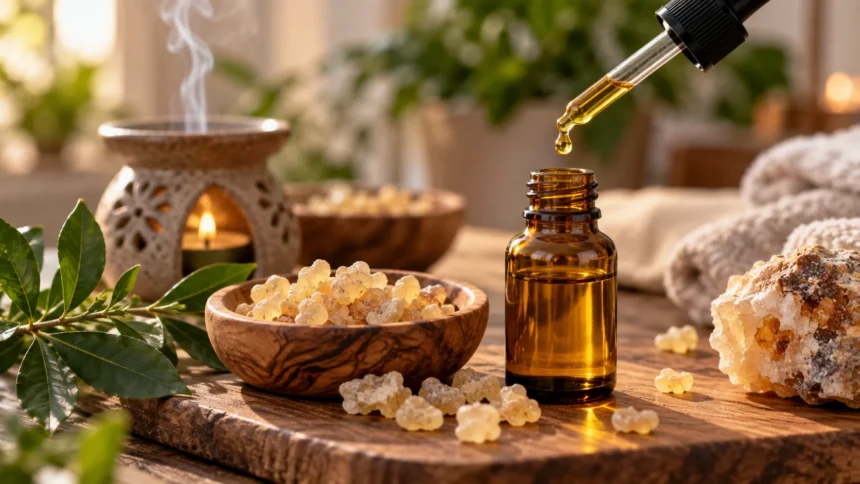
Frankincense Oil: Benefits, Uses & Side Effects
Frankincense oil is an aromatic essential oil made from the resin of trees in the Boswellia genus, plants with a long history of use in traditional wellness practices, incense, perfumery, and religious ceremonies. Today, frankincense essential oil is commonly added to diffusers, massage oils, skincare products, soaps, and personal-care formulas. Supporters often describe benefits ranging from relaxation and healthier-looking skin to reduced inflammation and joint discomfort. Some of these claims are based on laboratory findings or research involving Boswellia resin extracts rather than frankincense essential oil itself. That distinction is important because different preparations contain different active compounds and cannot automatically be expected to produce identical effects. Understanding what the evidence actually supports can help people use frankincense oil more realistically.
Frankincense is sometimes promoted online as a natural treatment for arthritis, anxiety, respiratory problems, wrinkles, infections, and even serious diseases, but many of those claims go beyond current human evidence. The essential oil may still be enjoyable and useful as part of aromatherapy or a carefully designed skincare routine, particularly when properly diluted. However, natural products can cause side effects, and frankincense oil has been linked with skin irritation and allergic contact dermatitis in susceptible individuals. Concentrated essential oil should not be casually swallowed or applied undiluted simply because it comes from a plant. Pregnancy, sensitive skin, asthma, medications, and underlying medical conditions may also require additional caution. This guide explores frankincense oil benefits, common uses, side effects, safety considerations, and what current evidence really tells us.
What Is Frankincense Oil and Where Does It Come From?
Frankincense oil is produced from the fragrant resin released by several species of Boswellia trees. Growers make small cuts in the bark, allowing a sticky sap to emerge and gradually harden into resin droplets often called frankincense tears. The dried resin can be burned as incense, processed into herbal preparations, or distilled to produce essential oil. Boswellia species grow naturally in parts of the Arabian Peninsula, northeastern Africa, India, and surrounding dry regions. Different species can produce oils with somewhat different aromas and chemical profiles. Common names encountered on product labels include Boswellia sacra, Boswellia carterii, Boswellia serrata, and Boswellia frereana.
Frankincense essential oil is usually obtained through steam or hydrodistillation of the resin. During distillation, volatile aromatic compounds travel with steam before being cooled and separated into concentrated essential oil. The resulting liquid usually has a resinous, woody, warm, slightly citrus-like aroma, although scent varies among species and batches. Its major constituents can include compounds from groups known as monoterpenes and sesquiterpenes. Alpha-pinene is commonly found in several frankincense oils, but exact composition depends on plant species, geography, harvesting conditions, storage, and processing. This natural variation is one reason essential oils from different manufacturers may smell and behave somewhat differently.
Frankincense oil should not be confused with Boswellia extract, even though both originate from the same type of resin. Boswellia dietary supplements are usually prepared specifically to concentrate resin compounds such as boswellic acids, which have received considerable research attention for their possible effects on inflammatory pathways. Boswellic acids are not highly volatile, meaning they are not major components transferred into ordinary steam-distilled essential oil. Therefore, a clinical trial showing a benefit from standardized Boswellia extract does not automatically prove that inhaling or rubbing frankincense essential oil on the skin will provide the same benefit. This distinction is one of the most important facts to understand when evaluating frankincense health claims.
The term olibanum oil is another name sometimes used for frankincense essential oil. In aromatherapy, it is commonly blended with oils such as lavender, citrus oils, sandalwood, cedarwood, or myrrh to create warm and calming fragrances. Cosmetic manufacturers may include small amounts in creams, serums, body oils, and soaps for scent or skin-conditioning purposes. People also use diluted frankincense oil during massage or add a small amount to a diffuser for its distinctive fragrance. None of these uses require someone to believe that frankincense cures a medical condition. Enjoyment, relaxation, scent, and cosmetic use can be valid reasons to use an essential oil even when therapeutic evidence remains limited.
Quality can vary considerably between frankincense oil products. Botanical species, country of origin, distillation method, age of the resin, storage temperature, exposure to light, and possible adulteration can all affect the final product. A label that simply says “frankincense fragrance oil” may describe a perfume blend rather than genuine essential oil distilled from Boswellia resin. Consumers interested in pure frankincense essential oil should look for botanical identification, ingredient transparency, appropriate packaging, and clear directions for use. Dark glass bottles can help reduce light exposure during storage. A strong marketing claim or high price, however, does not by itself prove that an oil is purer, safer, or more effective.
What Are the Potential Benefits of Frankincense Oil?
One of the most frequently discussed frankincense oil benefits is its potential influence on inflammatory processes. Laboratory studies involving frankincense compounds have produced findings that justify continued scientific interest, and Boswellia resin extracts have been researched more extensively for inflammatory conditions. However, it is important not to combine every Boswellia study into evidence for the essential oil. A capsule standardized for boswellic acids delivers a very different chemical mixture from aromatic oil used in a diffuser or skincare product. Human evidence specifically showing that frankincense essential oil meaningfully treats inflammatory diseases remains limited. People should therefore view anti-inflammatory claims as an area of research rather than a guaranteed therapeutic effect.
Frankincense oil is also frequently used for relaxation and aromatherapy. Its rich woody aroma may create an environment people personally associate with meditation, rest, prayer, massage, or winding down before sleep. Scent can influence mood and emotional experience through connections between smell, memory, and the brain, so enjoying an aroma can have genuine subjective value. However, saying that a fragrance feels calming is different from saying that frankincense oil clinically treats an anxiety disorder. Research on essential-oil aromatherapy often involves small samples, blended oils, or methods that make it difficult to isolate the effect of frankincense itself. Aromatherapy is therefore best treated as supportive wellness rather than a replacement for mental health treatment.
Another proposed benefit involves antimicrobial activity. Various essential oils, including frankincense preparations, have demonstrated effects against certain bacteria or fungi in laboratory environments. These experiments can help scientists identify interesting chemical properties, but laboratory antimicrobial activity does not automatically translate into a safe treatment for human infections. Concentrations that inhibit microorganisms in a test dish may irritate human skin or be impossible to achieve safely in body tissues. Frankincense oil should therefore not replace antibiotics, antifungal medicines, dental treatment, or wound care when an infection requires medical attention. Using essential oil on a serious infection can delay effective treatment while irritation makes the affected area more difficult to evaluate.
Antioxidant properties are another common marketing claim surrounding frankincense. Oxidative stress is involved in many normal biological processes and diseases, and laboratory testing can measure whether a substance interacts with reactive molecules under experimental conditions. Essential oil components may demonstrate antioxidant activity in certain testing systems. However, a product having antioxidant activity in a laboratory does not prove that applying it to the skin or inhaling it will prevent chronic disease or slow aging throughout the body. Human physiology is considerably more complicated than a laboratory assay. Consumers should therefore be cautious when antioxidant language is used to transform preliminary chemical findings into dramatic promises about immunity, detoxification, longevity, or disease prevention.
The most reasonable way to understand frankincense oil benefits is to separate established everyday uses from emerging health research. Its role as an aromatic ingredient in fragrances, massage blends, and personal-care products is clear. Its therapeutic role is less certain and depends heavily on the condition, formulation, dose, and route of administration being studied. People may enjoy the oil, feel relaxed by its scent, or like how a properly diluted skincare product feels without needing stronger medical claims. Evidence-based medicine does not require dismissing every traditional use. It requires matching the confidence of a claim to the quality of evidence actually available.
Frankincense Oil for Skin, Wrinkles, and Skincare
Frankincense oil has become popular in skincare because it is frequently marketed for mature skin, uneven texture, blemishes, dryness, and the appearance of fine lines. Cosmetic formulas may combine the oil with moisturizers, plant oils, antioxidants, and other ingredients that improve skin softness or hydration. This makes it difficult to determine how much visible improvement comes specifically from frankincense. A well-formulated moisturizer can make fine lines look temporarily less noticeable simply by increasing hydration in the outer skin layer. Someone who sees smoother skin after applying a frankincense cream may therefore be benefiting from the entire formulation rather than one essential oil. That does not reduce the cosmetic value of the product, but it changes how the benefit should be interpreted.
Claims that frankincense oil directly increases collagen or dramatically reverses wrinkles should be treated cautiously. Skin aging involves ultraviolet exposure, genetics, repeated facial movement, collagen changes, loss of elasticity, hormonal shifts, and environmental factors. No essential oil can realistically reverse all of these processes simply through topical application. Laboratory research may show interesting interactions between plant compounds and skin cells, but human skin provides a strong barrier that changes how ingredients penetrate. Evidence supporting frankincense essential oil as a clinically proven wrinkle treatment remains limited. For prevention of premature photoaging, daily sun protection has a far stronger role than relying on aromatic plant oils.
Frankincense oil may still have a place in a cosmetic routine when the user enjoys it and tolerates it well. The essential oil should generally be diluted in an appropriate carrier oil or incorporated into a professionally formulated skincare product rather than applied directly from the bottle. Common carrier oils include jojoba, sunflower, grapeseed, and other skin-compatible oils, although individual allergies and skin types vary. Concentrated essential oil can irritate the skin, especially around sensitive areas. Applying more product does not necessarily increase cosmetic benefits. A low, tolerable concentration used consistently is generally more sensible than creating intense tingling or redness and assuming irritation means the ingredient is working.
Acne is another area where frankincense oil is sometimes promoted because of its possible antimicrobial and anti-inflammatory properties. However, acne develops through multiple processes involving blocked follicles, excess oil, inflammation, hormones, and microorganisms. Reliable treatments such as benzoyl peroxide, salicylic acid, topical retinoids, and prescription options have substantially stronger clinical support. Essential oils can also irritate acne-prone skin, particularly when combined with exfoliating acids or retinoids. Irritation may make redness appear worse and can complicate an already sensitive skincare routine. Someone with persistent, painful, or scarring acne should consider dermatologic treatment rather than depending primarily on frankincense oil.
People with eczema, rosacea, very sensitive skin, or a history of fragrance allergy should be particularly careful. Essential oils contain numerous aromatic chemicals, and natural fragrance compounds can trigger irritant or allergic contact dermatitis. Frankincense oil itself has been associated with reported cases of allergic skin reactions. A product that feels soothing to one person may cause itching, redness, scaling, or swelling in another. Applying essential oil to already cracked or inflamed skin may increase discomfort because the protective skin barrier is compromised. Gentle fragrance-free products are often a safer starting point for highly reactive skin, with experimental botanical ingredients introduced only when tolerance is reasonably clear.
Frankincense Oil for Inflammation, Joint Pain, and Arthritis
Frankincense has a strong reputation in the natural-health market as an anti-inflammatory remedy, particularly for arthritis and joint pain. Some of that reputation is connected with research involving Boswellia serrata extracts taken orally. Standardized Boswellia preparations may contain boswellic acids that have been investigated for effects on inflammatory pathways and symptoms of osteoarthritis. The essential oil contains a different profile of volatile compounds and should not automatically be expected to reproduce the same clinical results. This distinction is often lost in online articles that use the words frankincense, Boswellia, resin, extract, and essential oil interchangeably. Accurate health information should identify which preparation was actually studied before describing a benefit.
People sometimes dilute frankincense essential oil in a carrier oil and massage it around sore muscles or joints. Massage itself can provide temporary comfort and relaxation, regardless of which fragrance is added. A carrier oil also reduces friction, making the massage feel smoother. The aroma may contribute to the overall experience and help someone feel more relaxed while managing ordinary post-activity soreness. However, these subjective benefits do not prove that the essential oil has reached a joint or reduced the underlying disease process. Deep joint structures lie beneath several layers of tissue, and topical delivery of active compounds is a complex pharmaceutical challenge.
Osteoarthritis, rheumatoid arthritis, gout, and overuse injuries all produce pain through different mechanisms. Osteoarthritis involves changes within the joint and surrounding structures, while rheumatoid arthritis is an autoimmune disease requiring medical management to reduce inflammation and protect joints. Gout involves urate crystals, and sudden joint pain can also result from infection or injury. One essential oil cannot be assumed to treat every condition simply because inflammation is involved. A hot, swollen, suddenly painful joint deserves appropriate evaluation rather than repeated essential-oil application. Temporary comfort should never be confused with treating the disease responsible for the pain.
For people with ordinary muscle soreness, a diluted aromatic massage blend may be reasonable if the skin is healthy and the product is well tolerated. Avoid applying frankincense oil to cuts, burns, freshly shaved skin, or areas affected by an unexplained rash. Do not cover an essential-oil preparation with tight bandages or heating pads unless the product specifically instructs that use, because heat and occlusion may increase irritation. Stop using the blend if burning, itching, or persistent redness develops. People should also wash their hands after application to reduce accidental transfer into the eyes. Simple safety habits matter because concentrated plant chemicals can irritate tissues even when used for wellness purposes.
Anyone experiencing chronic joint pain should build treatment around the actual diagnosis rather than around a trending ingredient. Exercise, strengthening, weight management when appropriate, physical therapy, medications, and disease-specific treatments may provide meaningful benefits depending on the cause. Frankincense oil can be considered an optional complementary product for aroma or massage when a clinician has no specific concern about its use. It should not replace prescribed arthritis medication or delay assessment of worsening symptoms. The strongest evidence associated with Boswellia generally concerns specific resin extracts rather than essential oil. Recognizing that difference prevents a promising herbal research area from being turned into claims that the oil itself has not yet earned.
Frankincense Oil for Relaxation, Stress, and Aromatherapy
Aromatherapy is one of the most common ways people use frankincense essential oil. A few drops may be added to an appropriate diffuser so that volatile aromatic molecules disperse into the surrounding air. People often describe the fragrance as warm, earthy, resinous, grounding, or meditative. Because frankincense has been used ceremonially for centuries, its scent can also carry strong cultural or personal associations. Those associations may contribute to feelings of relaxation during meditation, yoga, breathing exercises, or quiet evening routines. Enjoying the scent is a legitimate experience even if research has not established frankincense oil as a medical treatment for anxiety or insomnia.
Stress relief claims should nevertheless be framed carefully. Relaxation is influenced by environment, expectations, breathing patterns, music, lighting, previous experiences, and the activity performed while the scent is present. If someone sits quietly for fifteen minutes while using a frankincense diffuser, part of the calming effect may come from taking a break rather than from a unique pharmacological action of the oil. Clinical aromatherapy studies can also be difficult to blind because participants immediately recognize whether an aromatic product is present. Small studies may generate interesting hypotheses without proving that frankincense itself produces a strong therapeutic effect. Aromatherapy is therefore best used as an adjunct to healthy stress-management strategies.
Some people diffuse frankincense oil before bedtime because they find the fragrance relaxing. A calming pre-sleep routine can help signal that the day is ending, particularly when combined with dim lighting, reduced screen exposure, and a consistent sleep schedule. However, frankincense should not be described as a proven treatment for chronic insomnia. Persistent sleep problems can be related to sleep apnea, anxiety, depression, medications, pain, restless legs, shift work, or other conditions requiring different approaches. Someone who enjoys the scent may include it in a bedtime ritual, but the oil should not replace evaluation when poor sleep is persistent and affecting daytime function.
Respiratory claims require particular caution because frankincense has historically been associated with breathing and chest complaints in traditional medicine. Research involving oral Boswellia extracts has explored conditions such as asthma, but that does not mean diffusing frankincense essential oil is an established asthma treatment. Strong fragrances and essential-oil vapors can actually irritate the airways of some sensitive people. Anyone who notices coughing, chest tightness, wheezing, or shortness of breath around a diffuser should stop exposure and move to fresh air. People with asthma should continue prescribed inhalers and follow their asthma action plan instead of substituting aromatherapy for medical treatment.
Safe diffusion also depends on moderation and ventilation. Filling a small closed room with concentrated fragrance for hours can become uncomfortable even for someone who initially enjoys the scent. Follow the diffuser manufacturer’s instructions and use only the amount recommended for the device. Avoid positioning concentrated vapor directly beside a baby’s face, pet enclosure, or someone with respiratory sensitivity. Essential oils should also be stored securely because diffuser bottles contain much more concentrated material than the amount released into the air. Aromatherapy should create a pleasant environment, not an intense exposure that causes headache, nausea, coughing, or irritation.
How to Use Frankincense Essential Oil Safely
Topical use should begin with dilution because essential oils are highly concentrated plant preparations. Instead of applying drops of pure frankincense oil directly to a large area, combine an appropriate small amount with a compatible carrier oil or choose a professionally formulated product that already contains a suitable concentration. The ideal dilution depends on the body area, intended use, product formulation, age, and skin sensitivity. Facial skin usually requires more caution than less sensitive areas of the body. Avoid assuming that a stronger mixture will work faster or provide greater health benefits. Higher concentrations primarily increase exposure and can make irritation or sensitization more likely.
A small-area skin check can be useful before applying a new diluted preparation more broadly. Use only a small amount on intact skin and observe the area for redness, itching, swelling, or burning. A home patch check cannot guarantee that an allergic reaction will never occur, but it may identify obvious intolerance before widespread application. Stop using the product if a rash appears and gently wash the area. Persistent or worsening dermatitis may require medical advice. People who already have known fragrance allergies or multiple reactions to essential oils should consider consulting a dermatologist rather than repeatedly testing different products on themselves.
Keep frankincense essential oil away from the eyes, inside the nose, ear canal, mouth, and other sensitive mucous membranes unless a properly regulated product is specifically intended for such use. Essential oils can cause significant burning when accidentally transferred to delicate tissues. Wash hands after topical application, especially before handling contact lenses or touching the face. Do not apply essential oils to damaged skin because absorption and irritation can be different when the protective barrier has been disrupted. If a concentrated oil gets into the eye and symptoms persist after appropriate rinsing, seek professional guidance. Eye pain or vision changes should never be treated as an expected essential-oil reaction.
Internal use deserves far more caution than topical or aromatic use. Concentrated essential oils should not be casually added to water, tea, capsules, or food as a home remedy simply because a social-media post recommends swallowing them. Oil and water do not mix well, so a drop added to a glass may remain concentrated enough to contact tissues directly. Essential oils can cause gastrointestinal irritation and other toxicity when misused, and safe internal dosing cannot be assumed from aromatic use. If a product is specifically manufactured for oral use, follow its exact directions and consider professional advice, particularly when medications or medical conditions are involved.
Storage is another important part of essential-oil safety. Keep bottles tightly closed, protected from excessive heat and light, and out of reach of children and pets. Small bottles can contain enough concentrated oil to create a significant exposure if swallowed accidentally. Do not transfer frankincense oil into beverage containers, unmarked bottles, or anything that could be mistaken for food. Oils can also oxidize over time, potentially changing their aroma and increasing the likelihood of skin reactions. Discard products that smell unusually different, have been stored improperly for long periods, or no longer match the manufacturer’s recommended shelf life.
Frankincense Oil Side Effects, Risks, and Who Should Be Careful
The most common concerns with topical frankincense oil are skin irritation and allergic reactions. Mild reactions may include redness, itching, dryness, burning, or a rash where the product was applied. Allergic contact dermatitis can develop after the immune system becomes sensitized to a fragrance compound, sometimes after previous uses that caused no obvious problem. This means tolerating frankincense once does not guarantee lifelong tolerance. A widespread rash, facial swelling, difficulty breathing, or rapidly worsening allergic symptoms requires more urgent medical attention. Discontinue the product rather than continuing exposure in the hope that the skin will eventually adjust.
Inhaled fragrance can also cause unwanted effects in some people. Strong aromas may contribute to headache, nausea, dizziness, coughing, throat irritation, or a feeling of respiratory discomfort. People with asthma, fragrance sensitivity, migraine, or certain respiratory conditions may be more reactive to scented products. If symptoms begin while frankincense is diffusing, turn off the device, ventilate the space, and move away from the fragrance. A pleasant smell should not require tolerating wheezing or chest tightness. Significant breathing difficulty should be treated as a medical concern rather than simply an aromatherapy side effect.
Pregnancy and breastfeeding deserve additional caution because there is limited high-quality information about medicinal use of frankincense essential oil during these periods. Occasional exposure to a fragrance product is different from frequent concentrated topical application or intentional ingestion. Because potential benefits are usually optional rather than essential, avoiding unnecessary high-dose exposure is a reasonable approach when safety information is incomplete. A midwife, obstetric clinician, pharmacist, or other qualified healthcare professional can help review a specific product. This is especially important when the preparation contains multiple essential oils rather than frankincense alone. “Natural” does not provide enough information to establish safety during pregnancy.
Children also require additional protection because accidental ingestion represents a greater concern when concentrated oils are stored within reach. Young children may swallow pleasant-smelling liquids or spill them onto their skin and eyes. Products formulated for adults should not automatically be applied to children using an adult dilution. Children’s smaller body size and different skin characteristics can change the significance of an exposure. Parents should use only products appropriate for the child’s age and follow professional guidance when using essential oils for health purposes. Essential oils should never replace evidence-based treatment for fever, infection, asthma, breathing problems, or other childhood illnesses.
Possible medication interactions with frankincense essential oil are not as well characterized as interactions involving orally consumed herbal extracts. This uncertainty is another reason to avoid casual internal use, particularly for people taking several medications. Boswellia supplements and essential oil should also not be treated as interchangeable when researching interactions. Anyone using anticoagulants, immunosuppressive medications, cancer treatment, or multiple prescription drugs should discuss complementary products with their healthcare team before using them medicinally. A clinician does not need to oppose natural products to provide useful advice. Knowing everything a person uses makes it easier to identify avoidable risks and keep conventional and complementary care coordinated.
What Does the Evidence Really Say About Frankincense Oil?
The scientific evidence surrounding frankincense is often stronger than the evidence surrounding frankincense essential oil specifically. Research on Boswellia resin extracts has investigated osteoarthritis, inflammatory conditions, asthma, and other health concerns, with some studies reporting potentially useful findings. However, the overall research base still includes many small or methodologically limited trials. More importantly, standardized resin extracts contain compounds and concentrations that differ from steam-distilled essential oil. A supplement trial should therefore not be rewritten as proof that breathing frankincense vapor or applying diluted oil produces the same clinical benefit. Accurate interpretation requires keeping preparation type and route of administration clear.
For frankincense essential oil itself, much of the research involves laboratory experiments examining antimicrobial, anti-inflammatory, antioxidant, or cellular effects. These studies can reveal interesting biological properties and help researchers determine what might deserve clinical testing. They cannot establish treatment effectiveness in people by themselves. Cells growing in laboratory conditions are exposed directly to concentrations that may not occur after normal topical or aromatic use. Human bodies also metabolize, distribute, and eliminate compounds in complicated ways. Laboratory evidence should therefore be described as preliminary rather than turned into promises that frankincense oil prevents or cures disease.
Cancer claims are a particularly important example of how preliminary research can be overstated. Frankincense-derived compounds have been studied in cancer-related laboratory research, but this does not demonstrate that frankincense essential oil cures cancer in humans. Applying oil to the skin, diffusing it, or swallowing it should never replace surgery, radiation therapy, chemotherapy, immunotherapy, targeted therapy, or other oncology treatment. People undergoing cancer care should discuss supplements and essential oils with their medical team because complementary products can introduce interactions or side effects. A laboratory finding can be scientifically interesting while still being far removed from an effective cancer therapy.
The same principle applies to claims about Alzheimer’s disease, diabetes, autoimmune conditions, infections, and immune “boosting.” These are complex medical conditions involving biological systems that cannot be reliably corrected by assuming one essential oil has broad anti-inflammatory or antioxidant properties. Marketing often takes a real scientific term and expands it into a much larger promise than the evidence supports. Consumers can protect themselves by asking whether the research involved humans, how many participants were studied, what exact preparation was used, and whether the results have been independently replicated. These questions make it easier to separate promising research from exaggerated wellness advertising.
Frankincense oil can still be worthwhile without being a medical cure. People may value its fragrance, use it during meditation, enjoy it in a properly diluted massage blend, or prefer a cosmetic product that contains it. These uses can coexist with an honest understanding that clinical evidence for many therapeutic claims remains incomplete. The best approach is to use frankincense oil in ways that are low risk, realistic, and compatible with proven healthcare when needed. A product does not have to cure disease to have personal value. Evidence-aware use simply prevents enjoyment of a traditional aromatic oil from turning into unnecessary medical risk.
Frequently Asked Questions About Frankincense Oil
What is frankincense oil good for?
Frankincense oil is commonly used in aromatherapy, massage blends, fragrances, and skincare products. Potential therapeutic effects are still being researched, and many medical benefits associated with Boswellia research involve resin extracts rather than the essential oil itself.
Can you put frankincense oil directly on your skin?
It is generally better to use frankincense essential oil in a properly diluted preparation or professionally formulated skincare product. Undiluted essential oils can irritate the skin and may trigger allergic contact dermatitis in susceptible people.
Is frankincense oil good for wrinkles?
Frankincense is marketed heavily for mature skin, but strong clinical evidence showing that the essential oil reverses wrinkles is lacking. Sun protection, moisturizers, and evidence-supported skincare ingredients remain more reliable foundations for an anti-aging routine.
Can frankincense oil help with arthritis?
Research on Boswellia resin extracts has produced some encouraging findings for osteoarthritis, but this evidence should not automatically be applied to frankincense essential oil. A diluted massage blend may feel soothing, yet it should not replace appropriate arthritis treatment.
Is it safe to swallow frankincense essential oil?
Concentrated essential oil should not be casually swallowed as a DIY health remedy. Internal use can create irritation or toxicity risks, so only use a product orally when it is specifically intended for that purpose and appropriate professional guidance supports its use.