

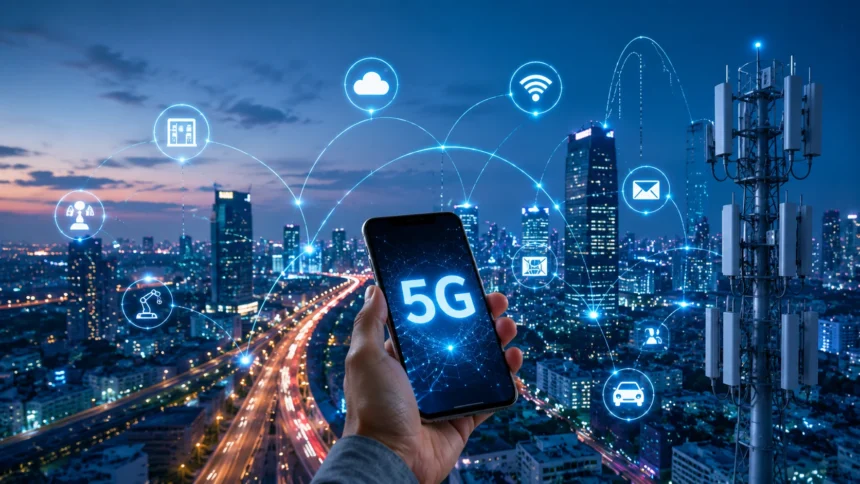
Benefits of 5G: 10 Ways It Changes Connectivity
What Is 5G and Why Does It Matter?
5G is the fifth generation of mobile network technology designed to improve the speed, responsiveness, capacity, and flexibility of wireless connectivity. It builds on earlier 4G LTE networks while introducing technologies that can support more demanding digital experiences. For everyday users, 5G can mean faster downloads, smoother video streaming, more responsive apps, and stronger performance in busy areas when network conditions are favorable. For businesses, the technology can also support connected equipment, private wireless networks, automation, and large numbers of Internet of Things devices. The benefits of 5G therefore extend beyond smartphones. It represents a broader shift toward networks designed to connect people, machines, sensors, vehicles, and digital services more efficiently.
One reason 5G matters is that internet use has changed dramatically since earlier mobile networks were introduced. People now depend on smartphones for video meetings, cloud applications, streaming, navigation, online gaming, financial services, and work that once required a desktop computer. Businesses are also connecting more equipment and collecting more real-time data from physical operations. Traditional mobile networks can become congested when thousands of devices compete for limited resources in the same area. 5G architecture is designed to handle higher traffic levels more effectively. This additional network capacity can improve the experience in places such as stadiums, transportation hubs, city centers, campuses, factories, and large events.
5G does not operate at one single speed or frequency because networks can use different parts of the radio spectrum. Lower-frequency 5G signals can travel longer distances and provide broader coverage, while higher-frequency connections can offer very high performance over shorter ranges. Mid-band spectrum often provides a useful balance between coverage and capacity. This is why two people using 5G in different locations may experience very different speeds. Phone capability, network congestion, building materials, signal quality, and carrier deployment all affect performance. Understanding this variation is important because the 5G symbol on a phone does not automatically guarantee the fastest possible connection.
Another important feature of 5G is lower potential latency, which refers to the delay between sending information and receiving a response. Lower latency can make interactive applications feel more immediate because devices spend less time waiting for data to travel through the network. This matters for cloud gaming, industrial automation, remote equipment control, augmented reality, and other applications where responsiveness is important. Actual latency still depends on the entire network path rather than the radio connection alone. Server distance, application design, internet routing, and congestion can all add delay. Even so, 5G creates a stronger foundation for services that depend on faster network response.
The importance of 5G is therefore not limited to achieving a larger number on a speed test. Its broader value comes from combining higher throughput, lower latency, greater device density, and more flexible network management. These capabilities can allow wireless networks to support uses that were previously difficult or inefficient. Some benefits are already visible through faster mobile broadband, while others depend on wider network deployment, compatible devices, and new applications. 5G should not be viewed as an instant replacement for every form of wired connectivity. Instead, it adds another powerful connectivity option that can complement fiber, Wi-Fi, satellite, and other communication technologies.
How 5G Improves Modern Connectivity
A major improvement introduced by 5G is the ability to use a wider range of radio frequencies more effectively. Earlier mobile networks often relied heavily on lower and mid-range spectrum, while 5G can operate across low-band, mid-band, and high-band frequencies. Each range provides different benefits for coverage, capacity, and speed. Network operators can therefore design deployments according to local requirements rather than using one identical solution everywhere. Rural areas may prioritize broad coverage, while dense city centers may need greater capacity. This flexibility helps 5G address different connectivity challenges within the same overall mobile technology standard.
Massive multiple-input multiple-output technology, often shortened to massive MIMO, is another important part of many 5G networks. It uses arrays of antennas to transmit and receive multiple streams of data more efficiently. Instead of treating every device as though it were using the same simple radio path, advanced antenna systems can direct capacity more intelligently. Beamforming can help focus radio energy toward particular users or areas rather than broadcasting it equally in every direction. These techniques can improve efficiency when many people are connected simultaneously. The result is not simply faster individual devices but better use of limited wireless spectrum across the network.
Network slicing is another concept associated with 5G that can make wireless connectivity more flexible. In simplified terms, a network operator can create different logical network experiences over shared physical infrastructure. One slice might be optimized for ordinary consumer mobile broadband, while another could prioritize reliability or specific performance characteristics for an enterprise application. This approach can be useful when different services have very different connectivity requirements. A factory sensor and a person streaming a movie do not necessarily need the same network behavior. Network slicing allows providers to think about connectivity in terms of service needs rather than treating every connection identically.
Edge computing can also work closely with 5G by placing computing resources closer to the people and devices generating data. Traditional cloud applications may send information to a distant data center before receiving a response. Moving some processing closer to the network edge can reduce travel distance and improve responsiveness. This can benefit applications such as industrial monitoring, computer vision, connected transportation, and immersive experiences. Edge computing is not exclusive to 5G, but the combination can be powerful. Faster wireless access paired with nearby processing creates opportunities for applications that require both mobility and low-latency data handling.
5G also improves connectivity by supporting a much larger ecosystem of connected devices rather than focusing only on smartphones. Sensors, cameras, meters, vehicles, industrial equipment, wearables, and smart infrastructure can all become part of wireless networks. Different devices may require very different amounts of bandwidth and battery power. Some sensors may send only tiny messages occasionally, while cameras can transmit large continuous data streams. A modern network needs to handle these differences efficiently. The ability to support diverse connected devices is one reason 5G is frequently discussed alongside IoT, smart cities, industrial automation, and connected infrastructure.
Benefits of 5G 1–5: Faster and More Responsive Connections
1. Faster mobile internet is one of the most noticeable benefits of 5G for everyday users. Under favorable conditions, 5G networks can deliver substantially higher data speeds than older mobile technologies, allowing large files, applications, photos, and videos to move more quickly. A download that previously required several minutes may complete much faster on a strong connection. Faster mobile broadband can also make cloud-based applications feel more practical away from Wi-Fi. Actual speeds vary significantly according to spectrum, location, carrier, network congestion, and device capability. The important benefit is not a guaranteed number but the network’s ability to provide much greater potential throughput when infrastructure supports it.
2. Lower latency can make connected experiences feel more immediate and responsive. Latency describes the delay between an action and the network response, which becomes particularly noticeable in interactive applications. Lower delay can improve cloud gaming, video collaboration, remote control systems, and certain augmented reality experiences. Businesses may also use low-latency connectivity for industrial systems where machines need to communicate quickly. Real-world performance depends on much more than the cellular connection because application servers and network routing also contribute to delay. Nevertheless, 5G provides a network foundation designed to reduce wireless latency compared with earlier generations.
3. Better performance in crowded locations is another major advantage. Stadiums, airports, shopping areas, business districts, universities, and festivals can place enormous demand on mobile networks because many people connect simultaneously. Even if each person uses only moderate bandwidth, the combined traffic can cause slowdowns. 5G networks are designed to support greater capacity and more efficient use of radio resources. This can help operators serve more users within the same geographic area. Performance can still decline when infrastructure is insufficient, but better network capacity gives providers more tools to manage dense demand than they had with older mobile technology.
4. Smoother high-quality video experiences become more practical as network capacity and speed improve. Mobile users increasingly watch high-resolution video, livestream events, participate in video calls, and upload their own content from smartphones. Higher bandwidth can reduce buffering and improve video quality when the network and streaming service support it. Content creators may also benefit from faster uploads when sending large video files from the field. Video performance still depends on the service provider, device, and signal conditions, so 5G cannot eliminate every playback issue. Even so, faster and more stable mobile broadband can make high-quality video easier to use without relying constantly on fixed Wi-Fi.
5. More reliable mobile work is another important benefit as smartphones, tablets, and laptops become central business tools. Employees may need to join video meetings, access cloud platforms, download large documents, upload media, or connect securely to company systems while traveling. Strong 5G coverage can provide a more capable alternative when public Wi-Fi is slow, unavailable, or unsuitable. Mobile hotspots can also share a 5G connection with laptops and other devices. This does not mean cellular connectivity should replace every office network. It does, however, provide workers with another flexible option for maintaining productivity from locations where wired connectivity is limited.
Benefits of 5G 6–10: New Possibilities for Devices and Industry
6. Support for more connected devices is one of the most important long-term advantages of 5G. Homes, businesses, cities, and industrial facilities are increasingly filled with sensors and connected equipment that need reliable network access. A smart building might contain environmental sensors, security devices, energy meters, lighting controls, and maintenance systems operating simultaneously. Industrial sites can have even greater device density. 5G architecture is designed to handle large numbers of connections more efficiently than earlier cellular generations. This creates a stronger foundation for Internet of Things deployments where thousands of devices may need to communicate within a limited area.
7. Smarter factories and industrial automation can benefit from flexible high-performance wireless connectivity. Manufacturing facilities traditionally depend heavily on wired industrial networks because reliability and predictable performance are essential. Private 5G networks can provide another option for connecting mobile robots, sensors, cameras, handheld devices, and machinery without running cables to every endpoint. Wireless equipment can also be repositioned more easily when production layouts change. Applications may include predictive maintenance, asset tracking, machine monitoring, and automated guided vehicles. 5G will not replace every industrial wired network, but it can expand where wireless connectivity is practical within demanding operational environments.
8. Improved smart city infrastructure is another potential benefit as local governments connect transportation systems, utilities, cameras, environmental sensors, and public services. Traffic signals could use real-time data to respond more intelligently to changing road conditions. Utility providers may monitor equipment and detect problems before customers report service failures. Parking systems, public transportation information, and environmental monitoring can also use connected sensors. 5G provides additional capacity for these applications, particularly when many devices operate in the same urban environment. Smart city benefits depend heavily on planning, security, funding, privacy policies, and useful applications rather than connectivity alone.
9. New augmented and virtual reality experiences may become easier to deliver over mobile networks as bandwidth increases and latency decreases. AR applications can place digital information over the physical environment for training, maintenance, navigation, retail, or entertainment. VR experiences often require large amounts of data and rapid response to user movement. Processing some information at the edge rather than entirely on the local device could make lighter mobile hardware possible in certain scenarios. The technology still faces challenges involving device design, battery life, software quality, and user comfort. However, better mobile connectivity removes one important limitation for immersive applications that need high-speed data access while users move around.
10. More flexible enterprise connectivity can give businesses alternatives to traditional wired networks in specific situations. A company might deploy private 5G across a warehouse, port, campus, mine, or manufacturing facility where mobility and controlled coverage are important. Temporary sites could also use cellular connectivity when installing fixed infrastructure would be slow or expensive. Businesses may use 5G for backup connectivity so critical services can continue if a primary network connection fails. In some locations, fixed wireless access can provide internet service to buildings through cellular infrastructure. These options make connectivity planning more flexible because organizations are no longer limited to choosing between conventional Wi-Fi and wired Ethernet for every use case.
How 5G Benefits Businesses and Industries
Retail businesses can use 5G to improve connectivity across stores, warehouses, and customer-facing technology. Mobile checkout devices, digital displays, inventory scanners, security systems, and smart shelves all depend on reliable data connections. Faster wireless networks can make it easier to deploy connected technology without installing new cables in every location. Retailers may also use augmented reality to help customers visualize products or navigate large stores. Back-office systems can synchronize inventory information more quickly between physical and online channels. The most valuable use cases are those that solve genuine operational problems rather than simply adding technology for novelty.
Healthcare organizations can benefit from faster and more reliable connectivity across hospitals, clinics, mobile units, and other care environments. Large medical images and records may need to move quickly between authorized systems, while connected monitoring devices can generate continuous information. Telehealth services also depend on stable video and data connections, particularly when patients or clinicians are away from fixed broadband. Some advanced remote applications may benefit from low-latency networking combined with edge computing. However, healthcare connectivity must meet strict privacy, reliability, security, and regulatory requirements. 5G can provide infrastructure, but successful medical applications still require carefully designed clinical systems and workflows.
Transportation and logistics companies can use 5G to connect vehicles, warehouses, ports, distribution centers, and tracking systems more efficiently. Delivery fleets already generate location and operational data, and richer connectivity can allow additional information to be transmitted in real time. Warehouses may connect cameras, robots, scanners, and environmental sensors through private wireless networks. Ports and large logistics facilities can use connected equipment across wide areas where wired infrastructure may be inconvenient. Better visibility can help businesses identify delays and equipment problems earlier. The value of 5G in logistics therefore comes from combining mobile connectivity with analytics, automation, and operational decision-making.
Energy and utility companies may use 5G to connect equipment spread across large or complex physical environments. Sensors can monitor electrical infrastructure, pipelines, renewable energy systems, water networks, and other assets. Real-time information can support predictive maintenance and faster response when equipment begins operating abnormally. Workers in the field can access cloud systems, technical documentation, and video assistance from locations away from traditional office networks. Private wireless coverage may also support facilities with strict reliability or security requirements. As with every industry, the network itself creates value only when it supports useful applications and well-designed operational processes.
Education and large campuses can also benefit from expanded wireless options. Universities, research centers, corporate campuses, and training facilities may have thousands of users and connected devices operating simultaneously. 5G can supplement Wi-Fi in outdoor spaces, temporary facilities, transportation areas, or specialized research environments. Students may gain more reliable access to cloud learning platforms when they are away from fixed networks. Researchers can connect field equipment and sensors in places where running cables is difficult. 5G does not eliminate the importance of high-quality campus Wi-Fi and fiber, but it adds another connectivity layer that institutions can use where cellular mobility provides practical advantages.
5G, IoT, and the Growth of Connected Technology
The Internet of Things refers broadly to physical objects that collect, send, or receive data through connected systems. These can range from simple temperature sensors to complex industrial machines, vehicles, medical devices, and smart infrastructure. As IoT adoption grows, networks must handle many more devices than traditional mobile systems were originally designed around. 5G can support this growth by improving device density, capacity, and network flexibility. Not every IoT device requires extremely high speed. In fact, many sensors transmit only small amounts of information, making efficient connection management just as important as raw bandwidth.
Consumer IoT can also benefit from wider 5G availability, although home devices will often continue using Wi-Fi, Bluetooth, or other short-range technologies. Connected security cameras, wearables, vehicles, and outdoor devices may benefit more directly from cellular access because they can operate away from a home router. A connected car, for example, may need network access across an entire city rather than only within one building. Cellular connectivity can provide this mobility without requiring the device to join a different Wi-Fi network every few minutes. 5G extends the capacity available for such mobile connected products as their numbers increase.
Industrial IoT represents an especially important area because factories and infrastructure operators may manage thousands of sensors and machines. Equipment can continuously report vibration, temperature, pressure, energy consumption, and other operating conditions. Analytics systems can use this information to detect patterns suggesting that maintenance will soon be required. Wireless networks make it easier to install sensors in locations where additional cabling is inconvenient. Private 5G may provide greater control over coverage and access than relying solely on public cellular service. The combination of sensors, wireless networks, and analytics can help organizations make physical operations more visible and responsive.
Agriculture provides another interesting IoT use case. Farms can use connected soil sensors, weather equipment, irrigation controls, machinery, livestock trackers, and cameras to collect operational information. Rural 5G coverage can help transmit this data when wired broadband is unavailable, although deployment economics and geography remain significant challenges. Farmers may use information from connected systems to reduce water use, monitor crop conditions, or identify equipment problems earlier. Drones and autonomous agricultural equipment could also benefit from improved connectivity in certain scenarios. The larger value comes from making data available where decisions are being made rather than from connectivity alone.
The growth of connected technology also increases the importance of cybersecurity. Every connected sensor, camera, controller, or machine can potentially become part of an organization’s digital attack surface. Deploying more devices without strong authentication, updates, encryption, and network segmentation can create serious risk. Private 5G and other network technologies can provide security tools, but configuration and device management still matter. Organizations need to know which devices are connected, what information they can access, and how software is maintained throughout their lifecycle. The benefits of 5G and IoT are greatest when connectivity expands alongside responsible security and data governance.
Limitations and Challenges of 5G
Coverage remains one of the most visible limitations because 5G performance differs substantially between locations. A user may experience excellent speeds in one neighborhood and performance similar to 4G only a few miles away. High-frequency 5G signals can provide remarkable capacity but generally cover shorter distances and have more difficulty passing through certain obstacles. Lower-frequency deployments reach farther but may not provide the same dramatic speed improvements. Building dense networks requires towers, small cells, fiber backhaul, spectrum, permits, and significant investment. As a result, 5G quality depends heavily on how extensively a carrier has deployed infrastructure in a particular area.
Device compatibility is another consideration because older phones, tablets, routers, and IoT equipment may not support 5G. Even devices labeled as 5G-capable do not necessarily support every frequency band used by every network. Consumers upgrading mainly for 5G should therefore check whether the device matches local carrier deployments. Businesses face an even bigger challenge when replacing large numbers of industrial devices or embedded systems. Existing equipment may remain operational for years, making immediate migration economically unrealistic. This means 4G, Wi-Fi, wired networks, and 5G are likely to coexist for a long time rather than one technology suddenly replacing all others.
Battery use can also vary depending on device design and network conditions. Modern 5G chipsets have become more efficient, but maintaining wireless connections and transferring large amounts of data still consumes power. A phone searching frequently for weak 5G coverage may sometimes use more energy than when operating on a stable connection. High-performance applications such as cloud gaming and video streaming also consume battery because the screen, processor, and radio are all active. Battery experience therefore depends on both the network and what the user is doing. Faster connectivity does not automatically mean every 5G device will have shorter or longer battery life.
Cost is another challenge, particularly for enterprise deployments. Building private 5G networks may require specialized radios, core network technology, devices, integration, spectrum arrangements, security systems, and technical expertise. For some organizations, improved Wi-Fi may solve the problem at significantly lower cost. Businesses should therefore begin with the operational requirement rather than deciding they need 5G because the technology is new. Public mobile plans and fixed wireless services can also vary in price and data limits. The strongest business cases occur when 5G creates measurable improvements in productivity, flexibility, reliability, or customer experience that justify the investment.
Security and privacy also require careful attention as networks connect more machines and critical services. 5G includes modern security capabilities, but no network technology can prevent every attack by itself. Vulnerable applications, weak passwords, compromised devices, outdated software, and poor configuration can still expose information. More connected devices also create more endpoints that organizations must monitor. Smart city systems and consumer applications can raise privacy questions when they collect large amounts of location or behavioral data. Successful 5G adoption therefore requires cybersecurity, governance, and privacy planning alongside network deployment rather than treating them as separate concerns.
How to Get the Most From 5G Connectivity
For individual users, the first step is confirming that 5G coverage is actually strong in the places where connectivity matters most. A premium 5G phone may provide little benefit if your home, workplace, or normal travel routes have limited 5G service. Carrier coverage maps can provide a starting point, but real-world performance can still differ inside buildings and crowded areas. Pay attention to normal daily experience rather than only peak speed-test results. A stable connection that consistently supports video calls and downloads can be more valuable than occasional extremely high speeds. The best network is ultimately the one that performs reliably where you use it.
Choosing compatible hardware is equally important. Smartphones and routers support specific cellular bands, and not every device takes advantage of all the spectrum available from a particular carrier. Before buying a 5G hotspot or fixed wireless router, confirm that it supports the network and service you plan to use. Businesses should perform even more detailed testing before purchasing large device fleets. Hardware lifecycle, security updates, antenna placement, and management tools can affect long-term value. A well-chosen device can remain useful for years, while buying incompatible equipment based only on a 5G logo can create unnecessary expense.
Businesses considering private 5G should identify a specific operational problem first. For example, a warehouse may need reliable wireless coverage for mobile robots in areas where Wi-Fi roaming creates interruptions. A manufacturing facility might need secure connectivity for equipment that moves frequently as production lines are reconfigured. These use cases provide measurable requirements such as latency, coverage, reliability, and device density. Pilot projects can then determine whether private 5G actually performs better than available alternatives. Starting with clear outcomes makes it easier to calculate return on investment and avoid expensive deployments that solve no meaningful problem.
Combining 5G with other network technologies can often produce better results than trying to replace everything with cellular connectivity. Homes may use fiber for the main internet connection, Wi-Fi for indoor devices, and 5G for mobile access or backup. Businesses can use Ethernet for fixed high-performance equipment, Wi-Fi for general employee access, and private 5G for specialized mobile or industrial systems. Each technology has strengths and limitations. Network design becomes more effective when organizations choose the appropriate connection for each workload. The future of connectivity is therefore likely to be heterogeneous rather than dominated by one universal network technology.
Finally, users should keep expectations realistic as 5G continues evolving. Network improvements occur gradually as carriers expand spectrum usage, deploy additional infrastructure, upgrade core networks, and introduce new services. Some of the most ambitious industrial benefits depend on technologies and applications that are still developing. Consumers may notice the greatest improvement initially through better mobile broadband and fixed wireless access. Enterprises may gain value more gradually as private networks, edge computing, and connected automation mature. 5G is best understood as an enabling platform rather than a single finished product. Its full impact depends on what people and businesses build on top of the connectivity it provides.
Frequently Asked Questions
What are the biggest benefits of 5G?
Major benefits include faster mobile internet, lower potential latency, greater network capacity, support for more connected devices, stronger IoT capabilities, and new options for enterprise and industrial connectivity.
Is 5G faster than 4G?
Yes, 5G can deliver significantly higher speeds than 4G under favorable network conditions. Actual performance depends on spectrum, device compatibility, location, congestion, and carrier infrastructure.
Does 5G reduce latency?
5G is designed to support lower latency than previous mobile generations. However, total application delay also depends on servers, internet routing, software design, and network congestion.
Why is 5G important for IoT?
5G can support large numbers of connected devices and different communication requirements within the same network. This makes it useful for sensors, industrial equipment, smart infrastructure, vehicles, and other IoT applications.
Can 5G replace home Wi-Fi?
5G fixed wireless access can serve as a home internet option in some locations, but it does not necessarily replace Wi-Fi inside the home. A 5G router often still distributes the internet connection to household devices through Wi-Fi.
What is private 5G?
Private 5G is a cellular network deployed for a specific organization or location, such as a factory, warehouse, campus, or port. It can provide controlled wireless coverage for specialized enterprise applications.
Is 5G useful for businesses?
Yes, particularly where businesses need mobile connectivity, dense device support, low latency, backup internet, private wireless coverage, or connected industrial equipment. The value depends on the specific use case.
Does 5G work everywhere?
No. Coverage and performance vary significantly by country, carrier, city, neighborhood, building, and frequency band. Some areas may have excellent 5G service while others still rely primarily on 4G.
Is 5G secure?
5G includes modern security capabilities, but overall security still depends on devices, applications, passwords, updates, network configuration, and operational practices. No wireless technology is automatically secure without proper management.
Will 5G replace 4G completely?
Not immediately. 4G and 5G are expected to coexist for years because billions of existing devices still depend on 4G and network upgrades happen gradually.