

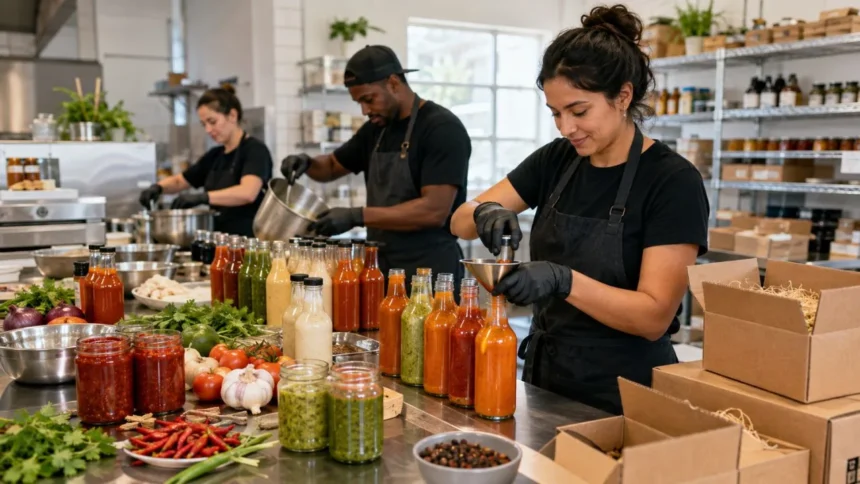
How to Start a Sauce Business: A Complete Step-by-Step Guide
Starting a sauce business can turn a distinctive recipe into a recognizable food brand. Hot sauce, barbecue sauce, pasta sauce, dipping sauce, salsa, chutney, marinade, and salad dressing can all become profitable products when they solve a clear customer need. The opportunity is appealing because sauces are frequently purchased, easy to demonstrate, and suitable for multiple sales channels.
A successful sauce company, however, requires much more than a good homemade recipe. The product must remain safe, stable, consistent, correctly labeled, and enjoyable throughout its stated shelf life. Entrepreneurs must also manage ingredient sourcing, commercial production, packaging, pricing, distribution, marketing, and legal compliance.
The safest path depends on the type of sauce you plan to sell. A refrigerated dairy dressing has different production and storage requirements from a shelf-stable hot sauce, while a meat-based sauce may fall under another regulatory system. Identifying the product category early prevents expensive mistakes later.
This guide explains how to start a sauce business from concept to launch and growth. It covers market research, sauce development, food-safety testing, commercial kitchens, co-packers, bottle selection, labeling, startup costs, wholesale sales, online marketing, and long-term expansion.
Understand How a Sauce Business Works
A sauce business develops, produces, packages, and sells condiments or cooking products to consumers or commercial buyers. Some founders make small batches in an approved kitchen, while others hire a co-packer to manufacture products at scale. The best operating model depends on capital, volume, technical knowledge, and growth plans.
Sauces can be sold directly through websites, markets, food festivals, subscription boxes, and branded stores. They can also be supplied to grocery retailers, specialty shops, restaurants, caterers, distributors, and private-label customers. Each channel has different packaging, pricing, volume, and delivery expectations.
The product format shapes the entire operation. Shelf-stable sauces can usually travel and remain in stores without refrigeration, but they require carefully validated processing. Refrigerated or frozen sauces may be easier to formulate in some cases, yet they create higher storage and transportation costs.
Profit comes from selling the product for more than the complete cost of ingredients, production, packaging, storage, marketing, delivery, and retailer margins. A sauce may appear inexpensive to make at home, but commercial costs can increase rapidly. Accurate costing is therefore essential before committing to a launch.
Choose a Focused Sauce Niche
Begin with a clear category rather than trying to compete across every condiment aisle. Possible options include hot sauce, barbecue sauce, pasta sauce, wing sauce, curry sauce, pizza sauce, garlic sauce, chili crisp, salsa, chutney, marinade, dessert sauce, or salad dressing.
A focused niche makes your sauce brand easier to understand. Customers should quickly recognize whether you offer smoky barbecue flavors, regional chili sauces, healthy dressings, traditional family recipes, or convenient cooking bases. A broad identity can make a new business difficult to remember.
You can narrow the niche further through dietary needs, flavor intensity, ingredients, or intended use. Examples include low-sodium sauces, vegan condiments, sugar-free barbecue sauce, gluten-free marinades, halal ingredients, mild family sauces, or extra-hot products for chili enthusiasts.
Select a niche that matches both market demand and your ability to manufacture safely. A product may attract attention but require costly ingredients, complicated temperature controls, or specialized equipment. The strongest starting idea balances customer interest, operational simplicity, and healthy profit potential.
Identify the Problem Your Sauce Solves
Customers rarely buy a sauce only because liquid has been placed inside an attractive bottle. They buy flavor, convenience, nostalgia, variety, or a faster way to prepare meals. Your product should offer a clear benefit that existing sauces do not provide effectively.
A cooking sauce may help busy families prepare dinner quickly, while a specialty hot sauce may bring a distinctive regional flavor to ordinary meals. A restaurant-style garlic sauce may satisfy customers who cannot find the same experience in supermarkets. Each benefit creates a different marketing message.
Ask why someone would purchase your sauce instead of a familiar national brand. The answer might involve fresher flavor, cleaner ingredients, unusual peppers, authentic preparation, better heat balance, lower sugar, convenient portioning, or compatibility with particular diets.
Avoid building the entire concept around a vague claim such as “better taste.” Taste is important, but buyers need a reason to try the product before they can experience it. A specific promise gives packaging, advertising, sampling, and retail presentations a stronger direction.
Research the Sauce Market
Market research helps determine whether enough customers are likely to pay for your idea. Visit supermarkets, specialty food stores, farmers’ markets, restaurant suppliers, and online marketplaces. Record competing products, bottle sizes, ingredients, prices, claims, flavors, and shelf placement.
Study customer reviews to find repeated praise and complaints. Shoppers may dislike sauces that are too sweet, watery, salty, artificial, difficult to pour, or poorly packaged. These comments can reveal opportunities to create a more satisfying product.
Speak directly with your target customers through interviews, surveys, tasting events, or small focus groups. Ask what sauces they buy, how often they use them, which flavors they prefer, and what price feels reasonable. Focus on actual purchasing behavior rather than polite enthusiasm.
Research should also examine sales-channel requirements. A local market customer may accept a handmade label and premium price, while a supermarket buyer expects barcodes, wholesale margins, case packaging, insurance, reliable supply, and professional product documentation.
Define Your Target Customer
A strong sauce business is designed for a recognizable group of buyers. Your audience might include home cooks, barbecue enthusiasts, restaurant owners, health-conscious shoppers, families, students, gift buyers, or people seeking culturally specific flavors.
Describe the customer’s lifestyle, spending habits, food preferences, shopping locations, and common frustrations. A premium chili sauce aimed at food enthusiasts needs different branding from an affordable pasta sauce intended for large households.
Consider how the customer will use the sauce. Some people want a finishing condiment, while others need a cooking ingredient, marinade, dipping sauce, or complete meal base. Usage affects bottle size, consistency, instructions, and repeat-purchase frequency.
Do not define the audience as “everyone who likes sauce.” A narrow initial audience makes advertising and retail outreach more efficient. The brand can later expand after establishing credibility with its strongest group of customers.
Write a Sauce Business Plan
A sauce business plan explains how the idea will become a sustainable company. It should include your product concept, target market, competition, manufacturing process, sales channels, marketing strategy, startup costs, pricing, and financial projections.
Describe whether you will produce the sauce yourself, rent an approved commercial kitchen, or use a contract manufacturer. Include expected batch sizes, equipment needs, ingredient suppliers, storage arrangements, staffing, and delivery methods.
Create conservative, realistic, and ambitious sales forecasts. Estimate the number of bottles you must sell each month to cover operating expenses. These calculations reveal whether the planned price, production volume, and market size can support the business.
A clear plan is useful even when you are not seeking outside investment. It helps organize decisions and identify assumptions that require testing. Lenders, retailers, co-packers, and potential partners may also request parts of the plan before working with you.
Decide Whether the Sauce Will Be Shelf-Stable or Refrigerated
One of the most important decisions is whether the sauce will be sold at room temperature, refrigerated, or frozen. This choice affects formulation, processing, packaging, storage, delivery, shelf placement, and the retailers willing to stock it.
A shelf-stable sauce offers convenient storage and broader distribution. However, it must be scientifically evaluated and processed using a validated method. Simply adding vinegar or cooking the sauce for a certain number of minutes does not automatically make it safe.
Refrigerated sauces may allow flavors or ingredients that do not work well in shelf-stable products. They usually require less severe heat processing, but the cold chain must remain controlled from production to the customer. Distribution costs and retail space can therefore be higher.
Choose the format based on product characteristics and commercial goals rather than convenience alone. Work with a food scientist or process authority before finalizing the formula, process, packaging, and storage instructions.
Turn a Homemade Recipe Into a Commercial Formula
A family recipe often relies on informal measurements such as one spoon, a handful, or enough vinegar to taste. Commercial production requires every ingredient to be measured accurately by weight. Precise formulas create consistent flavor, texture, safety, yield, and cost.
Record the exact variety, brand, and specification of each ingredient. Different tomato products, peppers, vinegars, oils, or sweeteners can change acidity, thickness, color, and flavor. Supplier substitutions should never be made casually in a validated commercial process.
Document the complete method, including ingredient order, blending time, cooking temperature, holding time, filling temperature, container type, closure, cooling, and expected batch yield. Every production run should follow the approved procedure.
Scale the recipe gradually. A sauce made in a small saucepan may behave differently inside a large kettle because heat transfer, evaporation, and mixing change. Pilot batches help identify problems before ingredients and packaging are purchased in commercial quantities.
Standardize Flavor, Texture and Appearance
Customers expect the same experience every time they buy your bottled sauce. One batch should not be thick and smoky while the next is thin and unusually acidic. Standardization turns an interesting recipe into a dependable commercial product.
Create measurable quality specifications for color, aroma, taste, thickness, fill weight, and appearance. Depending on the product, you may use scales, thermometers, pH meters, viscosity measurements, or visual comparison samples.
Natural ingredients can vary with season, region, and harvest. Fresh peppers may change in heat level, tomatoes may differ in sweetness, and spices can lose strength during storage. Approved ingredient specifications help reduce these variations.
Conduct sensory testing before releasing a batch. A trained team member should compare it with an accepted reference sample. Products outside the approved range should be investigated rather than blended into normal inventory without documentation.
Work With a Process Authority or Food Scientist
A process authority is a qualified expert who evaluates a food product and develops or confirms a safe commercial process. This support is especially important for shelf-stable sauces packed in sealed bottles or jars.
The expert may review the formulation, equilibrium pH, water activity, heat treatment, filling temperature, container, closure, and cooling method. Their recommendations are based on the complete product system, not one isolated measurement.
Do not assume that a pH reading alone proves safety. The sauce must be mixed and sampled correctly, the meter must be calibrated, and solid particles may require time to reach equilibrium. Other characteristics can also affect the required process.
Provide the specialist with an accurate formula and production method. Changing ingredients, bottle size, fill volume, thickener, acid source, or process may require another review. A validated process only applies to the conditions that were actually evaluated.
Understand pH and Acidity in Sauce Production
Acidity plays an important role in many shelf-stable sauces because it can limit the growth of dangerous microorganisms. In the United States, acidified foods are generally low-acid foods to which acid or acidic ingredients are added to achieve a finished equilibrium pH of 4.6 or below.
The number should not be treated as a do-it-yourself target. A product close to the regulatory limit may require a lower operating value to provide a safety margin. A process authority determines appropriate controls for the specific formula and process.
Use a suitable calibrated pH meter rather than relying only on paper strips. Keep calibration solutions, clean the probe correctly, and record results for every commercial batch. Staff should be trained to recognize inaccurate or unstable readings.
Acid also affects flavor, texture, color, preservatives, and packaging compatibility. Changing from one vinegar to another may influence more than taste. Recipe adjustments should therefore be reviewed before they become part of production.
Test Shelf Life Before Selling the Sauce
Shelf life is the period during which a sauce remains safe and maintains acceptable quality under stated storage conditions. It should not be guessed from a competitor’s date or chosen only because a longer period seems better for sales.
Testing may examine microbiological stability, pH, water activity, color, flavor, aroma, viscosity, separation, oxidation, packaging integrity, and preservative performance. The required tests depend on the sauce and intended storage conditions.
Keep samples from pilot and production batches under realistic conditions. Evaluate unopened products throughout the proposed shelf life and test how quality changes after opening. Customer instructions should reflect the results rather than assumptions.
Revalidate the shelf life after significant changes to the formula, supplier, process, bottle, closure, or storage method. A new ingredient or larger package can affect product stability even when the sauce appears similar.
Register the Business Legally
Choose an appropriate legal structure, such as a sole proprietorship, partnership, limited-liability company, or corporation. The best option depends on ownership, taxes, liability, investment plans, and local law.
Register the business name and obtain the required tax identification numbers. Check whether the proposed brand name conflicts with an existing company or trademark before ordering labels, bottles, signage, or website materials.
Open a separate business bank account and use it for company income and expenses. Separating personal and business finances improves recordkeeping and makes the operation appear more professional to suppliers, lenders, and retailers.
Consider professional legal and accounting advice before launch. Food businesses can face product-liability, employment, tax, contract, and labeling issues. A suitable structure and good records reduce avoidable risk as sales increase.
Obtain Food Business Licenses and Permits
The permits required for a sauce business depend on the location, product, production method, and sales channels. Common requirements may include a business license, food-manufacturing permit, health inspection, facility approval, food-handler training, and tax registration.
Shelf-stable acidified sauces may face additional federal requirements in some markets. In the United States, qualifying commercial processors may need to register their establishments and file scheduled processes for each applicable product, container, and processing method.
Contact local food-safety and health authorities before renting a production site. Explain the ingredients, packaging, process, storage method, and planned sales area. Written guidance is more reliable than assumptions based on another food business.
Create a compliance calendar for permit renewals, inspections, testing, training, and filings. A license that expires unnoticed can interrupt production or cause a retailer to suspend orders.
Can You Start a Sauce Business From Home?
Home production is legal in some locations, but cottage food rules vary significantly. Many programs allow only foods that do not require strict temperature control or specialized processing. Certain sauces, salsas, dressings, and canned products may be restricted.
Do not assume that vinegar, sugar, salt, or refrigeration makes a homemade sauce eligible for sale. Contact the authority responsible for cottage food or home-based food businesses and describe the exact product.
Even when home production is permitted, you may need an inspection, separate storage, approved equipment, food-safety training, labeling, sales limits, or restrictions on wholesale and interstate sales. Household pets and personal food can create additional compliance issues.
A shared commercial kitchen may be a safer starting option. It provides approved preparation space without the expense of building a complete facility. Confirm that the kitchen allows your process and has suitable cooking, filling, cooling, and storage equipment.
Choose Between Self-Manufacturing and a Co-Packer
Self-manufacturing gives you direct control over ingredients, scheduling, production, and quality. It can suit small local sales, but it requires equipment, trained staff, permits, facility management, and detailed food-safety records.
A co-packer, also called a contract manufacturer, produces and packages sauce for another brand. This arrangement can increase capacity and provide access to commercial equipment without building a factory.
Co-packers usually have minimum batch requirements. They may also charge for setup, ingredient sourcing, testing, storage, packaging, and formulation adjustments. A large production run can tie up significant cash in inventory.
Compare both options using complete costs rather than the manufacturing price alone. Consider control, minimum volumes, lead times, confidentiality, quality systems, flexibility, freight, and the ability to meet future demand.
Find the Right Sauce Co-Packer
Search for a manufacturer with experience in your sauce category and packaging format. A facility specializing in thin hot sauces may not have the equipment needed for chunky salsa, oily chili crisp, or refrigerated dairy dressing.
Ask about certifications, inspections, minimum order quantities, production capacity, lead times, ingredient purchasing, testing, traceability, allergen controls, packaging options, and storage. Request references from brands with similar needs where possible.
Clarify who owns the formula and manufacturing records. Use written agreements covering confidentiality, intellectual property, quality standards, rejected batches, price changes, and responsibility for regulatory compliance.
Complete a pilot run before ordering a large quantity. Evaluate taste, texture, fill consistency, labels, closures, shipping cases, and product stability. Problems are less expensive to correct before full-scale manufacturing begins.
Choose a Suitable Commercial Kitchen
A commercial kitchen should support a safe and efficient flow from ingredient receiving to finished cases. Separate raw materials, clean packaging, cooking, filling, cooling, and finished inventory as much as practical.
Confirm that the facility has suitable kettles, mixers, ventilation, sinks, washable surfaces, drainage, hot water, storage, and pest controls. Your bottle-filling method must also fit the approved process.
Check scheduling before signing a rental agreement. Shared kitchens may be busiest during the hours you need, and limited storage can require ingredients and bottles to be transported for every batch.
Calculate the complete cost of using the facility. Include hourly rent, cleaning time, storage, equipment fees, transportation, staff, and scheduling delays. A low hourly rate may not be economical when the workflow is inefficient.
Buy Essential Sauce-Making Equipment
Equipment requirements depend on the sauce’s thickness, ingredients, batch size, and packaging. Common needs include stainless-steel preparation tables, scales, kettles, mixers, thermometers, pH meters, funnels, pumps, fillers, cappers, and label applicators.
Begin with equipment that matches realistic demand. Purchasing an automated filling line before proving sales can create unnecessary debt. Manual or semi-automatic tools may be sufficient during early production.
Choose food-contact equipment that can be cleaned and sanitized effectively. Household appliances may not withstand repeated commercial use or meet facility requirements. Discuss equipment choices with your regulator and process expert.
Create calibration, cleaning, inspection, and maintenance schedules. A damaged thermometer, inaccurate scale, worn seal, or poorly calibrated pH meter can affect product quality and safety.
Source Ingredients From Reliable Suppliers
Consistent ingredients are essential for a repeatable sauce. Select suppliers according to quality, specifications, traceability, availability, minimum order size, delivery performance, and price.
Create written specifications for important ingredients such as peppers, tomatoes, vinegar, oil, salt, sweeteners, spices, and preservatives. Include variety, concentration, acidity, particle size, allergen status, or other relevant characteristics.
Maintain approved backup suppliers for critical ingredients. A shortage should not force an untested substitution that changes the validated formula. Test and document alternatives before an emergency occurs.
Inspect deliveries for damage, contamination, incorrect products, and temperature problems. Record lot numbers so ingredients can be traced to finished sauce batches if a supplier later announces a recall.
Manage Allergens and Cross-Contact
Sauces may contain common allergens through ingredients such as milk, eggs, fish, shellfish, peanuts, tree nuts, wheat, soy, and sesame. Mustard, celery, lupin, and other allergens may also require declaration in some countries.
Identify every allergen in the formula, including those inside compound ingredients. A seasoning blend, flavoring, Worcestershire-style sauce, or cooking base may contain allergens that are not obvious from its name.
Prevent cross-contact through controlled storage, dedicated tools where needed, validated cleaning, production scheduling, staff training, and clear ingredient identification. The label cannot compensate for poor allergen controls.
Review every packaging change carefully. Applying the wrong label to a bottle can create an undeclared-allergen emergency even when the sauce was manufactured correctly. Label checks should be documented during every run.
Build a Food-Safety Plan
A food-safety plan identifies possible biological, chemical, physical, and allergen hazards throughout production. It explains how significant risks will be prevented, monitored, corrected, verified, and recorded.
Map each step from receiving ingredients through preparation, cooking, filling, cooling, storage, and distribution. Consider contaminated ingredients, incorrect acidity, insufficient processing, foreign materials, chemical residues, and packaging failures.
Develop written procedures for handwashing, cleaning, sanitizing, pest control, glass breakage, allergen management, employee illness, equipment maintenance, and waste. Staff should follow the same system every day.
Requirements vary with the facility and market, so qualified professional help may be necessary. A practical food-safety plan should reflect the real operation rather than being a generic document stored away for inspections.
Create Batch Records and Product Traceability
Give every sauce batch a unique lot code. The code should connect the finished bottles with the production date, formula, ingredients, supplier lots, staff, equipment, processing records, and packaging.
Record critical measurements such as ingredient weights, temperatures, processing times, pH results, fill checks, closure checks, and product yield. Missing records can make it difficult to prove that a batch followed the approved process.
Keep distribution information showing which customers or retailers received each lot. Effective traceability allows the business to identify affected products quickly without removing every bottle from the market.
Test the system with a mock recall. Choose a batch and determine how quickly the team can find its ingredients, production records, remaining stock, and buyers. Fix gaps before a real problem occurs.
Prepare a Product Recall Plan
A recall plan explains how the business will respond when a sauce may be unsafe, mislabeled, contaminated, or otherwise unsuitable for sale. Preparing it in advance reduces confusion during a stressful situation.
Assign responsibilities for decision-making, regulatory communication, customer contact, stock control, public messaging, and investigation. Include current telephone numbers and backup contacts.
Create templates for retailer notices, consumer announcements, website updates, and internal instructions. The wording will need to match the incident, but templates save valuable time.
Record how recalled products will be identified, collected, isolated, and disposed of. After the incident, investigate the cause and verify that corrective actions prevent the same problem from happening again.
Select the Best Bottle or Jar
Packaging must protect the sauce, support the validated process, and appeal to customers. Common options include glass bottles, plastic bottles, squeeze containers, jars, pouches, and food-service tubs.
The container should match the sauce’s thickness and usage. A narrow-neck bottle may frustrate customers when used for a chunky product, while a wide opening may pour a thin sauce too quickly.
Consider heat resistance, oxygen protection, breakage, weight, shipping cost, recycling, and retailer preferences. The closure must create a dependable seal and remain compatible with the sauce.
Do not change bottle size or material without reviewing the process. Container dimensions can influence heating, cooling, fill control, and shelf life. Packaging is part of the food-safety system rather than decoration alone.
Design Packaging That Stands Out
Sauce shelves are crowded, so packaging must communicate quickly. Customers should understand the flavor, heat level, intended use, and main brand difference without studying the bottle for several minutes.
Choose a visual identity that fits the target audience. A family pasta sauce may need warm and reassuring packaging, while an extreme hot sauce can use a bolder personality.
Keep important text readable at actual label size. Decorative fonts, low contrast, and crowded designs may look attractive on a large computer screen but become difficult to understand on a small bottle.
Show the product honestly. Flavor names, serving images, and ingredient claims should match the experience inside the container. Repeat purchases depend on meeting the expectation created by the label.
Create a Legally Compliant Sauce Label
Labeling requirements differ by country and product, but packaged sauces commonly need a product identity, net quantity, ingredient list, allergen declaration, business details, and nutrition information where required.
Ingredients usually need to appear in descending order by weight. Compound ingredients may require their components to be declared. Preservatives, colors, and flavorings must be described according to applicable rules.
Storage instructions should clearly state whether the sauce must be refrigerated before or after opening. Include handling directions that are supported by shelf-life and product testing.
Claims such as organic, natural, low sodium, sugar-free, gluten-free, healthy, or preservative-free may have regulated meanings. Obtain a professional label review before printing a large quantity.
Add Nutrition Information Correctly
Most packaged sauces sold through conventional retail channels require nutrition information, although limited exemptions may exist in some markets. Eligibility should be confirmed rather than assumed.
Nutrition values may be developed through laboratory analysis or a qualified database calculation, depending on local rules and the formula. The chosen serving size must follow applicable requirements.
Small serving sizes can create rounding effects, especially for sodium, sugar, calories, and fat. The displayed numbers should not be manipulated to create a misleading impression of the product.
Update the nutrition panel when the formula, portion, supplier specification, or serving requirements change. Keep documentation supporting every value and marketing claim.
Obtain Barcodes and Case Information
Retailers commonly require a unique barcode for each product size and flavor. Buy codes through the recognized standards organization for your market rather than using unreliable recycled numbers.
Place the barcode on a flat, scannable part of the package with suitable contrast and quiet space. Test printed labels before completing the entire production run.
Wholesale cases may also need labels showing the product name, quantity, lot code, date, storage conditions, weight, and case barcode. Clear case information speeds receiving and inventory management.
Maintain a product data sheet containing dimensions, weights, shelf life, ingredients, allergens, case pack, pallet configuration, and ordering details. Retail and distribution partners may request this information during onboarding.
Calculate Sauce Business Startup Costs
Startup expenses may include recipe development, process evaluation, laboratory testing, licenses, insurance, kitchen rental, equipment, ingredients, bottles, labels, cases, branding, barcodes, website development, and marketing.
Packaging can require a significant upfront investment because suppliers often set minimum order quantities. Custom bottles and printed labels may reduce unit costs at volume but increase financial risk before demand is proven.
Production costs also include labor, utilities, cleaning, sanitation, storage, waste, damaged bottles, merchant fees, samples, delivery, and co-packer setup charges. Small expenses become meaningful across thousands of units.
Maintain working capital for future production runs. Retailers and distributors may pay weeks after delivery, while manufacturers and packaging suppliers often require earlier payment. A profitable business can still fail when cash flow is poorly managed.
Calculate the True Cost Per Bottle
List the exact cost of every ingredient in one batch and divide it by the number of sellable bottles produced. Use actual yield after cooking and processing rather than the theoretical recipe volume.
Add the bottle, cap, seal, label, neck band, case, divider, and pallet cost. Include packaging loss because damaged or misprinted materials are unlikely to be completely avoided.
Include direct labor, kitchen rent, co-packing, testing, utilities, storage, freight, transaction fees, and expected spoilage. Allocate a reasonable portion of fixed overhead to every unit.
Review costs whenever supplier prices, batch sizes, formulas, or production methods change. A sauce that was profitable last year can quietly lose margin after several small increases.
Set a Profitable Retail Price
Your price must cover all costs, retailer and distributor margins, discounts, promotions, and profit. Choosing a price only because competitors charge it can create an unsustainable business.
Calculate separate direct-to-consumer, wholesale, distributor, and food-service pricing. Every channel has a different cost structure and expected margin.
Work backward from the realistic shelf price. Subtract retailer and distributor requirements to determine the amount your company will receive. Compare that figure with the complete unit cost.
Do not compete only by being cheapest. Small sauce brands can justify higher prices through distinctive flavor, premium ingredients, convenience, authenticity, strong branding, or specialized dietary benefits.
Develop a Memorable Sauce Brand
Your brand should express the product’s personality and customer promise. The name, logo, colors, packaging, tone, and story should feel connected rather than assembled separately.
Choose a name that is easy to pronounce, remember, search, and print on a small label. Check trademarks, company registrations, website domains, and social media handles before committing.
A founder story can help customers connect with the product, but it should support the value of the sauce. Explain why the recipe exists, what inspired it, and what makes it useful or distinctive.
Consistency builds recognition. Use the same visual identity and message across bottles, boxes, websites, displays, advertisements, invoices, and social media content.
Protect the Brand and Recipe
Consider trademark protection for the business name, logo, or distinctive product line. Registration rules and costs vary, so professional advice may be valuable before entering larger markets.
Recipes can be difficult to protect through copyright because ingredient lists and basic methods receive limited protection in many jurisdictions. Operational secrecy and contracts may therefore be more practical.
Use confidentiality and manufacturing agreements when sharing the complete formula with consultants, employees, suppliers, or co-packers. Clarify who owns improvements and commercial variations.
Limit access to sensitive details without making production dependent on one person. The business needs secure documentation and trained backup staff to continue operating reliably.
Launch With a Small Product Range
A focused launch usually performs better than introducing many flavors at once. Start with one to three sauces that share ingredients, equipment, packaging, and customer appeal.
Fewer products simplify testing, label management, purchasing, production scheduling, storage, marketing, and inventory. They also make it easier to identify which flavor customers genuinely prefer.
Choose a flagship product that represents the brand clearly. Additional varieties can provide different heat levels or uses without confusing the main message.
Expand after repeat sales show stable demand. New flavors should earn their place through customer interest and financial potential rather than the founder’s desire for variety.
Conduct a Controlled Pilot Launch
Produce a limited commercial batch and sell it to a manageable group of real customers. A pilot tests not only flavor but also labeling, ordering, packing, delivery, and customer support.
Track production time, actual yield, waste, cost, damaged bottles, shipping problems, and customer questions. Compare these results with the assumptions in your business plan.
Ask customers about flavor, texture, heat, bottle usability, portion size, packaging, value, and likely repeat purchase. Specific feedback is more useful than general praise.
Correct problems before investing heavily in inventory or advertising. Strong promotion can create negative reviews when operations are not ready for a sudden increase in orders.
Sell at Farmers’ Markets and Food Events
Local markets allow customers to meet the founder, taste the sauce, and ask questions. Sampling can overcome hesitation because shoppers experience the product before buying.
Create a clean, attractive display with visible pricing, product uses, allergens, and payment options. Keep backup stock organized and protect products from unsuitable temperatures or damage.
Offer pairing ideas and simple recipes. Customers are more likely to buy when they can imagine using the sauce with familiar meals.
Record which flavors, bottle sizes, and messages attract attention. Markets can provide valuable research, but calculate stall fees, travel, labor, samples, and unsold stock before judging profitability.
Sell Sauce Online
An online store gives the brand direct access to customers and useful purchasing data. Product pages should clearly explain flavor, heat level, ingredients, allergens, size, storage, and suggested uses.
Shipping glass bottles requires tested protective packaging. Conduct drop and leakage tests before mailing customer orders. The cost of replacements can quickly damage online profit margins.
Use bundles to increase order value and spread the shipping cost across several bottles. Starter packs, heat-level collections, gift boxes, and recipe bundles can make purchasing easier.
Set realistic dispatch and delivery expectations. Send tracking information and respond quickly to broken, leaking, missing, or incorrect orders. Online reviews often reflect service as much as flavor.
Use SEO to Attract Sauce Customers
Optimize the website around terms customers actually search, such as hot sauce online, barbecue sauce gift set, spicy garlic sauce, low-sugar sauce, or locally made condiments.
Create separate pages for important products and categories. Include descriptive headings, useful copy, original images, FAQs, ingredients, usage ideas, and clear purchase options.
Publish helpful articles about marinades, meal ideas, spice levels, sauce storage, grilling, dipping, and cooking techniques. Educational content can reach customers before they are ready to purchase.
Local SEO is valuable when selling through nearby stores, markets, or collection points. Keep business details accurate and encourage genuine customers to leave useful reviews.
Market the Sauce Through Social Media
Visual content can show how the sauce looks, pours, cooks, and transforms a meal. Short recipe videos often communicate more value than photographs of the bottle alone.
Demonstrate several uses so customers do not view the product as suitable for only one dish. A barbecue sauce might also work in sandwiches, bowls, marinades, and roasted vegetables.
Feature real customer reactions and user-created recipes with permission. Authentic social proof can be more persuasive than repeated claims from the brand itself.
Post consistently without focusing on sales in every update. Ingredient stories, cooking tips, founder progress, retail locations, and behind-the-scenes production can build a stronger community.
Work With Food Creators and Influencers
Choose creators whose audience, content quality, location, and food preferences match the brand. A small creator with trusted engagement may produce better results than a large but unrelated account.
Provide clear information about flavor, allergens, storage, and key uses while allowing the creator to give an honest opinion. Overly scripted promotions can feel unconvincing.
Use trackable links, codes, or dedicated landing pages to measure sales. Views and likes are useful indicators, but they do not automatically produce profitable customers.
Follow advertising-disclosure requirements in the relevant market. Paid or gifted relationships should be communicated transparently to protect both the creator and the brand.
Approach Independent Retailers
Independent grocery stores, butcher shops, delis, farm shops, gift stores, and specialty markets are often more accessible to a new sauce brand than national chains.
Research each retailer before making contact. Explain why the product suits its customers rather than sending the same generic message to every buyer.
Prepare a wholesale sheet with product images, pricing, case quantities, shelf life, storage requirements, barcodes, allergens, ordering terms, and contact information.
Bring professional samples and follow up respectfully. Buyers need confidence that the sauce will sell, arrive consistently, and receive marketing support from the brand.
Prepare for Supermarket Distribution
Supermarkets may require insurance, certifications, product specifications, barcodes, case labeling, electronic ordering, promotional support, and dependable supply.
Retailers usually expect a meaningful margin and may charge fees for listings, promotions, distribution, returns, or data services. Understand every deduction before agreeing to the deal.
Large orders can create cash-flow pressure because production and packaging must be paid for before the retailer pays the invoice. Confirm that the business can finance the opportunity.
Entering a major chain is not automatically profitable. Evaluate net revenue, production capacity, operational risk, and the effect of promotions before accepting wide distribution.
Sell to Restaurants and Food-Service Buyers
Restaurants, cafes, caterers, food trucks, hotels, and meal-preparation companies may purchase sauces in larger containers. Food-service sales can create predictable recurring volume.
These buyers focus on consistency, preparation speed, yield, storage, allergens, and cost per serving. Attractive retail packaging may matter less than performance and reliability.
Develop food-service sizes only after confirming demand. Larger packs can require different processing, testing, closures, labels, and production equipment.
Offer clear ordering terms and dependable delivery schedules. A restaurant cannot easily replace an essential sauce after service has already begun.
Work With a Food Distributor
A distributor can place products in multiple stores and manage warehousing, ordering, and delivery. This can expand reach, but the distributor requires its own margin.
Choose a distributor that already serves the right retailers and understands your product category. A large network is less valuable when the sales team does not prioritize a small brand.
Clarify minimum orders, territories, fees, damaged goods, expired products, promotions, payment terms, and sales reporting. Put all expectations in a written agreement.
Continue supporting consumer demand after distribution begins. Products can be removed when they occupy shelf space without selling, even when delivery performance is excellent.
Manage Sauce Inventory Carefully
Sauce may have a long shelf life, but unsold bottles still trap cash and occupy storage space. Produce according to realistic demand rather than the lowest possible manufacturing price.
Use lot codes and a first-expired, first-out system. Place older stock where staff can select it before newer batches.
Track finished bottles, ingredients, packaging, damaged goods, samples, and retailer inventory. A spreadsheet may work initially, but accuracy becomes more important as sales channels increase.
Review seasonal demand, promotions, wholesale orders, production lead times, and packaging minimums. Good forecasting reduces shortages without creating excessive stock.
Store and Transport Sauce Correctly
Follow the storage conditions established during product testing. Shelf-stable sauces still require protection from extreme heat, freezing, direct sunlight, moisture, pests, and physical damage.
Refrigerated sauce must remain within the approved cold chain. Use monitored storage and suitable vehicles or insulated systems rather than assuming a short trip is harmless.
Pack cases to prevent bottle movement, breakage, cap damage, and label scuffing. Test pallet patterns and shipping materials before sending large wholesale orders.
Inspect returned or damaged goods before deciding whether they can be resold. Products with uncertain temperature history, broken seals, or compromised containers should be isolated.
Purchase Suitable Business Insurance
Product-liability insurance can help protect the company when someone claims that the sauce caused injury, illness, or property damage. Many retailers require proof of coverage.
General liability insurance may cover other business risks, while property, equipment, vehicle, cyber, workers’ compensation, and product-recall coverage may also be relevant.
Explain the complete operation to the insurer, including ingredients, manufacturing, storage, online sales, retail distribution, and markets served. Incomplete information can create coverage problems.
Review policies as the company expands. A small local operation may need different limits after entering supermarkets, hiring staff, exporting, or using a larger facility.
Track the Numbers That Matter
Monitor revenue, gross margin, contribution margin, operating expenses, cash flow, and net profit. Sales growth alone does not prove that the sauce business is healthy.
Track unit economics by flavor and sales channel. A product may perform well online but become unprofitable through distribution because of freight and retailer margins.
Measure repeat purchases, average order value, customer acquisition cost, wholesale reorder rate, returns, damaged shipments, and expired inventory. These figures reveal where improvements are needed.
Review the data regularly and connect it with practical decisions. Discontinue weak products, adjust prices, improve packaging, or change marketing based on evidence rather than guesswork.
Avoid Common Sauce Business Mistakes
One common mistake is treating a successful home recipe as a finished commercial product. Scaling, processing, packaging, and storage can change both safety and flavor.
Another mistake is guessing shelf life or relying on vinegar without expert evaluation. A sauce can look and smell normal while still requiring a more carefully controlled process.
Underpricing is also common. Founders count ingredients and bottles but forget labor, testing, freight, retailer margins, damaged stock, promotions, and overhead.
Launching too many flavors, ordering excessive packaging, or pursuing national retail too early can consume cash. Controlled growth usually creates a stronger business than rapid expansion without stable systems.
Scale the Sauce Business Responsibly
Before expanding, confirm that demand is repeatable and the existing operation produces consistent quality. A temporary viral trend should not automatically justify expensive equipment or a huge production order.
Document recipes, production procedures, sanitation, batch records, customer service, packing, and inventory. The business cannot scale effectively when all important knowledge exists only in the founder’s memory.
Negotiate better ingredient, packaging, and freight terms as volume grows, but do not sacrifice specifications for small savings. Inconsistent materials can damage the product customers already trust.
Expand one step at a time through new flavors, retailers, regions, food-service accounts, or export markets. Measure the financial and operational effect of each move before starting the next.
Final Thoughts on Starting a Sauce Business
Learning how to start a sauce business involves food science, regulation, branding, finance, and customer understanding. A memorable recipe creates interest, but a reliable system creates a sustainable company.
Begin with a focused product and validate demand before investing heavily. Standardize the formula, work with qualified food-safety experts, and secure the correct approvals before selling.
Calculate the full cost of every bottle and choose sales channels that leave enough margin. Strong packaging and marketing can attract first-time buyers, but consistent flavor and service generate repeat sales.
A sauce brand can grow from small local batches into a wider retail business when safety, quality, and profitability remain central. Careful preparation may slow the first launch, but it builds the trust needed for long-term growth.
Frequently Asked Questions
How much does it cost to start a sauce business?
Startup costs depend on testing, permits, kitchen rental, manufacturing, packaging, and initial inventory. A small local launch costs less than a shelf-stable retail range produced through a commercial co-packer.
Can I make sauce at home and sell it?
Home production depends on local cottage food laws and the type of sauce. Many sauces require an approved kitchen, process evaluation, permits, and controls that are not available in a domestic kitchen.
Does homemade sauce need FDA approval?
The FDA does not generally pre-approve ordinary food products or labels, but qualifying facilities and shelf-stable acidified products may require registration, process filing, and compliance with federal regulations.
How long does bottled sauce last?
Shelf life depends on the formula, acidity, process, packaging, and storage conditions. It should be established through qualified product evaluation and testing rather than copied from another brand.
Is a sauce business profitable?
A sauce business can be profitable when customers repurchase the product and pricing covers manufacturing, packaging, shipping, marketing, retailer margins, and overhead. Strong unit economics matter more than sales volume alone.