

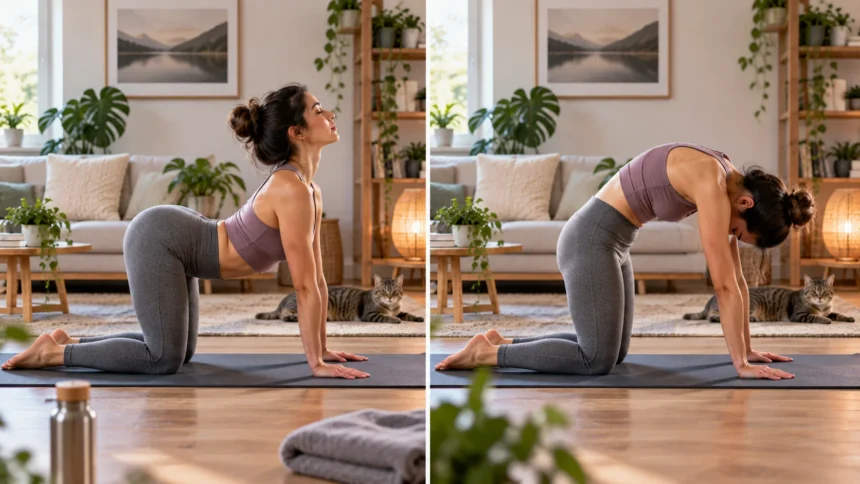
The cat cow stretch is a simple mobility exercise that gently moves the spine through flexion and extension. Often used in yoga, warm-ups, and rehabilitation routines, it can help you become more aware of how your back, pelvis, shoulders, and breathing move together. The exercise requires no equipment and can be performed almost anywhere with enough floor space.
Although cat cow looks easy, performing it slowly makes a significant difference. The goal is not to force the spine into the deepest possible arch or rounded position. Instead, you move gradually between two comfortable shapes while coordinating the movement with your breath and keeping your shoulders, hips, and neck relaxed.
Cat cow can be useful for people who spend long periods sitting, exercise regularly, or simply want a gentle way to improve spinal movement. It may also help prepare the body for other mobility exercises, yoga poses, and strength training. Proper technique and a comfortable range of motion are more important than trying to stretch aggressively.
What Is the Cat Cow Stretch?
Cat cow is a dynamic stretch performed on your hands and knees. The movement alternates between rounding the spine upward, known as the cat position, and gently arching the back while lifting the chest, known as the cow position. Moving continuously between these positions creates controlled motion through several regions of the spine.
During the cat phase, you gently tuck the pelvis, draw the abdomen inward, and allow the middle and upper back to round. During the cow phase, the pelvis tips in the opposite direction while the chest opens and the spine moves into extension. The neck follows the movement naturally instead of being forced dramatically upward or downward.
Because the exercise combines several joints and muscle groups, cat cow is often used as a general mobility drill rather than an isolated stretch. It encourages movement through the neck, thoracic spine, lower back, shoulders, and pelvis. The amount of motion will differ between individuals depending on flexibility, posture, and comfort.
How to Do the Cat Cow Stretch Correctly
Begin on your hands and knees with your wrists approximately underneath your shoulders and your knees underneath your hips. Spread your fingers comfortably and distribute pressure through your hands rather than collapsing into your wrists. Keep your spine in a neutral position and allow your head to remain aligned with your torso.
As you exhale, gently tuck your tailbone and round your back toward the ceiling. Let your head lower naturally as your upper back expands, but avoid aggressively pulling your chin into your chest. Think about creating a smooth curve through the entire spine while keeping the movement controlled and comfortable.
As you inhale, slowly move into cow by tipping the pelvis backward, allowing the abdomen to lower slightly, and lifting your chest forward. Keep your shoulders away from your ears and look slightly ahead rather than throwing your head backward. Continue alternating between the two positions for several slow, relaxed repetitions.
What Muscles Does Cat Cow Stretch?
Cat cow involves muscles throughout the back and trunk rather than targeting one isolated area. As the spine moves into flexion and extension, muscles around the spinal column lengthen and shorten in a coordinated way. The abdominal muscles also participate by helping control the pelvis and trunk during the rounded cat position.
The shoulders and upper back contribute because your arms remain supported against the floor throughout the exercise. Muscles around the shoulder blades stabilize the upper body while the thoracic spine moves. You may also feel gentle movement through the chest and rib cage, particularly when you breathe deeply during each phase.
The hips and pelvic region contribute as well because the pelvis tilts forward and backward with each repetition. This movement helps connect spinal mobility with hip positioning. Rather than thinking of cat cow as a back-only stretch, it is more useful to view it as a coordinated whole-trunk mobility exercise.
Key Benefits of the Cat Cow Stretch
One of the main benefits of cat cow is gentle spinal mobility. Sitting, driving, studying, or working at a computer can leave the back feeling stiff after several hours in a relatively fixed position. Slowly moving between flexion and extension gives the spine an opportunity to move through a comfortable range without requiring intense stretching.
The exercise can also improve body awareness. You begin to notice how your pelvis, rib cage, shoulders, and neck influence one another during movement. This awareness can be useful during yoga, strength training, or everyday activities because better control often makes it easier to recognize unnecessary tension or compensation.
Cat cow may also feel relaxing because it encourages slow breathing and controlled movement. Many people use it at the beginning or end of a mobility routine to reduce the sensation of stiffness. It should not be treated as a cure for back pain, but it can be a useful movement option when performed comfortably.
Can Cat Cow Help Improve Back Mobility?
Cat cow moves the spine repeatedly between flexion and extension, which can help maintain comfortable movement in people who feel stiff after sitting. The thoracic spine, or middle and upper back, often benefits from regular movement because daily activities can keep this region relatively static. Gentle repetition may help the back feel less restricted.
The exercise can also help you identify which parts of your spine move easily and which areas feel more limited. Some people create most of the movement through the lower back while barely moving the upper spine. Slowing down and focusing on segment-by-segment motion may help distribute movement more evenly.
However, mobility depends on more than one exercise. Hip flexibility, shoulder movement, muscle strength, activity levels, and individual anatomy all influence how your back feels. Cat cow works best as part of a broader routine that includes comfortable walking, strength training, and other mobility exercises suited to your needs.
Cat Cow for Neck and Shoulder Mobility
Your neck should move naturally with the rest of your spine during cat cow. In the rounded cat position, the head gently lowers, while the cow position allows the gaze to move slightly forward. The movement should remain smooth rather than forcing the neck into extreme flexion or extension.
The shoulders also receive gentle movement because your upper back changes position while your hands remain planted. Keeping the shoulders away from the ears can prevent unnecessary tension. As you move into cow, think about opening the chest rather than simply squeezing the shoulder blades together as hard as possible.
If your neck or shoulders already feel irritated, use a smaller range of motion. You can keep your gaze toward the floor instead of moving the head through the full sequence. Persistent pain, weakness, numbness, or tingling should be assessed professionally rather than repeatedly stretched in an attempt to make the symptoms disappear.
How Cat Cow Supports Pelvic and Core Awareness
The pelvis plays an important role in the cat cow stretch because it initiates much of the movement. During cat, the pelvis gently tucks under, while during cow it tips in the opposite direction. Learning to control these motions can improve awareness of how the pelvis and lower spine interact during everyday movement.
Breathing adds another useful layer. Slow inhalation and exhalation can help you notice how the abdominal wall and pelvic region respond as pressure changes through the trunk. This makes cat cow a gentle movement sometimes included within broader mobility or pelvic health programs, depending on individual needs.
Pelvic rehabilitation can involve many different approaches based on the underlying problem. Some people may also encounter tools such as vaginal dilators within professionally guided pelvic health care, but these serve a very different purpose from cat cow. Neither approach should be assumed appropriate without understanding the specific symptoms involved.
Breathing Technique During Cat Cow
Breathing helps create a steady rhythm during cat cow. A common pattern is to exhale while moving into the rounded cat position and inhale while moving into cow. This naturally matches the way the rib cage changes shape as the spine flexes and extends, making the exercise feel smoother.
Avoid holding your breath while trying to increase the range of motion. Breath-holding often creates additional tension through the neck, shoulders, and abdomen. Slow breathing can encourage you to move gradually rather than rushing from one position to the next, which usually improves both control and comfort.
There is no need to make each breath extremely long. Use a rhythm that feels natural and sustainable. If you become dizzy or uncomfortable, return to normal breathing and stop the exercise until you feel settled rather than continuing simply to complete a predetermined number of repetitions.
Common Cat Cow Mistakes to Avoid
One common mistake is forcing the lower back into an exaggerated arch during cow. More extension is not automatically better, especially if most of the movement is coming from one sensitive region. Aim for a smooth curve through the spine and stop before the position creates pinching or discomfort.
Another mistake is moving too quickly. Cat cow is most useful when you have enough time to coordinate the pelvis, spine, shoulders, neck, and breathing. Rapid repetitions can turn it into a mechanical motion and make it harder to notice which areas are actually moving or compensating.
Allowing the shoulders to shrug toward the ears is also common. Keep gentle pressure through your hands and create space between your shoulders and ears. If wrist discomfort makes this difficult, you can modify the position by using fists, supportive wedges, or another professionally recommended variation.
How Many Cat Cow Repetitions Should You Do?
For a general mobility routine, 6 to 10 slow repetitions can be a comfortable starting point. Each full movement from cat to cow counts as one cycle. You do not need dozens of repetitions to benefit, especially if you are moving deliberately and breathing throughout the exercise.
Some people prefer to perform cat cow for time rather than counting repetitions. Thirty to sixty seconds of controlled movement may fit easily into a morning routine, workout warm-up, or short movement break. The ideal amount depends on your comfort, mobility, and what other exercises you plan to perform.
More repetitions are not necessarily better if your technique begins to deteriorate. Stop when the movement becomes uncomfortable or when you notice yourself forcing the range. Consistency over several days or weeks is usually more useful than performing a very large number of repetitions in one session.
When Is the Best Time to Do Cat Cow?
Cat cow can work well in the morning if your back feels stiff after sleeping. A few gentle repetitions can help you begin moving without immediately jumping into deep stretches or demanding exercise. Keep the range small initially if your body feels particularly tight when you first get out of bed.
It is also commonly used before workouts because it can help prepare the trunk for movement. Strength training, yoga, Pilates, and general fitness routines may all include cat cow within the warm-up. It should complement more activity-specific preparation rather than replace every other warm-up exercise.
Evening mobility sessions are another good option. Slow cat cow repetitions combined with comfortable breathing can create a simple transition away from prolonged sitting or screen time. The best time is ultimately the time when you can perform it consistently without rushing or forcing the movement.
Cat Cow Stretch Modifications for Beginners
If kneeling on the floor feels uncomfortable, place a folded towel or exercise mat underneath your knees. Extra cushioning can make the position easier without changing the movement itself. You can also keep the spinal motion smaller until you become more comfortable coordinating the pelvis and upper body.
People with wrist discomfort can try placing their hands on yoga blocks or using closed fists if that feels better. Another option is performing a similar spinal flexion and extension movement while seated in a chair. A seated variation can be useful when getting onto the floor is difficult or inappropriate.
Beginners should focus on control rather than flexibility. You do not need to create a dramatic arch or round shape for the exercise to be useful. Start with a comfortable range, notice how your body responds, and gradually increase movement only when it remains smooth and pain-free.
When Should You Avoid or Modify Cat Cow?
Stop the exercise if it creates sharp back pain, significant neck pain, numbness, tingling, or weakness. These symptoms are different from a mild stretching sensation or general stiffness. Continuing to force movement through neurological or severe pain can make it harder to identify the underlying problem.
People recovering from spinal surgery, significant injury, or certain medical conditions may need individualized guidance before performing repeated spinal flexion and extension. Pregnancy can also change how comfortable the movement feels as the abdomen grows. A healthcare professional can suggest modifications suited to your circumstances.
If you experience persistent back pain, do not assume cat cow will correct the cause. Back discomfort can involve muscles, joints, discs, nerves, or other structures, and treatment depends on the underlying issue. Gentle movement may still be appropriate, but assessment is useful when symptoms are severe, worsening, or long-lasting.
Mobility Tips to Get More From Cat Cow
Move from the pelvis first instead of thinking only about your upper back. Initiating the movement with a small pelvic tilt can help the rest of the spine follow more naturally. This often produces a smoother sequence than trying to force the shoulders and head into position first.
Keep your weight relatively balanced between your hands and knees. Shifting excessively backward or forward can change the exercise and create unnecessary pressure. A stable base lets you concentrate on spinal movement rather than repeatedly adjusting your hands or hips during every repetition.
Finally, combine cat cow with complementary mobility exercises when appropriate. Gentle thoracic rotations, child’s pose variations, hip mobility drills, and walking can create a more complete routine. Mobility improves most effectively when movements are chosen for your needs rather than collecting as many stretches as possible.
Conclusion
The cat cow stretch is a simple way to move the spine, pelvis, shoulders, and trunk through a gentle, coordinated range of motion. It can fit easily into morning mobility, workout warm-ups, yoga routines, or short movement breaks. No equipment is required beyond a comfortable surface.
Good form means moving slowly, breathing naturally, and avoiding exaggerated positions. Keep your shoulders relaxed, allow the pelvis to guide the movement, and let the neck follow the spine without forcing it. A few controlled repetitions are usually more useful than rushing through a large number.
Cat cow can support mobility and body awareness, but it should not be expected to treat every cause of back or neck pain. Modify the exercise when needed and stop if symptoms become sharp, neurological, or concerning. Persistent pain is better assessed professionally rather than managed through stretching alone.
FAQs
What is the cat cow stretch good for?
Cat cow gently moves the spine through flexion and extension while involving the pelvis, shoulders, and core. It can support general mobility, body awareness, and comfortable movement after long periods of sitting.
How long should I do cat cow?
About 6 to 10 slow repetitions or 30 to 60 seconds can be a practical starting point. Focus on smooth breathing and controlled motion rather than trying to perform as many repetitions as possible.
Can cat cow help lower back stiffness?
Cat cow may help some people move a stiff lower back more comfortably, especially after prolonged sitting. However, persistent or significant back pain can have many causes and may require professional evaluation.
Should cat cow hurt?
No. You may feel gentle stretching or movement through the spine, but sharp pain, numbness, tingling, or significant discomfort are reasons to stop and modify the exercise or seek professional advice.
Can beginners do cat cow every day?
Yes, many beginners can perform gentle cat cow movements regularly if they remain comfortable. Start with a small range of motion and reduce frequency or intensity if the exercise consistently increases soreness.