
Boil Stages: Pictures, Symptoms & Healing Process
Boils are painful, pus-filled skin infections that usually begin around a hair follicle and gradually change in appearance as inflammation develops, pus collects, drainage occurs, and the skin heals. Medically known as furuncles, boils can appear almost anywhere hair grows, although the face, neck, armpits, thighs, groin, and buttocks are common locations. Early boils may resemble pimples, ingrown hairs, or insect bites, making them difficult to identify from pictures alone. Over several days, the bump often becomes larger, increasingly tender, and filled with pus before developing a white or yellow center. Many small boils eventually drain naturally and heal with simple home care. Larger, recurrent, rapidly worsening, or unusually painful boils may require professional drainage or other medical treatment.
Understanding boil stages can help people recognize whether a skin infection appears to be progressing normally or showing signs that need medical attention. A typical boil may move from a small tender spot to a firm swollen lump, then develop a pus-filled center before opening and draining. Once drainage occurs, pressure and pain often decrease as new tissue gradually closes the wound. However, boils do not always follow a perfectly predictable timeline, and conditions such as cysts, hidradenitis suppurativa, acne, folliculitis, and deeper skin abscesses can resemble them. Squeezing or cutting a boil at home can push infection deeper or spread bacteria to surrounding tissues. Observing the overall pattern while using appropriate wound care is safer than trying to force the boil into its next stage.
What Is a Boil?
A boil is a bacterial infection involving a hair follicle and the surrounding skin tissue. Most boils are associated with Staphylococcus aureus, a bacterium that commonly lives harmlessly on the skin or inside the nose but can cause infection when it enters damaged tissue. Small cuts, shaving irritation, insect bites, friction, or breaks in the skin barrier can create opportunities for bacteria to enter. As the immune system responds, white blood cells, bacteria, damaged cells, and fluid collect beneath the skin and form pus. This creates the characteristic painful lump associated with a boil. Mayo Clinic describes boils as painful, pus-filled bumps that develop when one or more hair follicles become infected and inflamed. (Mayo Clinic)
A boil is also known medically as a furuncle, while several connected boils can form a deeper infection known as a carbuncle. A single furuncle usually begins around one group of infected follicles, whereas a carbuncle can involve several openings and a larger area beneath the skin. Carbuncles are often more painful and more likely to cause fever, chills, or a general feeling of illness than a small isolated boil. They may also leave more noticeable scars because the infection extends deeper into surrounding tissue. Someone with several connected boils should generally seek medical evaluation rather than treating the entire area like a simple pimple. Professional drainage or antibiotics may sometimes be necessary depending on severity.
Boils are particularly common in areas exposed to sweat, pressure, friction, or frequent shaving. The back of the neck, face, armpits, thighs, groin, and buttocks are typical locations, but a boil can theoretically develop around almost any hair follicle. Tight clothing, repeated rubbing, or prolonged moisture can irritate follicles and make the skin barrier easier to penetrate. People who frequently shave may also confuse early boils with razor bumps or ingrown hairs. Although the appearance can initially be similar, a boil generally becomes progressively more painful, swollen, and filled with pus. An ordinary razor bump often remains much smaller and resolves without developing a deep tender pocket.
Anyone can develop an occasional boil, but certain factors can make them more likely. Diabetes can impair the body’s ability to fight infection, while eczema and other skin conditions can create cracks that allow bacteria to enter. A weakened immune system, close contact with someone who has a staph infection, obesity, and repeated friction in skin folds may also increase risk. Recurrent boils sometimes occur when people repeatedly carry Staphylococcus aureus on their skin or in the nose. If boils return frequently, a healthcare professional may consider bacterial cultures or other strategies rather than repeatedly treating each lump independently. Identifying contributing conditions can become more important than focusing only on individual outbreaks.
A boil is different from an ordinary whitehead because the infection generally extends deeper beneath the skin. Pimples usually involve blocked pores and may contain oil, dead skin cells, and bacteria near the surface. A boil often begins as a firm, deeply tender area before a visible white or yellow center appears. As pus accumulates, pressure increases and the surrounding skin becomes swollen and warm. This progressive deep tenderness is one reason boils can become much more uncomfortable than routine acne. Still, appearance alone is imperfect, especially during the earliest stage. A dermatologist or other healthcare professional can evaluate persistent or unusual bumps when the diagnosis remains unclear.
Stage 1: Early Boil Formation
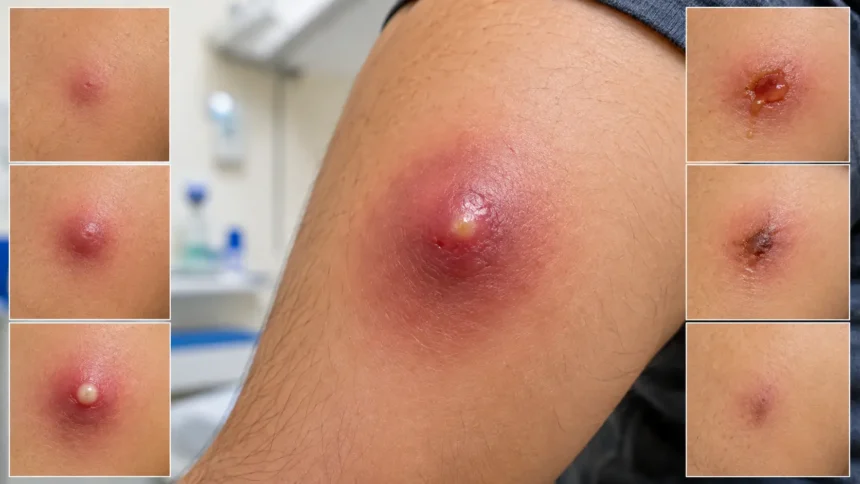
The first stage of a boil often begins as a small tender, itchy, or sensitive spot. The skin may look pink, red, purple, brownish, or darker than the surrounding area depending on natural skin tone. At this stage, there may be no visible pus and the bump can look almost identical to a pimple or irritated hair follicle. The area may feel firmer beneath the skin than it appears from the surface. Some people notice discomfort before seeing a clearly defined lump. NHS guidance notes that a boil may initially start as an itchy or tender area before becoming a painful pus-filled lump. These subtle beginnings explain why many early boil pictures are difficult to distinguish from other skin conditions.
As inflammation increases, the bump usually becomes more clearly raised and tender. The immune response sends cells and fluid toward the infected follicle, creating swelling around the site. Touching the area may feel uncomfortable even when the bump remains relatively small. The surrounding skin can also feel warmer than unaffected areas because local blood flow and inflammation have increased. At this point, squeezing is particularly unhelpful because there may not yet be a well-formed pocket of pus to release. Pressure can instead damage surrounding tissue and potentially push bacteria deeper. Warm compresses are generally a safer method for encouraging the natural healing process.
Early boils often grow over several days rather than appearing fully formed within minutes. A pea-sized bump may gradually enlarge as pus and damaged tissue accumulate beneath the surface. Mayo Clinic notes that boils can grow to more than two inches, or approximately five centimeters, although many remain much smaller. Rapid enlargement can make the skin feel stretched or throbbing. Pain can intensify because swelling increases pressure on surrounding nerve endings. A growing boil does not always mean that something has gone wrong, but extremely rapid expansion, severe pain, or spreading redness deserves greater attention. These changes can indicate a larger abscess or infection involving surrounding skin.
The earliest stage is also when people frequently mistake boils for ingrown hairs. An ingrown hair develops when a hair curls back into the skin and causes a small inflamed bump, usually after shaving or hair removal. A visible trapped hair may sometimes be present. A boil, by comparison, tends to become deeper, hotter, more painful, and progressively more swollen as infection develops. An ingrown hair can itself become infected and evolve into something resembling a boil, so the categories can overlap. Digging into the skin with needles or tweezers is therefore risky when the cause is uncertain. Keeping the area clean and reducing friction is generally safer.
Pictures of early boils should be interpreted carefully because skin color and lighting can dramatically change their appearance. On lighter skin, inflammation may appear bright red or pink, while on darker skin the area may appear purple, grayish, dark brown, or simply deeper in tone than surrounding tissue. Swelling, warmth, tenderness, and progressive enlargement can therefore be more informative than searching only for redness. A photograph also cannot show how deep the lump feels or whether it is becoming more painful. People comparing their skin with online pictures should focus on the overall symptom pattern rather than expecting an exact visual match.
Stage 2: The Boil Fills With Pus
As the boil progresses, immune cells, bacteria, and damaged tissue collect within the infected area and form pus. The lump usually becomes softer in the center while remaining firm and swollen around the edges. Pressure may build beneath the skin, causing throbbing or increasing pain. MedlinePlus describes boils as becoming more painful as they fill with pus and dead tissue. The skin may look increasingly stretched and shiny over the center. This is often the stage when a previously unclear bump begins to look more recognizably like a boil. The surrounding area can also become warm and tender, reflecting continued inflammation around the infected follicle.
A white or yellow center commonly develops as pus approaches the surface. People sometimes refer to this appearance as the boil “coming to a head.” The center may look similar to a large whitehead, but the infected pocket underneath can be much deeper than an ordinary acne lesion. Several small points may appear if multiple nearby follicles are involved. The yellow-white appearance comes from pus visible beneath thin surface skin rather than from a foreign object that needs to be manually extracted. This distinction is important because people often feel tempted to squeeze the boil as soon as the center becomes visible. Doing so can increase tissue injury and spread bacteria rather than speeding safe healing.
Pain may reach its highest level during the pus-filled stage because the closed pocket creates pressure inside the surrounding tissue. Activities that compress the area, such as sitting on a boil on the buttock or moving an arm against an armpit boil, can become particularly uncomfortable. Clothing friction can also worsen sensitivity. A boil located near a joint may feel painful with movement even when the joint itself is not infected. Warm compresses can provide comfort and may encourage natural drainage by improving local conditions around the skin. Mayo Clinic recommends warm, moist compresses for around ten minutes several times daily for small uncomplicated boils.
Not every pus-filled boil will open immediately after a white or yellow tip becomes visible. Some remain closed for several days before draining, while others gradually shrink without producing dramatic external drainage. Larger abscesses may contain pus too deep beneath the skin to empty completely on their own. Attempting to pierce these lesions with a pin, knife, or needle creates an uncontrolled wound and introduces additional bacteria. A healthcare professional can determine whether incision and drainage is necessary and can perform the procedure using appropriate sterile technique. Deep or large boils should therefore not be treated like oversized pimples.
A pus-filled boil also requires monitoring for surrounding cellulitis, an infection of nearby skin tissue. Increasing warmth, rapidly spreading swelling, severe tenderness, or redness extending away from the original lump can suggest that infection is moving beyond the central pocket. Fever, chills, or feeling generally ill may also appear with more significant infections. A small localized boil usually does not make an otherwise healthy person severely unwell. Systemic symptoms therefore deserve attention rather than being treated as a routine stage of maturation. People with diabetes or weakened immunity should be especially cautious because skin infections can progress more quickly or become harder to control.
Stage 3: The Boil Ruptures and Drains
Many uncomplicated boils eventually open naturally and begin releasing pus. This occurs when pressure inside the abscess and breakdown of overlying tissue create an opening through which fluid can escape. The drainage may initially be thick, yellow, cream-colored, or slightly greenish and can contain a small amount of blood. Once pressure decreases, pain often improves noticeably. MedlinePlus notes that discomfort commonly decreases after a boil drains. The area may remain tender because inflammation and damaged tissue are still present, but the intense tight or throbbing sensation often begins to ease. Natural drainage is generally preferable to trying to force the boil open prematurely.
A draining boil can continue releasing fluid intermittently rather than emptying all at once. Small amounts of pus or blood-stained fluid may appear on gauze for a period after the initial rupture. This does not necessarily mean infection is worsening if swelling, pain, and redness are steadily decreasing. The opening should be kept clean and covered so contaminated drainage does not spread to clothing, bedding, or other skin areas. Hands should be washed thoroughly before and after changing the dressing. Used gauze should be disposed of appropriately rather than left where another person could contact the drainage.
Squeezing after the boil opens is still discouraged. Pressing around the wound may appear to remove additional pus, but it can traumatize surrounding tissues and potentially push infected material into deeper spaces. Gentle cleansing and allowing drainage to occur naturally is generally safer. If a boil remains very swollen or painful despite opening, a deeper pocket may still be present. A clinician can evaluate whether formal incision and drainage is required. Some abscesses contain internal pockets that do not empty through a small spontaneous opening. In these situations, professional treatment can reduce infection more effectively than repeated home squeezing.
Drainage should usually be accompanied by gradual improvement rather than continued deterioration. The lump should begin becoming smaller, pressure should lessen, and the surrounding skin should slowly become less inflamed. Pus that continues heavily for several days, a worsening odor, expanding redness, increasing pain, or fever may indicate persistent or spreading infection. Thick drainage itself is expected from an abscess, so color alone is not enough to judge severity. The trend matters more. A wound that looks progressively cleaner and less swollen is behaving differently from one that becomes increasingly painful and inflamed despite drainage.
Once pus begins coming out, hygiene becomes particularly important because Staphylococcus aureus can spread through direct contact and contaminated objects. Towels, washcloths, razors, clothing, or bedding that contact the drainage should not be shared. NHS guidance advises covering draining boils with gauze or a dressing until they heal and regularly washing towels and bedding. Swimming pools and gyms may also create opportunities for transmission when an uncovered draining lesion contacts shared surfaces. Keeping the wound covered protects both the person with the boil and people around them. The dressing should be replaced whenever it becomes wet, dirty, or saturated.
Stage 4: Healing After a Boil Drains
Healing begins once the infected pocket has emptied and the body’s inflammatory response starts resolving. The open area may initially look like a small crater or raw spot where the pus escaped. New tissue gradually fills the space from beneath while the edges begin closing. Swelling should steadily decrease, and the skin should become less warm and painful. A small amount of clear or lightly blood-stained fluid may occasionally appear during early wound healing. The most important sign is gradual improvement. If the area becomes more swollen after initially shrinking, another pocket of infection could be developing and should be evaluated.
A crust or scab may develop over the opening as drainage decreases. This protective layer helps shield the healing tissue beneath it. Picking the scab can reopen the wound, increase bleeding, introduce bacteria, and potentially make scarring more noticeable. The area should instead be kept clean and protected according to ordinary wound-care principles. Harsh antiseptics or repeated scrubbing can irritate newly forming tissue and delay healing. People sometimes believe a strong burning disinfectant is necessary to “kill everything,” but healthy healing tissue can also be damaged by aggressive chemicals. Gentle cleansing and appropriate dressings are usually more useful.
Many uncomplicated boils complete the major part of their healing process within approximately one to two weeks, although larger or deeper infections may take longer. MedlinePlus notes that boils often need to open and drain to heal and that this commonly happens within about two weeks. The exact timeline depends on boil size, location, immune health, whether professional drainage was needed, and whether surrounding infection developed. A boil that has not improved after roughly two weeks deserves medical attention. Persistent lumps may represent an undrained abscess, cyst, hidradenitis lesion, or another condition rather than a straightforward resolving furuncle.
Temporary discoloration may remain after the infection itself has healed. On lighter skin, the area may look pink or reddish for a period, while darker skin can develop brown, purple, or grayish post-inflammatory pigmentation. This color change does not necessarily mean bacteria are still present. Pigmentation can persist considerably longer than pain or swelling because skin pigment responds to inflammation and takes time to normalize. Larger boils may also leave small scars, especially when the infection extended deeply or the lesion was repeatedly squeezed. Avoiding picking and protecting healing skin from unnecessary injury may reduce additional scarring.
A healed boil should no longer be actively draining, increasingly painful, hot, or swollen. Some firmness may persist temporarily as inflammation resolves, but the overall area should continue getting smaller. If a supposedly healed spot repeatedly fills again, there may be an underlying cyst, chronic infection, or condition such as hidradenitis suppurativa. Recurrent boils in the same location deserve more attention than isolated episodes. A healthcare professional may obtain a culture, assess for bacterial carriage, review underlying conditions, or recommend different treatment. Repeatedly draining the same lump without determining why it returns can allow a chronic problem to continue unnecessarily.
Boil Symptoms and What Pictures May Show
The most recognizable boil symptom is a painful raised lump that becomes progressively larger as pus accumulates. Early pictures may show only swelling or discoloration, while later images commonly reveal a yellow-white center. The skin surrounding the lump may appear inflamed and slightly swollen. Some boils reach only the size of a pea, while others become significantly larger. MedlinePlus notes that a boil can range from a small bump to a lesion approaching golf-ball size. Size alone does not determine severity, but rapidly increasing diameter combined with intense pain or fever is more concerning than a small stable boil.
Pain commonly changes throughout the boil healing process. Early discomfort may feel like tenderness when the area is touched. As pus builds, the sensation can become throbbing, sharp, or pressure-like and may remain uncomfortable even without direct contact. After the boil drains, pain often decreases substantially because internal pressure has been relieved. This characteristic change can provide more information than a single photograph. A bump that looks relatively small but produces severe or rapidly worsening pain may still require evaluation. Conversely, a healing lesion may remain visually discolored despite becoming much less tender.
Itching can occur before or during boil formation, although it is less widely recognized than pain. MedlinePlus describes itching as a possible symptom before the boil develops. Itching alone is not enough to identify a boil because eczema, insect bites, folliculitis, allergic reactions, and many other skin problems also itch. A progression from localized itchiness to a firm painful swelling that develops pus is more characteristic. Scratching should be avoided because fingernails can damage the skin barrier and potentially introduce additional bacteria. Keeping nails clean and minimizing repeated touching can help reduce contamination.
A boil may leak pus spontaneously after the center becomes thin enough to open. Pictures at this stage can show yellow drainage, blood-stained fluid, an open central wound, or crusting around the edges. These images can look alarming, but drainage is often part of the normal resolution process. What matters is whether swelling and pain decrease afterward. Increasing drainage accompanied by spreading redness, fever, or worsening pain is different from a shrinking boil that continues to release a small amount of fluid. Static online pictures cannot show this progression, which is why understanding the timeline matters more than matching one photograph.
Systemic symptoms are less typical with a small uncomplicated boil but can occur with larger infections or carbuncles. Fever, chills, fatigue, or feeling generally unwell may indicate that the immune response is more extensive. Mayo Clinic notes that carbuncles are more likely than single boils to cause fever and chills. Swollen lymph nodes may occasionally accompany nearby bacterial infection as well. These symptoms deserve more caution, particularly when they occur with rapidly spreading skin inflammation. Someone who feels significantly sick should not assume the boil simply needs more time to “come to a head.” Medical evaluation may be appropriate before the infection progresses further.
Boil vs Pimple, Cyst, Abscess and Ingrown Hair
Pimples and boils can look similar because both may develop a white or yellow center. Acne, however, usually begins with blocked pores containing oil and dead skin cells, while a boil is a deeper bacterial infection involving a hair follicle and surrounding tissue. Pimples are often smaller and may occur in clusters with blackheads or other acne lesions nearby. Boils tend to become increasingly tender, warm, and swollen over several days. The pain is often deeper than that produced by an ordinary pimple. A large acne nodule can still resemble a boil closely, so persistent facial lesions should be evaluated when the distinction affects treatment.
An ingrown hair develops when a hair grows sideways or curls back into the skin. The resulting bump may be itchy, tender, or inflamed and is especially common after shaving, waxing, or other hair removal. Sometimes the trapped hair is visible beneath the surface. A boil may begin similarly but usually becomes progressively more swollen and filled with pus as infection extends deeper around the follicle. Ingrown hairs can become secondarily infected, which can blur the distinction even further. Digging into either lesion with needles or tweezers can worsen inflammation and introduce bacteria, making conservative care safer when the exact cause is uncertain.
Epidermoid cysts are another common source of confusion. These slow-growing lumps develop beneath the skin and may contain keratin rather than pus from a bacterial infection. A cyst may exist painlessly for months or years before suddenly becoming inflamed. When an inflamed cyst becomes red, swollen, and tender, it can look almost identical to a boil. However, the underlying cyst wall may remain after drainage and allow the lump to return. Recurrent swelling in exactly the same location is one clue that a cyst could be involved. A dermatologist can determine whether removal of the cyst wall is necessary once acute inflammation has settled.
The terms boil and skin abscess also overlap. A boil is essentially an abscess that begins around a hair follicle, while a skin abscess can develop for additional reasons such as wounds, injections, or infections unrelated to an obvious follicle. Both involve pockets of pus and may require drainage when large. MedlinePlus describes skin abscesses as collections of pus in or on the skin caused commonly by bacterial infection. Clinically, treatment decisions often depend more on the size, depth, location, and presence of surrounding infection than on whether the pocket is specifically labeled a boil or another type of abscess.
Hidradenitis suppurativa can be repeatedly mistaken for ordinary boils because it causes painful deep nodules and abscesses, particularly in the armpits, groin, beneath the breasts, or between the buttocks. Unlike isolated furuncles, hidradenitis tends to recur in characteristic areas and may eventually produce tunnels beneath the skin or permanent scarring. People sometimes spend years treating each lesion as an individual boil without recognizing the chronic pattern. Repeated painful lumps in body folds deserve evaluation, especially when they leave scars or develop multiple draining openings. Hidradenitis is not caused simply by poor hygiene, and its treatment differs from standard care for an occasional boil.
How to Treat a Boil at Home
Small uncomplicated boils can often be managed at home with warm compresses and careful hygiene. A clean cloth soaked in warm, comfortable water can be held against the area for approximately ten minutes several times a day. Mayo Clinic and NHS guidance recommend this approach because warmth can reduce discomfort and encourage the boil to drain naturally. The compress should be warm rather than hot enough to burn the skin. A fresh clean cloth should be used, particularly when the boil has started draining. Regular gentle warmth is safer than attempting to force the pus out mechanically.
Squeezing, piercing, cutting, or lancing a boil at home should be avoided. Pressure can push infected material deeper or spread bacteria into nearby tissue. Homemade incision attempts can also damage blood vessels, nerves, or surrounding structures, depending on the boil’s location. Facial boils deserve particular caution because infection in certain facial areas can potentially spread to deeper structures. A healthcare professional performing incision and drainage uses sterile technique and chooses the opening based on the abscess anatomy. The fact that an infected lump looks ready to pop does not make a kitchen needle or razor an appropriate medical instrument.
Once a boil begins draining, gently clean the surrounding skin and cover the wound with sterile gauze or another clean dressing. The dressing helps absorb drainage and limits contact between infected fluid and other people or surfaces. Replace it whenever it becomes wet or dirty. Hands should be washed before and after handling the wound. Clothing or bedding contaminated with pus should be washed appropriately and should not be shared. Good hygiene is particularly important in households where several people live closely together because staph bacteria can spread through direct contact and shared personal items.
Pain can often be managed with appropriate over-the-counter medication when the person can safely take it. Paracetamol, also known as acetaminophen, or an anti-inflammatory medicine such as ibuprofen may help depending on individual health conditions and local medication guidance. People with kidney disease, stomach ulcers, blood-thinning medication, pregnancy, or other health considerations should verify which pain reliever is appropriate. Medication treats discomfort but does not drain the abscess. Increasing pain despite appropriate home care may indicate that pressure continues building or infection is spreading. In that situation, repeatedly taking more pain medicine is less useful than having the lesion assessed.
Home care should produce an overall trend toward improvement. The boil may initially become larger before drainage occurs, but pain and swelling should decline afterward. A small boil that never drains yet gradually shrinks can also resolve normally. What should not happen is continued rapid enlargement, spreading inflammation, increasing fever, or severe illness. Keeping a brief record or photo can make changes easier to notice over several days. Home treatment is intended for small uncomplicated lesions in otherwise well people, not for every abscess regardless of size, location, or medical history.
When a Boil Needs Medical Treatment
A boil should be medically evaluated when it rapidly worsens, becomes extremely painful, continues enlarging despite home care, or fails to heal within approximately two weeks. Mayo Clinic recommends seeking care for boils that worsen quickly, become very painful, cause fever, grow despite self-care, recur, or fail to heal within two weeks. These situations raise the possibility that natural drainage will not be sufficient. A clinician may examine the depth of the infection and decide whether incision and drainage is necessary. Waiting indefinitely for a very large abscess to rupture can prolong pain and allow infection to spread into surrounding tissue.
Boils on the face deserve particular caution. Mayo Clinic and NHS guidance both recommend medical evaluation for facial boils because infection in this area can sometimes involve important structures. A boil near the nose, upper lip, or eye should not be squeezed or punctured. Swelling affecting vision or the tissues around the eye deserves urgent medical attention. Facial skin infections can occasionally progress more seriously than an ordinary boil on the thigh or buttock. Even when complications remain uncommon, the potential consequences make conservative professional management more appropriate.
Fever, chills, rapidly spreading redness, severe warmth, or increasing swelling around a boil can indicate a more extensive infection. Cellulitis may develop when bacteria spread beyond the central abscess into surrounding skin. Rarely, bacteria can enter the bloodstream and cause serious systemic infection. Mayo Clinic notes that complications such as bloodstream infection, endocarditis, or bone infection can occur, although these outcomes are uncommon. Someone who feels significantly ill, confused, faint, or rapidly worse should seek urgent medical help rather than relying only on warm compresses. Serious infection can require antibiotics, drainage, and additional medical monitoring.
People with diabetes or compromised immunity should generally have a lower threshold for seeking care. Diabetes can impair circulation and immune defenses, while medications such as chemotherapy or certain steroids can reduce the body’s ability to contain infection. A small skin infection may therefore become more serious or heal more slowly in these individuals. The NHS specifically recommends urgent advice for people with boils who have weakened immune systems, including those with diabetes or certain medication exposures. People should disclose their medical history because it can influence whether antibiotics, culture testing, or closer follow-up is recommended.
Recurrent boils also deserve investigation. A clinician may collect pus for bacterial culture, particularly when infections repeatedly return or fail standard treatment. Culture results can identify Staphylococcus aureus, including resistant strains such as MRSA, and help determine which antibiotic is likely to work if medication is necessary. Household transmission, bacterial carriage in the nose, skin disease, diabetes, and hidradenitis suppurativa may also need consideration. Treating each boil independently without understanding why they recur can lead to repeated pain and antibiotic exposure. Long-term prevention often depends on identifying the underlying pattern rather than simply waiting for every lesion to drain.
How to Help Prevent Future Boils
Regular handwashing is one of the simplest ways to reduce the spread of bacteria responsible for many boils. Hands frequently contact the nose, skin, shared surfaces, and small cuts, providing numerous opportunities for bacteria to move between locations. Washing with soap and water after touching a boil or changing its dressing is particularly important. Alcohol-based hand sanitizer can also be useful when hands are not visibly dirty. People should avoid repeatedly touching or picking at healing areas because fingers can transfer bacteria in either direction. Basic hygiene is effective without requiring excessive scrubbing or harsh antibacterial products over the entire body.
Cuts, abrasions, and irritated skin should be cleaned and covered appropriately until the protective barrier heals. Bacteria are more likely to enter when skin is broken, which explains why boils can develop after small injuries, insect bites, shaving irritation, or eczema scratching. Moisturizing dry or eczema-prone skin can help reduce cracking when appropriate treatment is used. People who shave frequently should use clean equipment and avoid sharing razors. Repeatedly shaving directly over inflamed follicles can worsen irritation and spread bacteria. Replacing dull or contaminated blades can help protect the skin from unnecessary micro-injuries.
Personal items that contact skin should not be shared during an active boil infection. Towels, washcloths, razors, clothing, bedding, and athletic equipment can potentially carry staph bacteria. Mayo Clinic recommends avoiding shared personal items because staph infections can spread through contaminated objects as well as direct contact. Towels and bedding exposed to drainage should be washed appropriately. Shared gym equipment should be cleaned before and after use according to facility practices. An open draining boil should remain covered, and activities involving close skin contact may need to be avoided until the wound has healed.
Managing underlying health conditions can also reduce recurrence risk. Good diabetes management supports immune function and wound healing, while appropriate treatment for eczema reduces breaks in the skin barrier. People who develop repeated boils in areas of skin friction may benefit from discussing weight management, clothing, sweating, or hidradenitis with a healthcare professional. These issues should be approached as medical and mechanical factors rather than as evidence of poor cleanliness. Boils can occur in people with excellent hygiene because bacteria naturally live on human skin. Prevention focuses on reducing opportunities for infection rather than trying to sterilize the entire body.
Finally, people with frequent staph infections may occasionally need a clinician-directed decolonization strategy. Depending on the pattern, healthcare professionals may recommend specific antiseptic washes, nasal medication, household measures, or other approaches aimed at reducing recurrent bacterial carriage. These treatments should not be started randomly because unnecessary antimicrobial use can irritate the skin and contribute to resistance. Cultures and clinical history can help determine whether decolonization is appropriate. For most people with a single boil, simple hygiene and wound care are sufficient. Recurrent disease is the situation in which a more systematic prevention plan becomes particularly valuable.
Frequently Asked Questions About Boil Stages
What are the main stages of a boil?
A boil commonly begins as a small tender or itchy lump, becomes larger and increasingly painful as pus develops, forms a white or yellow center, then opens and drains before gradually healing. Not every boil follows the stages at exactly the same speed or develops an obvious white head.
How do you know when a boil is healing?
A healing boil should gradually become smaller, less painful, less swollen, and less warm after it drains. Drainage should decrease, the opening may crust over, and new skin should slowly close the area.
How long does a boil usually take to heal?
Many uncomplicated boils open and begin healing within about one to two weeks, although larger or deeper infections may take longer. A boil that has not healed after approximately two weeks or keeps becoming larger should be medically evaluated. (Mayo Clinic; MedlinePlus)
Should you squeeze a boil when it has a white head?
No. Squeezing, piercing, or cutting a boil yourself can push bacteria deeper into surrounding tissue and spread the infection. Warm compresses can encourage natural drainage, while large or persistent boils can be safely drained by a healthcare professional.
When should I worry about a boil?
Seek medical care if a boil is on the face, rapidly enlarges, becomes extremely painful, causes fever or chills, develops spreading redness or swelling, lasts longer than about two weeks, or repeatedly returns. People with diabetes or weakened immune systems should seek professional guidance earlier because skin infections can become more complicated.