
Vinegar Weed Killer: Does It Work & How to Use It
Vinegar weed killer has become a popular option for homeowners looking for a simple way to manage unwanted plants around patios, driveways, walkways, and garden edges. Its weed-killing ability comes primarily from acetic acid, the compound responsible for vinegar’s familiar sharp smell and acidic nature. When applied to foliage, acetic acid damages plant cells and causes leaves to dry out rapidly. However, vinegar is not a magic solution for every type of weed, and results depend heavily on weed age, concentration, weather, and application method. Young annual weeds are usually much easier to control than established perennial weeds with strong root systems. Understanding these limitations can help you use vinegar effectively instead of repeatedly spraying weeds that are likely to grow back.
Another important distinction is the difference between ordinary household vinegar and products specifically sold as acetic-acid herbicides. Grocery-store vinegar commonly contains around 5% acetic acid, while some commercial weed-control products contain substantially higher concentrations. Stronger does not automatically mean better for every homeowner because concentrated acetic acid can seriously injure skin and eyes and may damage nearby vegetation and surfaces. Current EPA information also emphasizes that higher concentrations carry greater safety concerns, so commercially formulated weed killers should always be used according to their labels. For many small home weed problems, careful spot treatment and prevention may be more practical than reaching immediately for the strongest available product.
The best approach is therefore to treat vinegar as one tool within a broader weed-management strategy. It can be useful for small seedlings appearing between paving stones or along gravel areas where desirable vegetation is absent. It is less dependable when the target is a mature dandelion, bindweed, thistle, or another perennial capable of regenerating from roots. Repeated treatment may weaken some persistent weeds, but digging, mulching, cultivation, or another properly labeled control method can sometimes be more effective. This guide explains how vinegar weed killer works, which weeds respond best, how to apply it more safely, and what common homemade recipes should be avoided. The goal is practical weed control without turning a simple garden task into a larger soil, plant, or safety problem.
Does Vinegar Weed Killer Really Work?
Yes, vinegar can kill weeds, but the answer is more accurately described as “it works under the right conditions.” Acetic acid acts as a contact herbicide, meaning it primarily damages the plant tissue directly touched by the spray. The foliage can begin wilting, discoloring, and drying relatively quickly after adequate coverage. Small annual weeds with limited root reserves may die because they lack enough stored energy to recover from severe leaf damage. Older plants are often less responsive because their larger roots, underground stems, or growing points can produce replacement foliage. This explains why someone may see impressive browning one day and fresh green shoots emerging from the same weed several weeks later.
Vinegar tends to work best on young weeds that have recently germinated and have only a small amount of foliage. Research summarized by University of Maryland Extension indicates that acetic-acid products are particularly effective against small annual broadleaf weeds, while established perennials and many grasses are harder to control completely. The same guidance notes that vinegar products are contact rather than systemic herbicides, so roots of established weeds may survive treatment. Timing therefore matters almost as much as the product itself. Treating weeds shortly after they appear generally requires less repeated effort than waiting until they have developed deeper roots, multiple stems, flowers, and seed heads.
Annual weeds are better targets because their life cycle depends heavily on completing growth and producing seed during a relatively short period. If young annual seedlings lose most of their active leaf tissue, they may not have enough stored energy to recover. Common small broadleaf weeds appearing in cracks, gravel, and disturbed garden areas may therefore respond reasonably well to vinegar-based treatments. Grassy weeds can be more difficult because their growing points and structure may allow them to recover after the exposed leaves are damaged. Mature weeds of almost any type become increasingly difficult as their root systems develop. For this reason, regular inspection and early spot treatment are more effective than waiting for a large weed infestation.
Perennial weeds present a much greater challenge because many store substantial energy below ground. Dandelions, Canada thistle, field bindweed, and other deep-rooted weeds can replace burned foliage from surviving crowns, taproots, rhizomes, or underground shoots. Vinegar may make these plants look dead temporarily without eliminating the underground structures responsible for regrowth. Repeated applications can sometimes reduce vigor, but they also require time, material, and careful avoidance of surrounding plants. Pulling or digging individual perennial weeds may be more efficient when their root systems can be removed successfully. In larger infestations, combining multiple weed-control strategies usually provides more durable results than expecting a single vinegar application to solve the entire problem.
Weather conditions also influence how well vinegar works after it reaches the leaves. Dry conditions help keep the treatment on the foliage instead of allowing rainfall or irrigation to wash it away shortly afterward. Warm, bright conditions often encourage rapid drying and visible injury, although product labels should always determine appropriate application conditions. Wind is undesirable because drifting droplets can injure flowers, vegetables, lawn grass, shrubs, and other plants you intended to keep. Extremely stressed or dormant weeds may also respond differently from small actively growing seedlings. Choosing a calm, dry period and treating weeds individually gives you much better control over where the vinegar lands and reduces unnecessary damage to the surrounding landscape.
How Vinegar Kills Weeds and Why They Sometimes Grow Back
The active weed-damaging component in vinegar is acetic acid. When adequate concentrations contact green plant tissue, the acid disrupts cell membranes and causes moisture to escape from the affected leaves. The tissue begins drying, producing the burned or wilted appearance commonly seen after treatment. Because the action occurs primarily where the liquid contacts the plant, complete leaf coverage generally produces stronger visible results than a light spray on one small section. This contact action can be useful when you want fast suppression of young weeds. However, visible leaf burn should not automatically be interpreted as complete plant death, particularly when the target has an established root system capable of supporting new growth.
Systemic herbicides work differently because their active ingredients can move through plant tissues and may reach growing points or roots. Vinegar does not provide the same type of dependable movement throughout established weeds, which is why top growth may die while underground structures remain alive. Oregon State University Extension similarly notes that horticultural vinegar functions primarily through contact activity and can struggle with perennial weeds because it does not reliably move into their root systems. This difference helps explain many mixed experiences reported by gardeners. Vinegar can produce dramatic visual results, yet the real test is whether the weed remains absent several weeks or months after the original foliage disappears.
Root reserves are particularly important when dealing with perennial weeds. A mature plant may have spent months or years storing carbohydrates underground, giving it the energy needed to replace damaged shoots. Burning the leaves removes some photosynthetic capacity, but it does not necessarily destroy the root or crown. When conditions improve, stored energy may be redirected into new shoots that emerge from the same location. Repeatedly removing young regrowth can eventually weaken certain weeds, although results vary considerably by species. If you know a weed spreads through deep roots or underground rhizomes, combine top-growth treatment with digging, persistent cutting, smothering, or another appropriate strategy rather than relying entirely on vinegar.
Vinegar also has little meaningful residual weed-control effect after application compared with products designed to prevent future germination. A seed lying in the soil may remain capable of sprouting after the originally treated plant has disappeared. This is why cracks and gravel areas can appear weed-free shortly after spraying yet produce another flush of seedlings later. Those are not necessarily the same weeds returning; they may be completely new plants germinating from the existing seed bank. Regular monitoring is therefore important if vinegar is your preferred control method. Treating new seedlings while they remain small is much easier than allowing each generation to become established and replenish the soil with additional seeds.
Preventing seed production can make vinegar-based weed management much more successful over the long term. Remove or treat young weeds before they flower and mature whenever practical. A single mature weed can contribute numerous seeds to the surrounding area, creating future work even after the parent plant is removed. Mulch, dense desirable plantings, hand weeding, and improved lawn health can help reduce the number of new seedlings that establish. Vinegar works best when used to manage occasional escapees rather than as the only defense against continuous weed germination. Combining prevention with early treatment can gradually reduce weed pressure and make routine maintenance much less demanding.
Household Vinegar vs. Horticultural Vinegar
Ordinary household vinegar generally contains about 5% acetic acid, although the exact concentration should be confirmed on the product label. At this level, vinegar can injure tender plant tissue and may control some very young seedlings when coverage and conditions are favorable. Its effectiveness usually decreases as weeds become larger, tougher, or more deeply rooted. Household vinegar is therefore better suited to limited spot treatment than clearing extensive areas of established vegetation. Repeated spraying may be necessary when plants survive the first application. Even ordinary vinegar should be kept away from eyes, children, pets during application, and desirable vegetation because familiar household products can still cause irritation or unintended plant damage.
Horticultural vinegar products can contain considerably higher concentrations of acetic acid, with commercial weed killers available in concentrations around 10%, 13%, 20%, or other labeled strengths. Higher concentrations can produce stronger and faster plant injury, but they also increase risks to the person handling the product. University of Maryland Extension warns that concentrated acetic acid can cause serious eye and skin injuries, while EPA information similarly highlights burn and eye-damage concerns at elevated concentrations. These products should not be treated like slightly stronger salad vinegar. Use only products labeled for the intended weed-control purpose and follow every required precaution, protective-equipment instruction, application rate, and site restriction.
A common mistake is assuming that a product described as “natural,” “organic,” or vinegar-based must automatically be harmless. The origin of an active ingredient does not determine how irritating, corrosive, or damaging it can be at concentrated levels. Acetic acid is a clear example because increasing its concentration significantly changes the hazard involved in handling it. A strong vinegar herbicide can harm desirable plants just as readily as unwanted weeds when spray reaches their foliage. It may also affect certain materials and finishes if used carelessly. Safety should therefore be based on concentration and label instructions rather than on marketing terms or assumptions about whether the ingredient originally came from a familiar household substance.
Another consideration is whether stronger vinegar is actually necessary for the weeds you are trying to manage. A few tiny seedlings in a driveway crack may not justify purchasing and storing concentrated horticultural acetic acid. Mechanical removal, boiling-water approaches where appropriate, or carefully used household vinegar may be sufficient for very small maintenance jobs. Large or established perennial weeds, meanwhile, may still recover even after their foliage is burned with stronger products. Increasing concentration does not change vinegar from a contact treatment into a dependable root-killing systemic herbicide. Choose the method according to weed biology and location rather than automatically escalating to a more concentrated acid whenever the first treatment produces incomplete control.
Product labeling is particularly important because regulations and approved uses can vary by location and formulation. A commercially registered vinegar-based herbicide provides instructions for where it may be applied, what protective measures are required, and how the material should be handled. Do not assume that concentrated acetic acid sold for cleaning, industrial use, or another purpose can automatically be substituted for a labeled weed-control product. Similarly, avoid experimenting with unlabeled concentrations in an attempt to create a stronger homemade herbicide. When using commercial products, the label is the appropriate source for application rate and protective equipment. This approach is both safer and more predictable than relying on recipes copied from social media or gardening forums.
How to Use Vinegar Weed Killer Correctly
Begin by identifying the weed and deciding whether vinegar is an appropriate treatment for that location. Small annual weeds growing between pavers, along gravel paths, or in isolated cracks are generally better candidates than mature weeds growing among valuable ornamental plants. Examine nearby vegetation carefully because vinegar is nonselective and can injure plants you want to keep. If the weed is surrounded by flowers, vegetables, lawn grass, or groundcover, pulling or another targeted method may provide better control. Choose a dry, calm period so spray is less likely to drift or wash away. Planning the application before filling a sprayer can prevent far more damage than trying to correct overspray afterward.
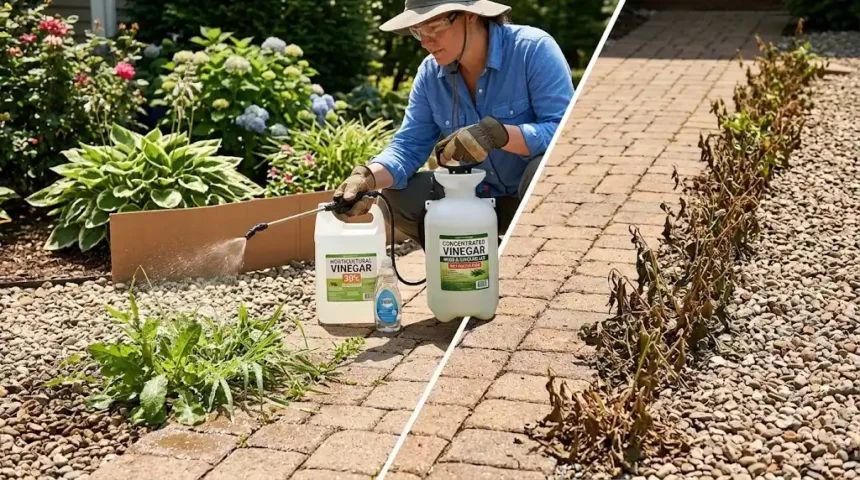
For household vinegar used as a small spot treatment, place it in a clearly identified sprayer reserved for garden maintenance rather than reusing a container associated with food or other household products. Adjust the nozzle so the liquid can be directed accurately at the target foliage instead of creating a fine mist that travels easily. Spray the weed leaves thoroughly enough to achieve useful contact while avoiding excessive runoff into surrounding soil. The goal is foliage coverage, not soaking an entire garden bed with vinegar. Keep the nozzle close to the target whenever practical and stop if wind begins moving droplets toward nearby plants. Never spray indiscriminately across mixed vegetation because vinegar cannot distinguish weeds from desirable plants.
After application, leave the treated foliage undisturbed and observe how it responds during the following days. Young susceptible weeds may wilt and dry rapidly, while larger weeds may show only partial damage. Do not assume that every brown plant is permanently dead, especially when treating perennial species. Check the same location later for fresh shoots emerging from surviving roots or crowns. If regrowth appears, remove it mechanically or repeat an appropriate treatment according to the product instructions. Persistent monitoring is an important part of vinegar weed control because the absence of residual activity means future seedlings can emerge even after the original treatment appears successful.
When using a registered horticultural vinegar herbicide, follow its label rather than substituting a generic homemade set of instructions. Wear every form of eye, skin, and other protection required by the manufacturer, and respect restrictions concerning application sites and weather conditions. Do not dilute, strengthen, mix, or transfer the product in ways that conflict with the directions. Keep children and pets away during application and for any period specified by the label. Store the product securely in its original container with the identifying information intact. Concentrated acetic acid demands much greater care than kitchen vinegar, so casual handling should never be justified simply because both products share the word “vinegar.”
Clean application equipment appropriately after use according to the relevant product instructions because acidic materials can affect some sprayer components. Never pour leftover concentrated weed killer into drains, stormwater systems, garden soil, or another unapproved location. Store only the amount you can manage safely, and follow local disposal requirements for unwanted pesticide products. If ordinary household vinegar has been used for targeted treatment, rinse reusable equipment thoroughly before storing it. Keep weed-control sprayers separate from equipment used to apply fertilizers or plant-care products to desirable vegetation. Clear labeling and dedicated equipment reduce the possibility of accidentally spraying vinegar residue onto flowers, vegetables, shrubs, or other plants during a later gardening task.
Where Vinegar Weed Killer Works Best
Cracks between pavers are among the most suitable places for targeted vinegar weed control because desirable plants are usually separated from the treatment area. Small weeds establishing in these narrow spaces can be difficult to pull completely, especially when roots extend beneath the paving material. Treating seedlings early can dry their exposed foliage before they become large enough to interfere with the appearance of the path. However, spray should still be kept off nearby lawn edges, flower borders, and ornamental groundcovers. Repeated weed emergence may indicate that organic debris and soil have accumulated inside the joints. Cleaning cracks and maintaining joint material can reduce future germination rather than relying entirely on repeated spraying.
Gravel driveways and pathways can also be practical areas for careful spot applications. Weed seedlings commonly emerge where dust, decomposed leaves, and soil collect between stones, creating small pockets suitable for germination. Vinegar can suppress young plants in these areas without the challenge of protecting turfgrass immediately beneath them. Nevertheless, nearby tree roots and desirable vegetation may extend farther than their visible foliage suggests, so widespread soil saturation is unnecessary and undesirable. Focus treatment on the leaves rather than pouring vinegar across large sections of gravel. Combining spot control with periodic raking and removal of accumulated organic matter can make the area less welcoming to future weeds.
Patios and other hardscape areas may benefit from vinegar treatments when weeds appear in isolated joints, but surface compatibility deserves attention. Acids can react with or discolor certain materials, metals, masonry finishes, or decorative surfaces depending on concentration and exposure. University of Maryland Extension specifically advises caution around reactive metals and certain masonry surfaces when using concentrated acetic-acid herbicides. Check the product label and test concerns before using strong formulations near valuable hardscaping. Accurate application directly to weed foliage is preferable to saturating the entire surface. If weeds can simply be pulled from accessible joints, mechanical removal eliminates the need to expose decorative materials to an acidic spray.
Vinegar is much less suitable for treating weeds scattered throughout a healthy lawn because acetic acid is nonselective. A spray strong enough to burn a broadleaf weed can also injure grass blades that receive the treatment. This may leave brown patches that are more noticeable than the original weeds and create open areas where new weed seeds can germinate. Selective lawn weed-control methods are usually better when preserving turf is the goal. Improving mowing height, soil conditions, irrigation practices, and turf density can also help lawns compete naturally with weeds. If only one or two weeds are present, hand removal may be simpler and less disruptive than applying any nonselective contact herbicide.
Garden beds require similar caution because desirable plants may be only a few inches from the weeds being targeted. Spray drift or splashing onto vegetable leaves, flowers, seedlings, or ornamental foliage can cause rapid visible injury. Hand pulling, hoeing, mulching, and targeted cultivation are often safer choices within densely planted beds. Vinegar may still be practical for isolated weeds along an empty border if you can protect nearby plants completely. Avoid spraying around newly planted seedlings whose tender leaves are particularly vulnerable. The closer the weed is to a valuable plant, the less attractive a nonselective foliar treatment becomes, even when the product is commonly described as a natural weed killer.
Common Vinegar Weed Killer Mistakes and Safety Risks
One of the biggest mistakes is adding table salt to homemade vinegar weed killer. Salt is frequently recommended online because it can damage vegetation, but that same property makes it problematic in landscapes where healthy plant growth may be wanted later. Sodium can persist in soil, interfere with plant water uptake, and move into surrounding areas with runoff. Penn State Extension warns against homemade weed-killer combinations involving salt, detergents, bleach, and similar household materials because of risks to soil, desirable vegetation, and the wider environment. Killing one weed is not a worthwhile trade if the treatment creates a longer-lasting soil problem that prevents flowers, grass, shrubs, or vegetables from growing successfully afterward.
Dish detergent is another ingredient frequently included in online vinegar recipes, usually because people hope it will help liquid stick to leaf surfaces. Household dishwashing products, however, are formulated for cleaning dishes rather than landscape application. They may contain fragrances, degreasers, surfactants, preservatives, and other ingredients that were not selected for routine use on garden plants or soil. If a registered herbicide requires an added surfactant, follow the product label and use only an appropriate labeled material. Do not assume that adding more soap will make household vinegar dramatically more effective against established roots. The fundamental limitation remains the same: vinegar primarily damages contacted foliage rather than reliably moving throughout a mature perennial weed.
Another mistake is spraying vinegar broadly over soil instead of targeting weed leaves. Acetic acid works through direct contact with plant tissue, so flooding bare ground generally provides little long-term prevention against future seed germination. Heavy or repeated applications can temporarily alter local soil conditions and may injure roots from nearby desirable plants. A better strategy is to spray only the unwanted foliage and then address the reasons new weeds continue appearing. Mulch, dense planting, clean pavement joints, and removal before seed formation can reduce future infestations. Treating the smallest necessary area also lowers material use and helps keep vinegar away from beneficial plants, irrigation components, hardscape surfaces, and other unintended targets.
Using concentrated horticultural vinegar without proper protection can create a far more serious problem than the weeds themselves. Products containing high percentages of acetic acid may cause severe eye injury and skin burns, so safety directions should never be treated as optional. Protective eyewear, gloves, clothing, and other equipment should match the specific label requirements rather than a generic assumption about what is adequate. Avoid inhaling concentrated spray mist and never apply it in a way that increases exposure to yourself or others. Keep the original container securely closed when not in use. If accidental exposure occurs, follow the product’s first-aid directions and seek appropriate medical or poison-control guidance when indicated.
Finally, avoid assuming that visible browning proves permanent weed control. This misunderstanding often leads gardeners to repeatedly spray the same perennial weeds without changing their strategy. After treatment, monitor the area for several weeks and identify whether new foliage comes from surviving roots or newly germinated seed. Persistent deep-rooted weeds may be better managed by digging, repeated cutting, smothering, or another properly labeled control option. Weed management becomes much easier when treatment is matched to plant biology. Vinegar is useful primarily as a fast contact treatment for susceptible young vegetation, and recognizing that role prevents unrealistic expectations, excessive product use, and unnecessary damage to the rest of the landscape.
Better Long-Term Weed Control Beyond Vinegar
Mulching is one of the most useful long-term strategies for reducing weeds in ornamental beds. A suitable layer of organic mulch blocks light from reaching many germinating weed seeds while also helping conserve soil moisture and moderate temperature. Wood chips, shredded bark, leaves, and other appropriate materials can be selected according to the planting area. Keep mulch away from direct contact with tree trunks and plant crowns to avoid unnecessary moisture problems. Weed seedlings that do emerge through mulch are often easier to remove while they remain small. Oregon State University Extension recommends a substantial mulch layer as one method for suppressing weeds, demonstrating why prevention can sometimes outperform repeated foliar treatment.
Hand weeding remains highly effective when performed early and under the right soil conditions. Pulling after rain or irrigation can make it easier to remove weeds with their roots rather than snapping the tops off at ground level. Use a narrow weeding tool for tap-rooted plants and try to remove as much of the underground structure as practical. Small seedlings can often be removed quickly before they become large enough to flower. Spending a few minutes regularly inspecting garden beds usually requires less effort than tackling a mature infestation once or twice each year. Mechanical removal also avoids exposing nearby desirable plants to a nonselective contact treatment.
Dense healthy planting can reduce the open space available for weeds to establish. In garden beds, appropriate groundcovers and well-spaced ornamentals eventually shade portions of the soil and compete with seedlings for resources. In lawns, healthy turf maintained at an appropriate mowing height can create a denser canopy that limits opportunities for certain weeds. Bare patches should be addressed instead of repeatedly treating weeds that colonize them. Determine whether poor drainage, compacted soil, excessive shade, drought, disease, or unsuitable plant selection is creating the empty space. Correcting the environmental cause can reduce weed pressure more effectively than repeatedly killing whatever happens to germinate there.
Preventing weeds from producing seeds should become a priority even when you cannot remove every unwanted plant immediately. Pull, cut, mow, or otherwise manage weeds before flowers mature and seed dispersal begins. This is particularly important for annual species that rely almost entirely on seed to produce future generations. Over time, reducing new seed input can lower the number of weeds emerging from the soil seed bank. Clean gardening tools after working in heavily infested areas so seeds, roots, or plant fragments are not transported unnecessarily. Weed management becomes easier when you think beyond today’s visible plants and consider how each species is likely to reproduce and spread.
The most effective approach is usually integrated weed management rather than dependence on one technique. Use vinegar selectively where its contact action makes sense, pull isolated deep-rooted weeds, mulch exposed soil, maintain healthy desired vegetation, and monitor problem areas regularly. If a pesticide or herbicide becomes necessary, choose a product labeled for the target weed and application site and follow the directions precisely. This flexible approach reduces unnecessary chemical use without pretending every “natural” remedy is automatically effective or harmless. It also allows you to respond differently to annual seedlings, perennial roots, lawn weeds, and pavement weeds. Matching the method to the weed produces better results with less repeated work.
Conclusion
Vinegar weed killer does work, but its effectiveness is highly dependent on what you spray and when you spray it. Young annual weeds are usually the best targets because their small root systems provide limited energy for recovery. Established perennial weeds can lose their foliage and still return from roots, crowns, or underground stems. This distinction explains why vinegar receives both enthusiastic recommendations and disappointing reviews. Two people can use the same product and achieve very different results simply because they are treating weeds at different stages. Successful use begins with identifying whether the target is a vulnerable seedling or a resilient established plant.
Household vinegar can be useful for limited spot treatment of small weeds, particularly in places such as gravel areas and pavement joints. Horticultural vinegar products contain stronger concentrations of acetic acid and may provide more aggressive foliar injury, but their hazards increase as concentration rises. Strong products should be treated as herbicides rather than ordinary kitchen ingredients and used only according to their labels. Protective equipment and accurate application are particularly important when concentrated acetic acid is involved. More strength is not always the answer, especially when the weed can regenerate from underground roots. Selecting the least hazardous practical method is generally a better starting point.
Avoid popular homemade recipes that add salt, dish detergent, bleach, or other household chemicals without a clear labeled purpose. These combinations may injure plants but can also create unintended problems for soil, surrounding vegetation, hard surfaces, or the person applying them. Salt is particularly problematic when you expect to grow desirable plants in the treated area later. Instead, keep vinegar applications focused directly on the weed foliage and avoid unnecessary runoff. Do not spray on windy days or close to plants you want to preserve. Careful spot treatment is more consistent with vinegar’s strengths than trying to use it as a broad, long-lasting vegetation sterilizer.
You should also expect to monitor the area after treatment because vinegar generally provides little continuing protection against new seedlings. If a weed regrows, determine whether the original root survived rather than automatically applying more spray. Digging may be faster for individual perennial weeds, while mulch and cultivation may be more practical for larger beds. Healthy lawns and dense ornamental plantings can reduce open spaces where weeds establish. Prevention becomes increasingly valuable when the same location produces weeds year after year. A successful weed-control program therefore combines immediate removal with changes that make future germination and establishment more difficult.
Ultimately, vinegar is best viewed as a targeted contact weed-control option rather than a universal replacement for every other method. It can be fast, convenient, and useful when applied to small susceptible weeds in appropriate locations. It becomes less reliable when weeds are mature, deeply rooted, perennial, or surrounded by desirable vegetation. Combine accurate identification, early treatment, mechanical removal, mulching, healthy planting, and sensible prevention for more dependable results. This approach reduces unnecessary spraying while keeping gardens, pathways, and outdoor spaces easier to maintain. Used with realistic expectations and appropriate safety precautions, vinegar can earn a practical place in a broader weed-management routine.
Frequently Asked Questions
Does household vinegar permanently kill weeds?
Household vinegar can kill very young annual weeds, but it usually damages only the foliage of established perennial weeds. Deep roots may survive and produce new shoots, so repeat treatment or root removal may be necessary.
How long does vinegar take to kill weeds?
Visible wilting or browning may occur relatively quickly when susceptible young weeds receive good coverage under favorable conditions. Complete control should be judged over a longer period because established weeds can initially look dead and later regrow.
Is vinegar weed killer safe for lawns?
Vinegar is nonselective and can burn lawn grass along with the weeds you are targeting. For weeds growing within healthy turf, hand removal or an appropriately labeled selective weed-control method is usually more suitable.
Should I mix vinegar with salt and dish soap?
Adding salt and household detergent is generally not recommended because the mixture can create additional soil, plant, and environmental problems. Salt may persist in soil, while dish detergents are cleaning products rather than garden herbicide ingredients.
Can vinegar kill weeds between paving stones?
Yes, small weeds growing between paving stones are among the better candidates for careful vinegar spot treatment. Direct the application toward the foliage, protect nearby plants, and check that the product will not harm or discolor the paving material.