
Skin Tag on Eyelid: Identify It and Remove It Safely
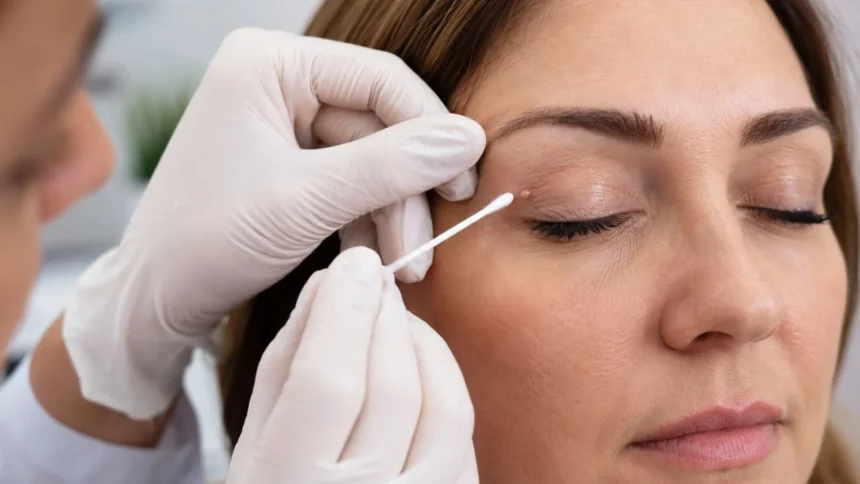
A skin tag on eyelid skin is usually a small, soft and harmless growth. It may hang from the upper or lower eyelid by a narrow stalk and match your natural skin tone. Skin tags are medically known as acrochordons and commonly develop on eyelids, the neck and other areas where skin folds or rubs.
Although most eyelid skin tags do not affect health, they may become irritating or distracting. A tag can rub against the eye, interfere with blinking, catch during face washing or make applying makeup uncomfortable. Larger growths may also enter the field of vision, depending on their exact location and how far they extend from the eyelid.
Not every bump near the eye is a skin tag. Milia, warts, cysts, chalazia, xanthelasma and several benign or cancerous eyelid growths can look similar. A healthcare professional can examine its surface, colour, shape, growth pattern and relationship to the eyelashes before confirming what the lesion is.
This guide explains eyelid skin tag causes, symptoms, professional removal methods, costs, aftercare and warning signs. It also explains why cutting, freezing or burning a skin tag near the eye at home is unsafe. Seek an eye specialist promptly when a growth changes, bleeds, affects vision or causes persistent irritation.
What Is an Eyelid Skin Tag?
An eyelid skin tag is a benign growth made from normal skin components. It often appears as a soft, fleshy bump attached to the eyelid by a thin stalk. Skin tags may be skin-coloured or slightly darker, and their smooth, flexible texture helps distinguish them from rough warts or firm cysts.
Most skin tags are small, although their size can vary. DermNet describes them as hanging growths that may measure from approximately one millimetre to several centimetres, while common acrochordons are usually much smaller. A tag near the eye often becomes noticeable early because even a tiny growth can affect appearance or blinking.
Skin tags are not contagious and do not spread between people through touching, towels or makeup. They are different from viral warts, although the two may sometimes look similar without close examination. A skin tag is also not the same as a pimple because it does not contain trapped oil or pus.
A genuine skin tag is generally painless unless it becomes twisted, scratched or repeatedly rubbed. Irritation can make it red, swollen or tender and may occasionally cause bleeding. Sudden inflammation does not automatically mean the growth is dangerous, but an irritated eyelid lesion should be examined when it fails to settle.
Eyelid Skin Tag Causes
The exact cause of skin tags is not completely understood. They appear when extra tissue develops in the upper layers of the skin, particularly in folds or areas exposed to friction. Natural eyelid movement, rubbing and contact between nearby skin surfaces may contribute to their formation in susceptible people.
Age is one important risk factor. Skin tags can occur in younger adults, but they become more common as people get older. Genetics may also play a role because some people develop several tags while others never experience them, even when their lifestyles and skin-care habits are similar.
Skin tags are also reported more frequently in people with obesity or type 2 diabetes. Hormonal and growth-factor changes during pregnancy may increase the likelihood of developing them. However, one small skin tag on the eyelid does not prove that a person has diabetes, insulin resistance or another medical condition.
Rubbing the eyes does not always create a skin tag, but repeated irritation may make an existing one more noticeable. Glasses, cosmetics and skin-care products can also rub against a raised lesion. Avoid repeatedly pulling or scratching the growth because trauma may lead to swelling, bleeding or infection around the delicate eyelid.
What an Eyelid Skin Tag Looks Like
A typical eyelid skin tag looks like a soft piece of skin hanging from a narrow base. It may be round, oval, thread-like or slightly folded. The colour commonly matches the surrounding eyelid, although some tags appear brown or darker, particularly in people with naturally deeper skin tones.
The surface is generally smooth rather than crusty, scaly or filled with fluid. A tag may move slightly when touched because it is attached by a flexible stalk. Avoid testing its movement repeatedly, however, because twisting the base can interrupt its blood supply and make the lesion painful or inflamed.
Most skin tags grow slowly and remain stable after reaching a certain size. Rapid enlargement is less typical and deserves professional assessment. A photograph taken in clear lighting can help you notice changes, but an image cannot reliably determine whether an eyelid growth is harmless or needs a biopsy.
A skin tag may occasionally become dark after twisting or losing its blood supply. Although this can happen to a benign tag, darkening may also occur in other skin lesions. Arrange an examination instead of assuming that every dark or changing eyelid bump is simply a damaged skin tag.
Conditions That Look Similar
Milia are tiny white cysts that commonly appear around the eyelids and cheeks. Unlike skin tags, they sit beneath the skin rather than hanging from a stalk. They are firm, rounded and filled with keratin, and they often require no treatment unless they remain bothersome or difficult to distinguish from another growth.
A chalazion is a lump caused by a blocked oil-producing gland within the eyelid. It usually feels deeper and firmer than a skin tag and may become red or tender. Warm compresses may help some chalazia, but that approach will not remove an actual skin tag hanging from the eyelid surface.
Xanthelasma creates flat or slightly raised yellow patches near the inner eyelids. These cholesterol deposits look different from ordinary skin tags and may be associated with elevated cholesterol or other health conditions. A clinician may recommend blood tests when the appearance suggests xanthelasma rather than an acrochordon.
Warts, seborrhoeic keratoses, moles and skin cancers can also resemble skin tags. Healthcare providers examine eyelid growths because appearance overlaps and treatment depends on the correct diagnosis. Removing an unidentified lesion at home could destroy tissue that should have been examined and delay appropriate medical care.
Is a Skin Tag on Eyelid Dangerous?
Most eyelid skin tags are harmless and do not become cancerous. They can usually remain untreated when they are small, stable and symptom-free. Cleveland Clinic and the NHS both note that ordinary skin tags generally do not require removal unless they become bothersome or create a practical problem.
The location makes careful evaluation more important, however, because the eyelid protects the eye and supports normal blinking. A tag positioned along the lash line may scratch the eye, disturb tear distribution or interfere with eyelid closure. Removal may be medically useful when the growth affects function rather than appearance alone.
The greater concern is misidentifying another lesion as a skin tag. Certain eyelid cancers can begin as small painless bumps and may initially appear harmless. Features such as ulceration, eyelash loss, visible abnormal blood vessels or distortion of the eyelid shape require assessment by an ophthalmologist or another qualified clinician.
A growth is not automatically cancerous because it bleeds after being scratched. Nevertheless, repeated bleeding, crusting, persistent soreness or ongoing enlargement should not be ignored. Moorfields advises specialist assessment for eyelid bumps that grow, bleed, blister, cause significant discomfort, affect vision or fail to resolve.
When to See a Doctor
Arrange a routine appointment when you are uncertain that the bump is a skin tag. A general practitioner, dermatologist, ophthalmologist or optometrist may be able to assess it, depending on local services. Lesions close to the eyelid margin or tear drainage system may be referred to an ophthalmologist or oculoplastic surgeon.
Seek an earlier evaluation when the growth increases in size, changes colour or develops an irregular surface. Bleeding without a clear injury, crusting that repeatedly returns and a sore that does not heal are additional warning signs. These features do not confirm cancer, but they require proper examination.
Loss of eyelashes around the growth, an altered eyelid edge or visible small blood vessels can be concerning features of an eyelid tumour. A clinician may recommend photography, close examination or biopsy when the diagnosis remains uncertain. Early assessment makes treatment easier when a lesion proves to need medical attention.
Get urgent help when the eyelid growth is accompanied by sudden vision loss, severe eye pain, extensive swelling or difficulty opening the eye. A skin tag itself rarely produces these symptoms, so another eye problem may be present. Do not apply chemicals or continue home treatment while waiting for an urgent evaluation.
Can You Remove It at Home?
You should not attempt skin tag on eyelid removal with scissors, nail clippers, razors or needles. Eyelid skin is thin, sensitive and supplied by small blood vessels. A slight hand movement could cut the eyelid, damage nearby structures, cause bleeding or introduce bacteria into the wound.
Tying dental floss or thread around the base is also unsuitable near the eye. The knot can slip, scratch the eye or leave injured tissue behind. It may also be difficult to confirm that the growth is a true skin tag before interrupting its blood supply through an unmonitored home method.
Avoid wart removers, strong acids, essential oils and skin tag removal creams around the eyelids. Cleveland Clinic warns that home creams and patches may cause irritation, burning or skin ulcers, while consumer freezing kits can damage surrounding tissue. Those risks are especially serious when treatment is only millimetres from the eye.
Do not apply a home freezing kit to the eyelid. Medical cryotherapy uses controlled equipment and careful placement, yet even professional treatment near the eye can cause temporary swelling. A consumer applicator cannot provide the same diagnostic assessment, precision or protection for the eyeball and surrounding structures.
Professional Removal Options
A clinician may remove a small eyelid skin tag by carefully cutting or shaving it after numbing the area. This method can provide immediate removal and may allow the tissue to be sent for laboratory examination when the diagnosis is uncertain. The exact technique depends on the tag’s size, base and position.
Electrocautery uses controlled heat or electrical energy to remove the growth and seal small blood vessels. It can reduce bleeding and may be useful for selected superficial tags. The clinician protects the eye and limits treatment to the lesion, which cannot be done safely with an uncontrolled home burning device.
Cryotherapy freezes the skin tag so the treated tissue eventually separates. The NHS lists freezing among established skin tag removal methods, although the eyelid location requires particular care. Swelling, blistering and pigment changes may occur, and cryotherapy should not be used when the diagnosis is uncertain.
An ophthalmologist or oculoplastic surgeon may be preferred when the tag is close to the eyelashes, tear duct or eye surface. Oculoplastic specialists diagnose and treat conditions affecting the eyelids and surrounding structures. Simpler superficial tags may also be managed by dermatologists or other experienced medical professionals.
What Happens During Removal?
The appointment normally begins with an examination to confirm that the lesion looks benign. The clinician may ask how long it has been present, whether it has changed and whether it bleeds or affects vision. Suspicious features may lead to a biopsy or a different treatment plan instead of simple cosmetic removal.
For many small procedures, the area is cleaned and numbed with local anaesthetic. The clinician then removes or destroys the tag using the selected technique. You may feel pressure or movement but should not feel sharp pain once the anaesthetic has taken effect.
The procedure is often brief, although preparation and careful eye protection may take longer than removing the tag itself. A small amount of bleeding can occur after cutting, and the clinician may use pressure, cautery or another method to control it before applying ointment or a light dressing.
Ask whether you can drive afterward, especially when the eyelid will be covered or vision may temporarily blur from ointment. Follow the clinic’s instructions about contact lenses, makeup, washing and exercise. The advice may differ according to the location and removal technique used.
Recovery and Aftercare
Mild swelling, tenderness or bruising can occur after eyelid lesion removal. These effects usually improve as the wound heals, but recovery time varies according to the lesion’s size and the procedure performed. Cryotherapy near the eye can produce a noticeably puffy eyelid, particularly the following morning.
Keep the area clean and follow the clinician’s instructions for ointment or dressings. Do not pick at a scab because doing so can reopen the wound and increase scarring. Wash your hands before touching the eyelid, and avoid rubbing the area even when healing causes temporary itching.
Your clinician may ask you to avoid eye makeup, swimming or contact lenses for a short period. Do not apply active skin-care ingredients, acids or fragranced products near the wound until it has healed. Sun protection may help limit darkening of the healing area after the skin surface closes.
Contact the clinic when redness spreads, swelling becomes severe, pus appears or pain increases rather than improves. Seek urgent care for new vision changes, heavy bleeding or difficulty closing the eyelid. These problems are uncommon after minor removal but require timely assessment when they occur.
Will Removal Leave a Scar?
Any method that removes skin can leave a small mark. A tiny eyelid tag may heal with minimal visible scarring, particularly when treated by an experienced professional. The final result depends on the tag’s size, depth, location, removal method and the way your skin naturally heals.
The NHS notes that skin tag removal may cause scarring or changes in skin colour. Hyperpigmentation can be more noticeable on black or brown skin and may occasionally persist. Cryotherapy can also produce lighter or darker areas because freezing affects pigment-producing cells around the treated lesion.
Do not use bleaching products or strong exfoliating acids on a new mark near the eye. Healing colour changes often improve gradually, while harsh treatment can create irritation and make pigmentation more noticeable. Ask your clinician before applying any scar product to eyelid skin.
A properly removed skin tag does not usually grow back from the same tissue. New tags can still develop elsewhere on the eyelids or body because removal does not change a person’s underlying tendency to form them. The NHS states that a removed skin tag generally does not return.
Eyelid Skin Tag Removal Cost
The cost of eyelid skin tag removal varies by country, clinic and healthcare system. Important factors include the specialist’s fee, whether a biopsy is required, the number of growths and the procedure used. Removal close to the eyelid margin may cost more because it requires greater precision and specialist experience.
Health insurance may classify removal as cosmetic when the tag causes no symptoms. Coverage may be more likely when the lesion blocks vision, repeatedly bleeds, irritates the eye or interferes with eyelid function. Ask the clinic and insurer what documentation is needed before scheduling the procedure.
The quoted price may or may not include consultation, local anaesthetic, laboratory testing and follow-up care. Request a complete written estimate rather than comparing the basic procedure fee alone. A cheaper service is not good value when it does not include diagnosis by a qualified healthcare professional.
Do not choose an unlicensed salon or home service simply to reduce the cost. Correct identification and eye protection are essential parts of eyelid treatment. Paying for professional assessment can prevent injury and ensure that a suspicious lesion is examined rather than cosmetically destroyed without diagnosis.
Can Eyelid Skin Tags Be Prevented?
There is no guaranteed way to prevent every eyelid skin tag because age, genetics and individual skin characteristics contribute to their development. Avoiding friction may reduce irritation, but it cannot remove an inherited or biological tendency to form these growths.
Try not to rub the eyes unnecessarily, especially when allergies, dryness or irritation make them itchy. Treating the reason for repeated rubbing may protect the eyelid surface from ongoing trauma. Ask an eye-care professional about persistent itching instead of relying on frequent rubbing for temporary relief.
Maintain clean makeup brushes and remove eye makeup gently without pulling the eyelid. Replace products according to their recommended schedule and avoid sharing cosmetics. These steps support general eyelid hygiene, although they have not been proven to prevent all skin tags from forming.
Cleveland Clinic suggests that maintaining a healthy weight and reducing repeated friction may help lower the chance of future tags in some people. However, developing a skin tag does not mean that someone has poor hygiene or has failed to care for their skin correctly.
Skin Tag on Eyelid During Pregnancy
Skin tags may become more noticeable during pregnancy because hormonal and growth-factor changes can affect the skin. Some people develop new tags or notice existing ones becoming larger during this period. Pregnancy-related skin tags are generally harmless, but an eyelid growth should still be checked when its appearance is uncertain.
Do not apply over-the-counter removal solutions during pregnancy without professional advice, particularly near the eye. Product safety, skin sensitivity and the possibility of misdiagnosis must all be considered. An obstetric clinician, dermatologist or eye specialist can help determine whether treatment should wait.
Removal may be postponed until after pregnancy when the lesion causes no medical problem. Waiting avoids an unnecessary procedure during a time when skin and pigmentation may respond differently. A tag that affects vision, repeatedly bleeds or scratches the eye may still justify earlier professional treatment.
Some tags may become less noticeable after pregnancy, while others remain unchanged. Do not assume that every growth appearing during pregnancy is hormone-related. Rapid enlargement, ulceration, eyelash loss or unexplained bleeding requires the same medical assessment recommended at any other time.
Warning Signs to Check
A stable, soft tag attached by a stalk is generally reassuring, but changes should be monitored. Take note when the lesion becomes noticeably larger over several weeks, develops an uneven shape or changes colour without being twisted or injured. A clinician can determine whether observation or biopsy is appropriate.
Repeated bleeding, crusting or ulceration deserves evaluation. Skin cancers can sometimes appear as sores that heal and return or bumps that bleed after minor contact. These warning signs are not specific to cancer, but they should not be treated repeatedly with home remedies.
Watch the eyelashes and natural eyelid outline. Loss of lashes around a lesion, a notch in the eyelid margin or distortion of the lid can indicate a more concerning process. Visible small blood vessels over the growth are another feature an ophthalmologist may assess carefully.
Seek professional care when the growth interferes with vision, prevents normal blinking or causes ongoing eye irritation. Moorfields specifically recommends assessment when an eyelid lump grows, bleeds, blisters, causes significant discomfort or obscures vision. Prompt evaluation protects both the eyelid and the eye beneath it.
FAQs
Can I cut a skin tag off my eyelid?
No. Cutting an eyelid skin tag at home can cause bleeding, infection or accidental injury to the eye. Have the growth identified and removed by a qualified healthcare professional.
What causes a skin tag on the eyelid?
Skin tags develop when extra skin tissue forms, often in areas affected by folds or friction. Age, genetics, pregnancy, obesity and diabetes may increase the likelihood of developing them.
Will an eyelid skin tag disappear naturally?
Most skin tags remain unless they are removed, although one may occasionally twist and fall off after losing its blood supply. Do not twist or tie it intentionally, especially near the eye.
Is a skin tag on the eyelid cancerous?
Ordinary skin tags are benign. However, several eyelid tumours can resemble harmless growths, so arrange an examination when the bump changes, bleeds, removes eyelashes or affects the eyelid shape.
Who removes skin tags from eyelids?
A dermatologist, ophthalmologist or oculoplastic surgeon may remove an eyelid skin tag. A specialist is particularly appropriate when it sits near the eyelashes, tear duct or eye surface.
Skin Tag on Eyelid: Final Takeaways
A skin tag on eyelid skin is usually a harmless, soft growth attached by a narrow stalk. It may be left alone when it is stable and causes no symptoms. Removal becomes reasonable when the tag irritates the eye, catches during daily activities, affects vision or causes cosmetic concern.
Do not cut, tie, freeze or burn the growth at home. Eyelid skin is delicate, and consumer removal products can cause burns, ulcers or injury to surrounding tissue. Professional assessment also confirms that the bump is truly a skin tag rather than another eyelid condition.
Doctors can remove an eyelid skin tag through careful excision, cautery or cryotherapy. The best method depends on its size, position and appearance. Tags near the eyelid margin may be treated by an ophthalmologist or oculoplastic surgeon to protect blinking, tear drainage and the eye surface.
Arrange prompt assessment when the lesion grows, repeatedly bleeds, develops an ulcer, removes eyelashes or changes the eyelid shape. Most eyelid tags are benign, but recognising warning signs helps ensure that a suspicious growth is diagnosed and treated without unnecessary delay.