

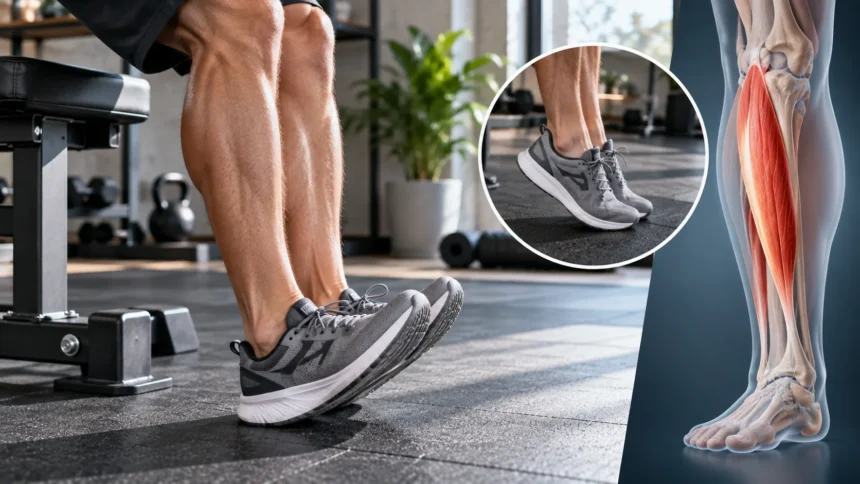
Tibialis raises are a simple lower-leg exercise designed to strengthen the muscles along the front of the shin. They require little equipment, can be performed almost anywhere, and may help improve ankle control, walking mechanics, running efficiency, and lower-leg strength. Because the movement is easy to learn, it works well for both beginners and experienced athletes.
The exercise mainly targets the tibialis anterior, a muscle responsible for lifting the front of the foot toward the shin. Stronger muscles in this area can support balanced lower-leg development and help control the foot during walking and running. Learning proper tibialis raise form is important because small technique mistakes can reduce the effectiveness of the movement.
What Is a Tibialis Raise?
A tibialis raise is an exercise in which you lift your toes and forefoot upward while keeping your heels planted on the ground. The movement creates ankle dorsiflexion, meaning the top of the foot moves toward the shin. This action directly challenges the tibialis anterior and other muscles on the front of the lower leg.
The exercise is commonly performed while leaning against a wall with the feet positioned slightly forward. You then raise the toes as high as comfortably possible before lowering them slowly. Because body weight provides much of the resistance, beginners can start without machines, weights, or specialized gym equipment.
More advanced versions can involve resistance bands, tibialis machines, weighted attachments, or greater distance between the feet and wall. Regardless of the variation, the basic goal remains the same: strengthen the muscles responsible for lifting and controlling the foot. Controlled movement is more important than trying to complete repetitions as quickly as possible.
What Muscles Do Tibialis Raises Work?
The tibialis anterior is the primary muscle trained during tibialis raises. It runs along the front and outside portion of the shin and helps pull the foot upward. This movement is important during walking because it helps prevent the toes from dragging as the leg swings forward.
Other smaller muscles around the ankle may also contribute to dorsiflexion and foot control. These muscles help stabilize the ankle and support smooth movement during walking, running, jumping, and direction changes. Tibialis raises therefore train more than appearance; they strengthen muscles involved in everyday lower-leg function.
The exercise complements calf training because the calves mainly perform the opposite movement, pushing the foot downward. Training both sides of the lower leg can create more balanced strength around the ankle. This balance may be especially useful for runners, athletes, and people who regularly perform calf raises or jumping exercises.
How to Do a Tibialis Raise Correctly
Stand with your back against a wall and move your feet several inches forward while keeping your heels firmly planted. Your legs can remain relatively straight, although a slight bend in the knees is comfortable for many people. Keep your body supported by the wall so you can focus on moving the ankles.
Lift the front of both feet toward your shins as high as you comfortably can while the heels remain on the floor. Pause briefly at the top and focus on feeling the muscles along the front of the lower legs contract. Avoid rocking your body forward or using momentum to create extra movement.
Lower the toes slowly until the forefoot nearly touches the ground, then begin the next repetition. Control the lowering phase rather than allowing the feet to drop quickly. Start with a comfortable range of motion and gradually improve it as ankle strength and control develop.
Key Benefits of Tibialis Raises
One major benefit of tibialis raises is improved strength at the front of the lower leg. Many workouts emphasize calves while giving little direct attention to the tibialis anterior. Adding dorsiflexion exercises can create a more balanced training routine and strengthen an area that plays an important role in walking and running.
The exercise may also improve ankle control. The tibialis anterior helps manage foot position as the heel contacts the ground and the body moves forward. Better control can make walking, running, and descending stairs feel smoother, particularly when combined with calf strength, mobility, and overall lower-body conditioning.
Tibialis raises are also convenient because they require very little equipment. A wall is enough for the basic variation, making them easy to perform at home or during a gym session. Their simplicity allows beginners to add direct shin strengthening without learning complicated movement patterns or handling heavy weights.
Tibialis Raises for Runners and Athletes
Running repeatedly challenges the muscles around the ankle because the foot must absorb impact and transition quickly into the next stride. The tibialis anterior helps control the forefoot as the foot approaches and leaves the ground. Strengthening this muscle can therefore support overall lower-leg conditioning for runners.
Athletes involved in basketball, football, tennis, and other sports also rely on ankle control during acceleration, deceleration, and changes of direction. Tibialis raises can complement calf raises, squats, lunges, and jumping exercises by strengthening the opposite side of the lower leg. This can create a more complete lower-body training program.
However, tibialis raises should not be viewed as a guaranteed injury-prevention exercise. Running mechanics, training volume, recovery, footwear, strength, and previous injuries all influence lower-leg health. The exercise is most useful when included as one part of a broader strength and conditioning routine.
Can Tibialis Raises Help With Shin Discomfort?
Tibialis raises may help strengthen the muscles along the front of the shin, which can be useful when weakness or low training capacity contributes to discomfort. Gradual strengthening helps tissues adapt to repeated loading. However, shin pain can have several causes, so exercises should not automatically be used without understanding the source.
Pain along the shin can be related to overuse, rapid increases in running volume, stress injuries, muscle strains, or other lower-leg conditions. Strengthening through mild muscular effort is different from repeatedly training through sharp or worsening pain. If symptoms increase during the exercise, reducing the workload is usually sensible.
Persistent shin pain, swelling, or pain that becomes noticeable even during normal walking should be assessed professionally. A physical therapist or doctor can help determine whether strengthening is appropriate. Exercise is most effective when it addresses the actual problem rather than being used as a universal solution for every type of shin discomfort.
Tibialis Raises and Knee Function
The ankle and knee work together during walking, squatting, and running, so lower-leg strength can influence overall movement. Good ankle control helps the shin move appropriately as the body travels over the foot. Tibialis raises may therefore contribute indirectly to smoother lower-body mechanics when combined with hip, knee, and calf strength.
They are not, however, a direct treatment for every form of knee pain. Discomfort around the front, sides, or back of knee can come from muscles, tendons, joints, nerves, or other structures. The correct exercise depends on the underlying cause and the movements that trigger symptoms.
If knee pain develops during tibialis raises, check your stance and reduce the exercise difficulty. Keep the movement focused at the ankle instead of repeatedly bending and straightening the knees. Ongoing knee pain, swelling, or instability deserves assessment rather than trying to correct the problem by adding more repetitions.
How Many Tibialis Raises Should You Do?
Beginners can start with two or three sets of 10 to 15 controlled repetitions. The final few repetitions should feel challenging through the front of the shins without causing sharp pain. If the movement is very easy, move your feet slightly farther from the wall to increase the difficulty.
As strength improves, you can gradually work toward higher repetitions or additional resistance. Some people respond well to sets of 15 to 25 repetitions because the exercise often uses relatively light resistance. The ideal range depends on your goals, exercise variation, and how the movement fits into the rest of your program.
Training the tibialis anterior two or three times per week is sufficient for many people. More frequent work may be appropriate when the exercise is very light, but recovery still matters. Progress comes from gradually increasing the challenge rather than performing large numbers of repetitions every day without a clear reason.
Best Tibialis Raise Variations
The wall tibialis raise is the easiest variation for most beginners. Moving your feet farther from the wall increases the leverage and makes the muscles work harder. This provides a simple form of progression without adding weights or purchasing specialized equipment.
Resistance-band dorsiflexion is another useful option. Sit with the leg extended and attach a band in front of the foot, then pull the toes toward your shin against resistance. This variation makes it easier to train each leg separately and adjust resistance through different bands.
Advanced trainees may use a tibialis machine or weighted foot attachment. These options allow more precise progressive overload once bodyweight versions become too easy. Regardless of the variation, use controlled repetitions and avoid adding resistance so quickly that your ankle range becomes very small or uncomfortable.
Common Tibialis Raise Mistakes
One common mistake is lifting the heels instead of keeping them planted. When the heels move, the exercise turns into a different movement and reduces the focus on ankle dorsiflexion. Keep pressure through the heels and think about lifting only the toes and front portion of the feet.
Another mistake is using momentum. Quickly bouncing the toes up and down may allow you to perform many repetitions, but it reduces muscular control. A slower lifting and lowering phase keeps tension on the tibialis anterior and makes lighter resistance more challenging without requiring excessive volume.
People may also progress too aggressively. Moving very far away from the wall or adding heavy resistance before developing control can shorten the range of motion and irritate the lower leg. Start with a version you can perform smoothly and increase difficulty only after the current variation becomes consistently manageable.
Best Practices for Adding Tibialis Raises to Your Workout
Tibialis raises can be performed near the end of a lower-body workout after larger movements such as squats, lunges, or deadlifts. They can also be paired with calf raises as a lower-leg finishing combination. This makes it easy to train both the front and back of the lower leg efficiently.
If running or sports performance is your priority, avoid exhausting the tibialis muscles immediately before demanding speed work. Fatigued lower-leg muscles may alter movement quality during high-intensity training. Perform heavier tibialis work after athletic sessions or on separate strength days when possible.
Progress slowly and track how the lower legs respond. Mild muscular fatigue or soreness after a new exercise can be expected, but worsening shin pain is not a sign that training is working better. Consistency, appropriate resistance, and gradual overload are more effective than repeatedly pushing the muscles to excessive fatigue.
Conclusion
Tibialis raises strengthen the muscles along the front of the lower leg, particularly the tibialis anterior. This muscle helps lift and control the foot during walking, running, and many athletic movements. The exercise can complement calf training and create more balanced strength around the ankle.
Proper form is simple but important. Keep your heels planted, lift the forefoot under control, pause briefly at the top, and lower slowly. Beginners can use a wall for support before progressing to resistance bands, weighted variations, or specialized equipment as their strength improves.
Tibialis raises work best as one part of a complete lower-body routine. Combine them with calf exercises, hip and knee strengthening, mobility, and sensible activity progression. If the exercise causes sharp or persistent pain, reduce the workload and seek professional guidance when symptoms do not improve.
FAQs
What do tibialis raises work?
Tibialis raises primarily work the tibialis anterior at the front of the shin. They also involve smaller muscles that assist with ankle dorsiflexion and foot control.
Are tibialis raises good for runners?
Yes. They can strengthen muscles involved in controlling the foot during running. However, they should be combined with calf, hip, and leg strengthening rather than used as a complete running program.
How many tibialis raises should I do?
Beginners can start with two or three sets of 10 to 15 repetitions. Increase repetitions or resistance gradually once you can complete every repetition with good control.
Can I do tibialis raises every day?
Light versions may be tolerated frequently, but daily training is not necessary for most people. Two or three focused sessions per week can provide enough stimulus while allowing recovery.
Should tibialis raises cause shin pain?
You may feel muscular fatigue or mild burning at the front of the shin, but sharp or persistent pain is not normal. Stop or reduce the exercise if symptoms worsen.