
Strong hamstrings support walking, running, jumping, bending, and many everyday movements. These muscles work with the glutes and lower back to control the hips and knees, making them important for both athletic performance and general mobility. Hamstring strengthening exercises can improve lower-body stability, help balance quad-dominant training, and make common movements feel more controlled.
The best hamstring exercises include a mix of hip-hinge movements and knee-flexion exercises. Romanian deadlifts, bridges, leg curls, Nordic curls, and single-leg variations all challenge the hamstrings differently. Combining several movement patterns is usually more effective than relying on one exercise because the hamstrings contribute to both hip extension and knee bending.
Good form matters more than using heavy resistance. Moving too quickly, rounding the back, or forcing a range you cannot control can shift stress away from the intended muscles. The guide below explains effective hamstring strengthening exercises, their benefits, proper technique, common mistakes, and practical tips for building stronger legs safely and progressively.
What Are the Hamstring Muscles?
The hamstrings are a group of muscles located along the back of the thigh. They include the biceps femoris, semitendinosus, and semimembranosus. Together, these muscles help bend the knee, extend the hip, control the leg during walking and running, and stabilize the lower body during many strength and athletic movements.
Hamstrings work closely with the glutes during hip extension. When you stand up from a hip hinge, climb stairs, sprint, or push your hips forward, both muscle groups contribute. They also help slow the lower leg during running, which makes eccentric hamstring strength particularly important for people involved in fast or explosive activities.
Because the hamstrings cross both the hip and knee joints, they respond well to exercises that challenge them in different positions. Hip-hinge movements emphasize lengthened hamstring tension, while curls train knee flexion more directly. A balanced routine should usually include both types rather than focusing entirely on one movement pattern.
Benefits of Hamstring Strengthening Exercises
Stronger hamstrings can improve lower-body strength and make movements such as running, squatting, lifting, and climbing more efficient. They help stabilize the knees and hips while supporting the glutes during powerful movements. Balanced posterior-chain strength can also reduce excessive reliance on the quadriceps during lower-body training.
Hamstring training may also improve control during deceleration and quick changes of direction. The muscles work eccentrically when they lengthen under tension, especially during running and landing. Building this strength can be useful for athletes, recreational runners, and anyone who performs activities requiring repeated acceleration and slowing down.
For everyday movement, stronger hamstrings can support better hip control during bending and lifting. They may also make it easier to maintain good movement mechanics when picking objects up from the floor. If you are building a broader mobility routine, you can also pair strengthening with a short hamstring mobility guide once you have the final internal URL.
Romanian Deadlift
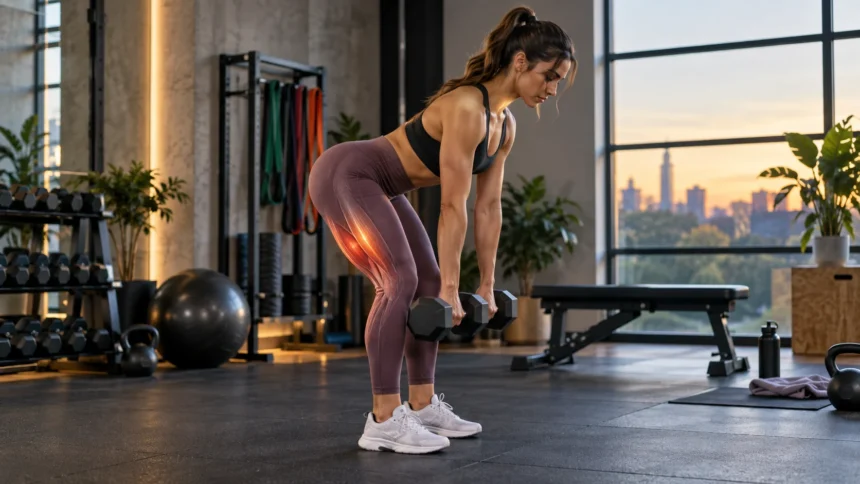
The Romanian deadlift is one of the most effective exercises for strengthening the hamstrings through a hip-hinge movement. Stand with the weight held in front of your thighs, soften your knees slightly, and push your hips backward. Keep your spine neutral while lowering the weight until you feel strong tension through the back of your legs.
The goal is not to reach the floor. Stop when your hamstrings are stretched and you can no longer move your hips backward without rounding your lower back. From that position, press your feet into the ground and drive the hips forward until you return to standing.
Start with light dumbbells, a barbell, or even body weight while learning the pattern. The exercise should feel primarily in the hamstrings and glutes rather than the lower back. Keep the weights close to your legs and move slowly so the hamstrings remain under controlled tension throughout each repetition.
Glute Bridge With Hamstring Emphasis
Lie on your back with your knees bent and your feet flat on the floor. Move your feet slightly farther away from your hips than you would for a standard glute bridge. Press through the heels and lift your hips until your torso forms a comfortable line from your shoulders toward your knees.
Placing the feet farther away increases the contribution of the hamstrings, although the glutes will still work strongly. Keep your ribs controlled and avoid overextending the lower back at the top. Pause briefly when your hips are raised, then lower slowly rather than dropping back to the floor.
Beginners can start with two-legged bridges before progressing to single-leg versions. You can also add resistance by placing a weight across the hips or using a resistance band. The movement works well in home workouts because it requires little equipment while still training hip extension effectively.
Hamstring Curl
Hamstring curls directly train knee flexion, which complements hip-hinge exercises such as Romanian deadlifts. On a machine, position your body according to the equipment instructions and curl your heels toward the back of your thighs. Keep your hips stable and avoid using momentum to swing the weight through the movement.
You can also perform hamstring curls at home with resistance bands, sliders, or a stability ball. For slider curls, begin in a bridge position with your heels on sliding discs or towels. Slowly extend your legs away from your body, then pull the heels back while keeping your hips elevated as much as you can control.
Use moderate resistance and focus on a smooth contraction rather than choosing a weight that forces you to shorten the range. The lowering phase is especially valuable because the hamstrings must control the resistance while lengthening. Slow repetitions often make the exercise more challenging without requiring very heavy loads.
Single-Leg Romanian Deadlift
The single-leg Romanian deadlift strengthens the hamstrings while also challenging balance, hip stability, and coordination. Stand on one leg with a slight bend in the knee, then hinge at the hip while extending the opposite leg behind you. Keep your pelvis as level as possible instead of allowing the body to rotate open.
Lower only as far as you can maintain balance and a neutral spine. You should feel tension in the hamstrings and glutes of the standing leg. Drive through the foot and extend the hip to return upright without twisting or rushing the movement.
Beginners can hold onto a wall, chair, or rack for support while learning the exercise. Once balance improves, add a light dumbbell or kettlebell in one or both hands. A supported version still provides excellent hamstring training and may allow you to focus more on strength than balance.
Nordic Hamstring Curl
The Nordic hamstring curl is an advanced bodyweight exercise that places a large eccentric load on the hamstrings. Begin kneeling with your ankles secured by a partner, sturdy pad, or appropriate equipment. Keep your hips extended and slowly lower your body forward while resisting gravity with the muscles at the back of your thighs.
You do not need to lower all the way to the floor to benefit. Descend only as far as you can maintain control, then use your hands to catch yourself when necessary. Push lightly from the floor to help return to the starting position, especially when you are still developing enough strength for the upward phase.
Nordic curls are demanding, so start with a small number of controlled repetitions. Using a resistance band for assistance can make the exercise more manageable. Because soreness can be significant when you are new to eccentric training, introduce the movement gradually instead of doing high volume immediately.
Stability Ball Hamstring Curl
Lie on your back with your heels resting on top of a stability ball. Lift your hips into a bridge position, then bend your knees and roll the ball toward your body. Keep your hips elevated while the hamstrings pull the ball inward, then slowly extend the legs again.
This exercise combines knee flexion with hip stabilization, making it useful for training the hamstrings and glutes together. Your core also works to keep the pelvis controlled while the unstable ball moves. Avoid allowing the hips to drop significantly as the legs straighten.
If the exercise feels too difficult, practice holding a bridge with your heels on the ball before adding the curl. More advanced exercisers can progress toward single-leg variations. Move carefully because the unstable surface increases the coordination demand compared with a machine-based hamstring curl.
How Often Should You Train Your Hamstrings?
For many people, training the hamstrings two to three times per week is enough to build strength while allowing recovery between sessions. The exact frequency depends on your training experience, workout intensity, overall lower-body volume, and recovery. Beginners usually benefit from moderate volume rather than trying to train the muscles hard every day.
A balanced session might include one hip-hinge exercise and one knee-flexion exercise. For example, you could combine Romanian deadlifts with hamstring curls or pair bridges with a lighter slider curl. This approach trains the hamstrings through multiple functions without requiring a long list of exercises in every workout.
Start with around two to four sets per exercise and use a repetition range that allows good technique. Six to twelve repetitions can work well for heavier strength exercises, while curls and bridges may also be effective at higher repetitions. Progress gradually by adding resistance, repetitions, or control rather than changing everything at once.
Common Hamstring Exercise Mistakes
One common mistake is using too much weight before learning proper hip-hinge mechanics. Heavy Romanian deadlifts performed with a rounded back or excessive knee bending may shift tension away from the hamstrings. Use lighter resistance until you can move the hips backward smoothly and maintain a stable spine throughout the set.
Another mistake is rushing the eccentric phase. The hamstrings respond strongly when controlling a load as they lengthen, so lowering quickly can remove an important part of the exercise. Slower repetitions also make it easier to notice when posture changes or momentum begins replacing muscular control.
Avoid forcing range of motion just to move farther. People have different levels of flexibility, limb length, and joint mobility, so your ideal range may not match someone else’s. Stop where you can maintain good form and gradually increase mobility and strength instead of sacrificing technique to reach an arbitrary depth.
Tips for Safer and More Effective Hamstring Training
Warm up with a few minutes of light movement before harder hamstring exercises. Walking, easy cycling, bodyweight hinges, and light bridges can increase blood flow and help you practice the movement patterns you will use later. The warm-up should prepare you without creating enough fatigue to reduce your performance.
Progress gradually, especially when adding Nordic curls or heavier Romanian deadlifts. The hamstrings can become quite sore after unfamiliar eccentric training, so sudden increases in volume may make recovery difficult. Add one variable at a time, such as a small amount of resistance or a few additional repetitions.
Muscle effort is expected, but sharp pain is not. Stop an exercise if you feel sudden pain, significant pulling, or symptoms that worsen with each repetition. If pain continues after training or follows an injury, seek appropriate professional assessment rather than repeatedly testing the same painful movement.
Strengthening vs Stretching the Hamstrings
Stretching and strengthening serve different purposes. Stretching can temporarily improve range of motion and reduce the feeling of stiffness, while strengthening improves the muscles’ ability to produce and control force. A complete lower-body routine may include both, depending on your mobility, training goals, and current symptoms.
Many people assume tight hamstrings only need more stretching, but perceived tightness can sometimes coexist with weakness or limited hip control. Strengthening through a comfortable range may help the muscles become more capable in lengthened positions. Exercises such as Romanian deadlifts are particularly useful because they combine strength with controlled hamstring lengthening.
If you stretch after training, keep the intensity comfortable and avoid aggressive bouncing. Stretching should not create sharp pain or numbness. Strength gains still require progressive resistance, so do not replace strength exercises entirely with flexibility work if your main goal is stronger hamstrings.
Conclusion
Hamstring strengthening exercises can improve lower-body strength, hip control, knee stability, and overall movement quality. Effective options include Romanian deadlifts, bridges, hamstring curls, single-leg deadlifts, Nordic curls, and stability ball curls. Using more than one movement pattern helps train the hamstrings through both hip extension and knee flexion.
Good technique should always come before heavier resistance. Keep movements controlled, avoid forcing range, and pay attention to how your hips, knees, and spine move during each exercise. Slow progress is often more sustainable than increasing weight or training volume too quickly.
Build hamstring training into a balanced lower-body program that also includes glute, quad, calf, and core exercises. Train consistently, allow enough recovery, and adjust difficulty according to your current strength. Over time, these habits can help you develop stronger hamstrings that support both exercise performance and everyday movement.
FAQs
What is the best exercise to strengthen the hamstrings?
Romanian deadlifts are an excellent option because they train the hamstrings under lengthened tension. Hamstring curls are also valuable because they directly train knee flexion, so combining both movements can provide balanced development.
How many times per week should I train my hamstrings?
Most beginners can train their hamstrings around two to three times per week. Allow enough recovery between harder sessions, especially when performing heavy deadlifts, Nordic curls, or other challenging eccentric exercises.
Can I strengthen my hamstrings without weights?
Yes. Bridges, sliding hamstring curls, Nordic curls, and single-leg bodyweight hinges can strengthen the hamstrings without traditional weights. Resistance bands and stability balls can also add difficulty in home workouts.
Should hamstring exercises make my lower back hurt?
No. Some exercises involve the lower back for stabilization, but sharp or increasing pain is not expected. Reduce the load, check your form, or choose another exercise if discomfort continues.
Are hamstring curls enough to build strong hamstrings?
Hamstring curls are useful, but they mainly emphasize knee flexion. Combining curls with hip-hinge exercises such as Romanian deadlifts usually provides more complete hamstring training across their main functions.