

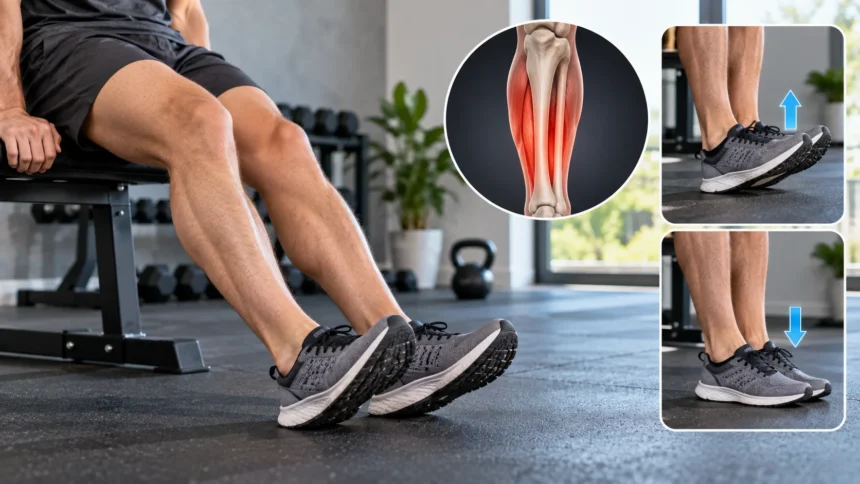
Tibia raises are a simple lower-leg exercise that strengthen the muscles along the front of the shin, especially the tibialis anterior. These muscles help lift the foot, control the ankle, and support walking, running, and balance. Although calf exercises get more attention, training the front of the lower leg can help create better muscular balance around the ankle.
The exercise is easy to perform with body weight and requires very little equipment. You can do tibia raises against a wall, from a standing position, or with resistance when you need a greater challenge. Good form matters because rushing through repetitions or using momentum can reduce the amount of work performed by the target muscles.
Tibia raises can be useful for runners, athletes, gym beginners, and anyone wanting stronger ankles and lower legs. They may also complement calf strengthening, mobility work, and general lower-body training. This guide explains how to perform tibia raises correctly, their benefits, common mistakes, progressions, and practical tips for adding them to your routine.
What Are Tibia Raises?
Tibia raises, often called tibialis raises, are exercises designed to strengthen the muscles at the front of the lower leg. The movement mainly involves dorsiflexion, which means pulling the toes and front of the foot upward toward the shin. The heels usually stay planted while the forefoot lifts away from the floor.
The tibialis anterior is the main muscle involved, although other smaller muscles around the lower leg also assist the movement. This muscle helps control the foot as it contacts the ground during walking and running. It also helps prevent the toes from dragging when the leg swings forward.
Unlike calf raises, which involve lifting the heels and pushing through the toes, tibia raises work the opposite side of the lower leg. Training both movement patterns can create more balanced ankle strength. This can be useful for everyday movement and activities that require repeated running, jumping, or changes in direction.
Muscles Worked During Tibia Raises
The tibialis anterior is the primary muscle targeted during tibia raises. It runs along the front and outer portion of the shin and helps lift the foot toward the lower leg. When you raise your toes while keeping your heels on the floor, this muscle contracts strongly to produce the movement.
Other muscles that assist with ankle dorsiflexion include the extensor hallucis longus and extensor digitorum longus. These muscles also help control the toes and foot during movement. Although tibia raises do not isolate one muscle perfectly, the exercise places significant emphasis on the front of the lower leg.
The calves work differently during the exercise because they are positioned on the opposite side of the lower leg. Balanced lower-leg training should generally include both dorsiflexion and plantar flexion movements. Pairing tibia raises with calf raises can help strengthen the muscles surrounding the ankle from both directions.
How to Do Tibia Raises With Proper Form
Stand with your back against a wall and place your feet slightly forward so your heels remain firmly on the ground. Keep your knees comfortably straight or slightly soft rather than locked. Your body should feel supported by the wall so you can focus on moving the ankles instead of worrying about balance.
Lift your toes and the front of both feet toward your shins while keeping your heels planted. Raise them as high as you comfortably can, pause briefly at the top, and feel the muscles along the front of your lower legs contract. Avoid leaning forward or bending excessively at the hips to create the movement.
Slowly lower the front of your feet back toward the floor without allowing them to drop suddenly. Repeat the movement using a controlled tempo throughout the set. If your form begins to deteriorate, end the set rather than forcing extra repetitions with momentum or a reduced range of motion.
Benefits of Tibia Raises
One major benefit of tibia raises is improved strength at the front of the lower leg. These muscles help lift and control the foot during each step you take. Strengthening them may improve your ability to manage repeated walking, running, and other movements that require ankle control.
Tibia raises can also complement calf training by strengthening the opposing side of the ankle. Many lower-body routines include frequent calf raises but very little direct dorsiflexion work. Adding tibia raises creates a more balanced program and can expose weak areas that might otherwise receive little specific training.
Another benefit is that the exercise is easy to scale. Beginners can start with body weight, while stronger individuals can increase the challenge using a steeper body angle, resistance bands, specialized equipment, or weighted variations. This makes tibia raises useful across different experience levels and training goals.
Tibia Raises for Runners
Runners repeatedly lift the front of the foot during the swing phase of each stride. The tibialis anterior also helps control how the foot lowers after the heel contacts the ground. These repeated actions mean the muscles at the front of the shin can experience significant workload over longer runs.
Strengthening these muscles may improve lower-leg endurance and help runners tolerate repeated dorsiflexion demands. However, tibia raises should be treated as one part of a complete running strength program. Hip strength, calf capacity, foot control, training volume, and overall recovery also matter.
Running discomfort is not always caused by weak shins, so avoid assuming one exercise will solve every problem. If you experience issues elsewhere after training, such as hip pain after running, the cause may involve a different part of the movement chain. Persistent pain deserves individual assessment rather than a one-exercise solution.
How Many Tibia Raises Should You Do?
Beginners can start with two or three sets of about 10 to 15 controlled repetitions. The goal should be feeling the muscles at the front of the shins working without losing control. If that range feels too difficult, reduce the repetitions and focus on performing each one with good technique.
As endurance improves, gradually increase the number of repetitions or the difficulty of the variation. Higher-repetition sets can work well because the tibialis anterior is active repeatedly during walking and running. However, simply chasing large numbers is less useful if you begin bouncing or shortening the movement.
You can perform tibia raises two or three times per week as part of a general lower-body routine. More frequent training may be appropriate for some people, but recovery still matters. Increase volume gradually, particularly if you are also running, jumping, or doing other activities that heavily load the lower legs.
Common Tibia Raise Mistakes
One common mistake is lifting the feet too quickly and allowing them to drop back to the floor. This reduces muscular control and turns the exercise into a bouncing movement. Slowing down the lowering phase keeps the target muscles working longer and makes a simple body-weight variation more challenging.
Another mistake is moving from the knees or hips instead of isolating the ankle. The heels should remain planted while the toes lift toward the shins. If your whole body rocks forward and backward, reposition your feet or stand closer to the wall until you can control the movement properly.
Some people also use too small a range of motion. You do not need to force your toes as high as possible, but you should move through a comfortable range that produces a clear contraction. A slightly smaller controlled movement is better than a larger range achieved through momentum or uncomfortable joint positioning.
Tibia Raise Variations and Progressions
Wall-supported tibia raises are usually the easiest place to begin because they provide stability and allow you to focus on ankle movement. Moving your feet farther away from the wall changes the angle and can increase the challenge. This simple adjustment lets you progress without adding equipment.
Resistance bands can also make the movement more difficult. Secure a band in front of your foot and pull the toes toward the shin against resistance. This variation works well when you want more direct loading and gives you greater control over how much resistance you use.
Advanced trainees may use a tibialis machine, weighted attachment, or other equipment designed specifically for dorsiflexion. These options can provide more progressive overload than body-weight variations. However, they are not required for most beginners, and basic wall raises can remain effective when performed with good form.
How to Add Tibia Raises to Leg Workouts
Tibia raises fit easily into most lower-body workouts because they do not require much setup. You can perform them after squats, lunges, deadlifts, or other compound movements. Placing them near the end of a workout often works well because they do not need to interfere with heavier exercises.
They also pair naturally with calf raises. For example, you could perform one set of standing calf raises followed by a set of tibia raises. This trains both plantar flexion and dorsiflexion, giving the lower leg a more balanced stimulus without adding much extra workout time.
Runners can include tibia raises on strength-training days or after easier running sessions if the lower legs are not excessively fatigued. Avoid suddenly adding very high volumes, especially when increasing running distance at the same time. Gradual progression usually produces better tolerance than making several training changes at once.
Tibia Raises and Ankle Mobility
Tibia raises strengthen dorsiflexion, but strength and mobility are not exactly the same thing. Ankle mobility refers partly to how far the ankle can move through a particular range, while tibia raises focus on actively controlling movement. Both can be useful depending on your needs.
If your ankles feel stiff during squats or walking, strengthening the tibialis anterior may help improve active control. However, limited mobility can also come from calf stiffness, joint structure, previous injury, or other factors. Tibia raises should therefore not be treated as a guaranteed fix for every mobility restriction.
Combining tibia raises with gentle ankle mobility exercises can provide a more complete approach. Controlled ankle circles, calf stretching, and knee-over-toe mobility drills may complement strengthening when they feel comfortable. The best combination depends on whether your main limitation involves strength, stiffness, pain, or movement control.
When Tibia Raises May Not Be Appropriate
Mild muscle fatigue or a burning sensation along the front of the shin can be normal during a challenging set. Sharp pain, sudden swelling, or pain that worsens with each repetition is different. Stop the exercise if symptoms feel unusual rather than assuming that all discomfort means the muscles are getting stronger.
People recovering from a recent ankle fracture, severe sprain, surgery, or significant lower-leg injury should follow professional guidance before adding resistance exercises. The appropriate timing depends on healing and the specific structures involved. Returning to strengthening too early can sometimes interfere with recovery.
Persistent shin pain can have several causes, including training overload and stress injuries. If pain continues during walking, running, or daily activities despite reducing your training load, consider professional evaluation. A healthcare professional or physical therapist can help determine whether tibia raises are appropriate for your particular symptoms.
Tips for Better Tibia Raise Results
Focus on controlled repetitions rather than simply completing the set as quickly as possible. A brief pause at the top followed by a slow lowering phase makes each repetition more deliberate. This also helps you notice whether one side feels weaker or fatigues faster than the other.
Progress gradually once your current variation becomes easy. You can increase repetitions, change your body angle, add resistance, or move to single-leg work if appropriate. Avoid increasing every variable at once because gradual overload makes it easier to identify how your lower legs are responding.
Consistency is more important than performing extremely difficult sessions occasionally. Adding a few sets to your regular lower-body routine can provide enough stimulus without overwhelming the muscles. Track your form, repetitions, and resistance so you can see whether your strength improves over time.
Conclusion
Tibia raises are a simple exercise for strengthening the tibialis anterior and other muscles along the front of the lower leg. These muscles help lift the foot, control ankle movement, and support activities such as walking and running. The exercise also complements traditional calf work by training the opposite side of the lower leg.
Proper technique involves keeping the heels planted, lifting the toes toward the shins, and controlling both the upward and downward phases. Beginners can start with wall-supported body-weight raises before gradually adding more repetitions or resistance. Good form matters more than trying to complete the highest possible number of repetitions.
Add tibia raises to a balanced lower-body routine rather than relying on them as a solution for every ankle or shin problem. Strength, mobility, running volume, footwear, recovery, and other muscles all influence lower-leg function. Stop and seek appropriate advice if the exercise causes sharp, persistent, or worsening pain.
FAQs
What muscles do tibia raises work?
Tibia raises mainly strengthen the tibialis anterior at the front of the lower leg. Other muscles involved in ankle dorsiflexion also assist when you lift the toes toward the shin.
Are tibia raises good for runners?
They can be useful for runners because the front shin muscles repeatedly control the foot during each stride. They work best as part of a broader strength and running program.
How many tibia raises should beginners do?
Beginners can start with two or three sets of roughly 10 to 15 controlled repetitions. Adjust the number according to strength, fatigue, technique, and other lower-leg training.
Can I do tibia raises every day?
Daily training is not necessary for most people. Performing tibia raises two or three times per week can be enough, especially when your legs also receive significant loading from running or sports.
Should tibia raises hurt?
You may feel muscular fatigue or burning at the front of the shin, but sharp or worsening pain is not expected. Stop the exercise and seek advice if unusual pain persists.