

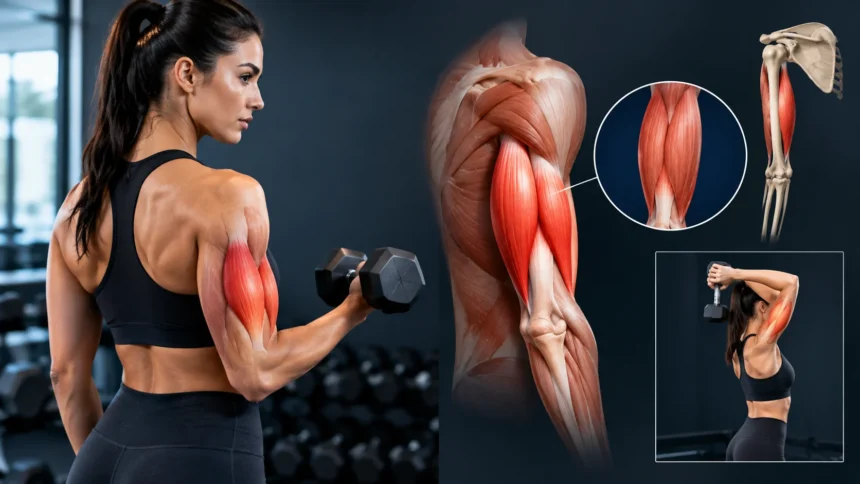
The tricep is one of the major muscles of the upper arm and plays an important role in pushing, lifting, throwing, and straightening the elbow. Although many people think of it mainly as a gym muscle, the tricep is involved in countless everyday movements, from pushing open a door to getting up from a chair.
Understanding tricep anatomy can help you train the upper arms more effectively and recognize how different movements involve the muscle. Learning its structure, functions, and common exercises also makes it easier to build balanced arm strength without relying on random workouts or excessive weight.
What Is the Tricep?
The tricep, more accurately called the triceps brachii, is a large muscle located along the back of the upper arm. Its name comes from the fact that it has three separate heads. These muscle sections work together to help straighten the elbow and support several movements involving the shoulder and arm.
The triceps brachii sits opposite the biceps on the upper arm. While the biceps is strongly involved in bending the elbow, the triceps performs the opposite action by extending it. This relationship allows the arm to move smoothly in both directions during daily activities, sports, and resistance training.
The tricep also makes up a significant portion of upper-arm muscle mass. For people trying to build bigger or stronger arms, training the triceps is just as important as training the biceps. A balanced approach can improve both appearance and functional pushing strength.
Tricep Anatomy Explained
The triceps brachii runs along the back of the upper arm and connects the shoulder and upper-arm region to the forearm near the elbow. All three heads eventually come together and attach through a common tendon. This structure allows the muscle to generate force whenever the elbow needs to straighten.
Each tricep head begins from a slightly different location. The long head originates from the shoulder blade, while the lateral and medial heads originate from different areas of the upper-arm bone. Because of these different starting points, certain arm positions may emphasize one portion more than another.
The three heads still work together during most pushing and elbow-extension movements. It is difficult to completely isolate one head while excluding the others. However, adjusting shoulder position, grip, and exercise angle can slightly change how strongly each part of the triceps contributes.
What Are the Three Heads of the Tricep?
The long head is the largest portion of the triceps and runs along the inner-back side of the upper arm. Because it crosses both the shoulder and elbow joints, it contributes to elbow extension and certain shoulder movements. Overhead exercises often place the long head in a more stretched position.
The lateral head sits more toward the outer side of the upper arm. It becomes highly active during many pressing and pushing movements, particularly when greater force is required. This part of the muscle contributes significantly to the defined shape people often associate with well-developed triceps.
The medial head lies deeper than the other two heads and is active during most elbow-extension movements. Although it is less visible, it plays an important role in controlling and stabilizing elbow extension. Strong development of all three heads supports balanced tricep strength and overall upper-arm function.
What Is the Main Function of the Tricep?
The primary function of the tricep is elbow extension, which means straightening the arm at the elbow joint. Every time you push something away from your body or straighten your arm after bending it, the triceps becomes involved. This makes it essential for both everyday movement and exercise.
The long head of the triceps also assists with movements at the shoulder because it crosses the shoulder joint. It can help bring the upper arm backward and toward the body. This additional role makes the triceps more than simply an elbow-straightening muscle.
Tricep strength also supports joint stability during pressing movements. When you perform exercises such as push-ups, bench presses, or overhead presses, the triceps helps complete the movement as the elbows straighten. Weak triceps can therefore limit performance during many upper-body exercises.
How the Tricep Works in Everyday Movement
You use your triceps whenever you push a door, move furniture, push yourself out of a chair, or place an object onto a high shelf. These activities require some degree of elbow extension. Even simple tasks can become more difficult when the muscles at the back of the upper arm are weak.
The triceps also contributes to sports that involve throwing, pushing, or forceful arm extension. Basketball passes, certain swimming strokes, racket sports, and throwing activities all require coordinated upper-arm movement. The triceps works with the shoulders, chest, forearms, and back muscles to produce smooth motion.
Daily function depends on coordination rather than one muscle working alone. Strong triceps are useful, but they should be developed alongside the biceps, shoulders, chest, and upper back. Balanced strength supports better movement and reduces the tendency to rely too heavily on one muscle group.
Why Tricep Strength Matters
Strong triceps improve your ability to perform pushing movements. Whether you are doing a push-up, pressing a weight overhead, or pushing an object away from your body, the triceps helps finish the movement. Building strength here can improve both exercise performance and everyday physical capability.
Tricep strength can also support more stable elbow movement. The muscle and its tendon contribute to controlling how the elbow extends under resistance. Developing strength gradually can help the arm tolerate normal training demands without depending entirely on the shoulder or chest muscles.
For people interested in arm development, tricep training is especially important because the muscle occupies a large portion of the upper arm. Focusing only on curls may produce limited results. A balanced arm program normally includes both pulling exercises for the biceps and pushing or extension exercises for the triceps.
Best Exercises for the Triceps
Close-grip push-ups are a simple bodyweight exercise that places strong demand on the triceps. Keeping the hands closer than in a standard push-up generally increases elbow extension work. Beginners can perform the movement against a wall, bench, or elevated surface before progressing to the floor.
Tricep pushdowns are another popular option when a cable machine or resistance band is available. The movement involves keeping the upper arms relatively still while straightening the elbows against resistance. Controlled repetitions help keep tension on the triceps without requiring extremely heavy weight.
Overhead tricep extensions can place the long head under greater stretch because the arms are raised above the head. Dumbbells, cables, or resistance bands can all be used. Dips and pressing exercises also train the triceps, although proper technique and suitable resistance are important for shoulder and elbow comfort.
Tricep Stretching and Mobility
Stretching the triceps can help maintain comfortable movement around the shoulder and elbow, especially after upper-body exercise. A common stretch involves raising one arm overhead, bending the elbow, and gently guiding the elbow backward with the opposite hand. The movement should create mild tension rather than sharp discomfort.
Mobility work should involve the whole body rather than focusing only on one muscle. If your routine includes broader flexibility exercises, a gentle Happy Baby pose can complement upper-body stretching by adding hip and lower-body mobility. Combining different movements can make a general mobility routine more balanced.
Stretching alone does not automatically improve strength or prevent every injury. It works best alongside controlled resistance training, appropriate recovery, and gradual progression. Avoid forcing the elbow or shoulder into uncomfortable positions simply to create a stronger stretching sensation.
Common Tricep Pain and Injuries
Tricep discomfort can occur after unfamiliar or intense exercise, particularly when training volume increases too quickly. Normal post-workout soreness often develops gradually and improves over several days. Sharp pain, sudden weakness, or significant swelling is different and deserves more careful attention.
The triceps tendon can also become irritated from repeated pressing, throwing, or heavy extension movements. Pain may be felt near the back of the elbow where the tendon attaches. Continuing to load a painful tendon aggressively can make symptoms more difficult to manage.
More serious tricep injuries are less common but can occur during heavy lifting, falls, or sudden forceful movements. A noticeable loss of strength, bruising, or inability to straighten the elbow normally may require professional assessment. Training through severe pain is not a useful way to build muscle or strength.
How to Strengthen the Triceps Safely
Start with resistance that allows you to control every repetition. The triceps responds to progressive overload, but increasing weight too quickly can make technique break down. Smooth repetitions and a comfortable range of motion are generally more useful than forcing heavy loads with poor elbow or shoulder positioning.
Use a combination of compound and isolation exercises. Presses and push-ups train the triceps alongside the chest and shoulders, while pushdowns and extensions place more direct emphasis on elbow extension. This variety can help develop strength through different movement patterns without relying on a single exercise.
Recovery matters as well. Muscles need time to adapt after demanding training, especially when several upper-body exercises target the triceps in the same workout. Allow enough recovery between hard sessions and reduce volume if persistent soreness or joint discomfort begins interfering with normal movement.
Key Facts About the Tricep
The triceps brachii contains three heads: the long, lateral, and medial heads. All three contribute to elbow extension, although their involvement can vary slightly depending on arm position and exercise selection. The long head is unique because it also crosses the shoulder joint.
The triceps works during nearly every major pushing exercise. Bench presses, overhead presses, push-ups, dips, and many throwing movements depend on strong elbow extension. This is why tricep weakness can sometimes become a limiting factor even when the chest or shoulders feel strong.
You do not need dozens of different exercises to develop the triceps effectively. Consistent training, appropriate resistance, and good technique matter more than constantly changing movements. A few well-chosen exercises performed regularly can build strength, endurance, and muscle over time.
Conclusion
The tricep is a major upper-arm muscle responsible primarily for straightening the elbow. It consists of three heads that work together during pushing, pressing, throwing, and many everyday movements. The long head also contributes to movement around the shoulder.
Building strong triceps can improve upper-body performance, arm strength, and the ability to complete common pushing movements. Exercises such as push-ups, pushdowns, presses, and overhead extensions can all train the muscle effectively when performed with controlled technique.
A balanced approach is the best way to train the triceps. Combine appropriate strengthening exercises with recovery, mobility work, and training for surrounding muscle groups. Gradual progression and good form are more valuable than using excessive weight or performing unnecessary amounts of exercise.
FAQs
What is the tricep?
The tricep, or triceps brachii, is the large muscle at the back of the upper arm. Its main job is to straighten the elbow during pushing and extension movements.
How many muscles are in the tricep?
The triceps brachii is one muscle with three separate heads: the long head, lateral head, and medial head. These sections work together during most elbow-extension movements.
What exercise works the triceps best?
There is no single best exercise for everyone. Pushdowns, close-grip push-ups, presses, dips, and overhead extensions can all effectively train the triceps when performed with good technique.
Why does my tricep hurt after exercise?
Mild soreness may occur after unfamiliar or challenging training. Sharp pain, swelling, significant weakness, or discomfort that does not improve may indicate an injury that needs further assessment.
Do push-ups work the triceps?
Yes. Push-ups train the chest, shoulders, and triceps together. Narrower hand positions generally increase the amount of work placed on the triceps compared with wider push-up variations.