

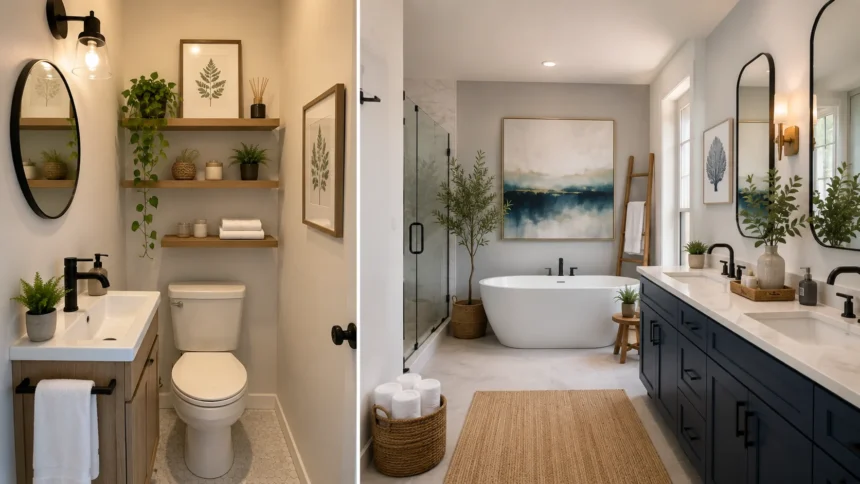
Bathroom Wall Decor Ideas for Small and Large Spaces
The right bathroom wall decor ideas can completely change how a bathroom feels without requiring a full renovation. Walls take up a large amount of visual space, so even a few thoughtful changes can make the room feel brighter, more polished, more spacious, or more luxurious. Whether you have a compact powder room or a large primary bathroom, wall decor gives you an opportunity to introduce personality while keeping the space practical.
Small bathrooms often benefit from decor that creates visual openness rather than overwhelming the room. Mirrors, light-colored artwork, floating shelves, subtle patterns, and streamlined accessories can make a limited space feel more intentional. In larger bathrooms, homeowners have greater freedom to experiment with oversized artwork, feature walls, decorative paneling, gallery arrangements, and architectural details that might feel too dominant in a smaller room.
Bathroom decorating also requires more consideration than decorating a bedroom or living room. Moisture, humidity, splashes, ventilation, and cleaning products can affect materials over time. Choosing moisture-resistant bathroom decor, sealed artwork, suitable frames, waterproof finishes, and durable wall coverings can help decorative features remain attractive instead of becoming damaged.
The goal is not to fill every empty wall. Effective bathroom wall decoration balances style with breathing room and functionality. By considering wall size, lighting, bathroom layout, color palette, storage requirements, and moisture levels, you can create walls that enhance the overall atmosphere rather than simply adding more objects to the room.
Start With the Size and Layout of Your Bathroom
Before purchasing wall art or installing shelves, study how much open wall space you actually have. Bathrooms contain mirrors, vanities, showers, doors, windows, towel bars, cabinets, and plumbing fixtures that naturally divide the walls into smaller sections. Understanding these visual zones makes it easier to choose decor that fits comfortably instead of competing with functional elements.
In a small bathroom, decorating every available wall can quickly create visual clutter. It is often better to select one or two areas that naturally attract attention, such as the wall above the toilet, beside the vanity, or opposite the entrance. Leaving some walls relatively simple gives the room greater visual breathing space.
Large bathrooms can feel unfinished when walls remain completely empty. Wider walls can support larger artwork, decorative molding, wall-mounted lighting, architectural panels, or carefully arranged groups of objects. The additional space allows you to create stronger focal points while still maintaining separation between decorative features.
Measure walls before buying anything. A beautiful piece that looks perfectly proportioned online may feel surprisingly small on a wide bathroom wall or excessively large above a compact vanity. Choosing decor based on actual dimensions creates a more balanced result and helps prevent unnecessary purchases.
Use Mirrors to Add Style and Make Bathrooms Feel Larger
Mirrors are among the most practical small bathroom wall decor ideas because they serve a functional purpose while visually expanding the room. A generously sized mirror reflects light and surrounding surfaces, making compact bathrooms feel less enclosed. Choosing a mirror with an attractive frame also allows it to function as a decorative feature.
Instead of automatically selecting a standard rectangular mirror, consider shapes that complement the room. Round mirrors can soften bathrooms dominated by straight lines, while arched mirrors introduce architectural interest. Oval, pill-shaped, irregular, and softly curved mirrors can create a more contemporary appearance without requiring additional decorative accessories.
In a larger bathroom with a double vanity, you can install two separate mirrors above individual sinks or use one wide statement mirror. Matching mirrors create symmetry, while oversized designs can make the vanity wall feel more luxurious. Wall sconces positioned around mirrors can further strengthen the visual composition.
Mirror frames should coordinate with surrounding finishes without needing to match them exactly. Black frames create graphic contrast, warm wood adds natural character, metallic finishes introduce elegance, and frameless designs provide a minimalist look. Consider how the frame works with faucets, lighting fixtures, cabinet hardware, and nearby bathroom accessories.
Hang Bathroom-Friendly Artwork
Artwork is one of the easiest ways to make a bathroom feel more personal. Prints, photography, illustrations, abstract art, botanical designs, landscapes, and minimalist compositions can introduce color and character without taking up valuable floor or counter space. The key is choosing pieces that visually complement the bathroom rather than treating wall art as an afterthought.
For small bathrooms, one medium-sized piece often works better than several tiny frames. Too many small objects can make limited walls appear crowded. A single artwork above the toilet or on an empty wall can provide enough personality while maintaining the clean, open appearance that smaller bathrooms usually benefit from.
Large bathrooms can accommodate oversized artwork or a coordinated pair of prints. A substantial piece can anchor an empty wall near a freestanding bathtub, dressing area, or vanity. When ceilings are high, vertically oriented artwork can help connect lower bathroom fixtures with the upper portion of the wall.
Humidity should influence your artwork choices. Avoid placing delicate originals or moisture-sensitive materials in areas exposed to excessive steam or splashing. Framed prints behind protective glazing, sealed artwork, metal prints, and other durable formats are generally more practical choices for bathrooms that experience regular humidity.
Create a Bathroom Gallery Wall
A gallery wall can add personality to a bathroom when it is carefully scaled and organized. Instead of relying on one large artwork, you can combine smaller prints, photographs, typography-free illustrations, sketches, or botanical images into a coordinated composition. Repeating colors or frame styles helps multiple pieces feel connected.
Small bathrooms require restraint. A mini gallery of three or four pieces may be enough to decorate an empty wall without making the space look busy. Maintain consistent spacing between frames and avoid extending the arrangement too close to surrounding fixtures, doors, or shelving.
Larger bathrooms offer room for more elaborate gallery walls. You might combine different frame sizes while maintaining a shared color palette or artistic theme. An arrangement positioned opposite the vanity or along an open wall can add visual richness to a bathroom that might otherwise feel overly plain.
Before making holes in the wall, arrange the frames on the floor or create paper templates matching their dimensions. This allows you to experiment with positioning and spacing. Planning beforehand is particularly useful in bathrooms because fixtures restrict where frames can comfortably fit.
Install Floating Shelves for Decor and Storage
Floating shelves combine bathroom wall decor with practical storage, making them especially helpful in rooms where floor and counter space are limited. A shelf above the toilet, beside a vanity, or on an unused wall can hold attractive everyday items while making the bathroom feel more organized.
Style shelves with a mix of useful and decorative objects. Folded hand towels, small baskets, ceramic containers, candles, plants, and attractive toiletries can create a relaxed composition. Avoid overcrowding each shelf, because some negative space helps individual pieces stand out.
In small bathrooms, narrow shelves are usually more proportionate than deep shelving. They provide enough room for lightweight accessories without protruding too far into circulation areas. Matching the shelf finish with the vanity or other wood elements can also create visual continuity.
Large bathrooms can support wider shelving arrangements or several vertically stacked shelves. These can fill empty walls while adding functional storage. Keep heavier everyday items within comfortable reach and reserve upper shelves for lighter decorative accessories that are used less frequently.
Decorate the Wall Above the Toilet
The area above the toilet is one of the most frequently overlooked decorating opportunities in a bathroom. Because the floor space is already occupied, using the wall adds visual interest without reducing usable room. This makes it particularly valuable in compact bathrooms and powder rooms.
A framed print, decorative mirror, floating shelf, shallow wall cabinet, or small group of coordinated artwork can work well in this location. Keep the decoration centered relative to the toilet rather than centering it automatically on the entire wall, especially when the toilet is positioned asymmetrically.
Shelving above the toilet can also provide practical storage for extra toilet paper, folded towels, or attractive containers. However, shelves should be installed high enough that they do not interfere with comfortable movement or make the person using the toilet feel enclosed.
Avoid stacking too many decorative items in this area. Because the toilet itself already creates a strong visual shape, wall decor should complement rather than compete with it. A simple, well-proportioned arrangement often looks more polished than multiple unrelated accessories.
Try Wallpaper for a Stronger Visual Impact
Wallpaper can transform a bathroom faster than almost any other wall treatment. Botanical patterns, geometric designs, subtle textures, stripes, and abstract prints can introduce personality even when the bathroom fixtures themselves are relatively simple. Powder rooms are particularly well suited to expressive wallpaper because their smaller size allows stronger designs to feel intentional.
In small bathrooms, wallpaper can actually make the room more interesting rather than automatically making it feel smaller. A consistent pattern across several walls creates a cohesive visual envelope, while vertical patterns can make ceilings appear taller. Softer patterns can provide texture without dominating limited space.
Large bathrooms can use wallpaper to define a specific area instead of covering every wall. Consider applying it behind the vanity, around a freestanding tub, or on a wall opposite the shower. This creates a bathroom accent wall while allowing surrounding surfaces to remain calmer.
Choose wallpaper suitable for the bathroom’s moisture conditions and ensure the room has adequate ventilation. Areas directly exposed to water generally require more durable waterproof finishes. Proper installation is equally important because poorly sealed edges can become vulnerable in consistently humid spaces.
Create a Feature Wall With Tile
Tile is not limited to showers and backsplashes. Extending decorative tile across an entire wall can turn an ordinary bathroom into a sophisticated space. Stone-look tile, terrazzo, zellige-inspired surfaces, subway tile, mosaics, and large-format designs can all provide distinct visual effects.
A tiled vanity wall works particularly well because it creates a strong backdrop for the mirror, lighting, and cabinetry. In small bathrooms, using the same tile across a larger continuous area can sometimes make the room feel more cohesive than breaking the walls into multiple contrasting finishes.
Large bathrooms provide additional opportunities for dramatic tile installations. A floor-to-ceiling tiled wall behind a freestanding bathtub can create a luxurious focal point, while large-format slabs can produce a clean and contemporary appearance with fewer visible grout lines.
Consider how strongly patterned tile will interact with flooring and countertops. When one surface has significant visual movement, quieter surrounding materials usually create better balance. The goal is to establish one clear focal point rather than having every surface compete for attention.
Add Wall Paneling for Architectural Character
Wall paneling can introduce depth and architectural interest into bathrooms that otherwise feel flat. Beadboard, board-and-batten, vertical paneling, decorative molding, and half-wall treatments can work across traditional, transitional, coastal, farmhouse, and contemporary interiors.
In a small bathroom, installing paneling on the lower portion of the walls can provide visual structure without overwhelming the room. Painting it the same color as the upper wall creates a subtle textured effect, while contrasting colors produce a stronger decorative statement.
Large bathrooms can handle taller paneling or more elaborate molding designs. Full-height decorative panels can make large walls feel finished and provide the character sometimes missing from newer homes with simple drywall surfaces.
Because bathrooms experience moisture, use materials and finishes appropriate for humid environments. Proper sealing, moisture-resistant substrates, suitable paint, and good ventilation help decorative wall treatments maintain their appearance over time.
Bring Nature Indoors With Bathroom Plants
Plants introduce natural texture and color, making them useful additions to bathrooms dominated by hard surfaces such as ceramic tile, stone, glass, and metal. Even one well-positioned plant can soften the room and make it feel more welcoming.
Wall-mounted planters can work in small bathrooms where vanity and floor space are limited. Small trailing plants positioned on shelves can also provide greenery without interfering with daily routines. Choose plants according to the bathroom’s actual light and humidity conditions rather than assuming every plant thrives in humid environments.
Large bathrooms can support more dramatic greenery. A tall plant placed near a bright window or a grouping of plants around a freestanding bathtub can create a spa-inspired atmosphere. Hanging plants can also emphasize ceiling height without adding furniture.
Artificial plants can be practical in bathrooms with very limited natural light. High-quality artificial greenery can provide visual softness without requiring specific growing conditions. Keep the styling restrained so plants support the bathroom design rather than making the room feel crowded.
Add Decorative Wall Sconces
Lighting can function as decoration rather than simply serving a practical purpose. Wall sconces beside or above a mirror create visual symmetry, frame the vanity, and provide another opportunity to introduce metal, glass, or sculptural shapes.
In smaller bathrooms, streamlined sconces can add sophistication without consuming valuable surface area. Fixtures with simple silhouettes help maintain an open appearance, while warm diffused lighting can make hard bathroom surfaces feel less clinical.
Large bathrooms can accommodate more substantial decorative fixtures. Oversized sconces, double-arm lights, or sculptural wall lamps can fill vertical space and strengthen the connection between mirrors, cabinetry, and surrounding architecture.
Consider both appearance and function when selecting fixtures. Vanity lighting should provide useful illumination for grooming while avoiding harsh shadows. Proper bathroom-rated fixtures should also be chosen where electrical codes or moisture exposure require them.
Use Paint to Turn a Wall Into a Feature
Paint remains one of the most affordable ways to transform bathroom walls. A carefully chosen color can alter the perceived warmth, size, mood, and overall style of the room without adding physical objects.
Light neutrals, soft greens, muted blues, warm whites, and gentle earthy tones can help small bathrooms feel calm and open. Painting walls and trim in closely related colors can reduce visual interruptions, which may make compact spaces appear more continuous.
Large bathrooms can handle richer colors such as deep green, charcoal, navy, chocolate brown, or saturated earth tones. A darker wall behind a light vanity or bathtub can create contrast and make architectural elements feel more deliberate.
Do not choose bathroom paint solely from a small sample viewed in another room. Bathroom lighting, tile color, mirrors, and artificial illumination can dramatically affect how paint appears. Test samples on several walls and observe them at different times of day before making a final decision.
Add Decorative Hooks That Work as Wall Accessories
Hooks are among the simplest ways to combine style and practicality. Instead of treating towel hooks as basic hardware, choose designs that contribute to the overall bathroom aesthetic through their material, shape, and finish.
A row of matching hooks can create visual rhythm while providing storage for towels, robes, baskets, or lightweight accessories. This approach works particularly well in narrow bathrooms where traditional towel bars may consume too much horizontal wall space.
In larger bathrooms, decorative hooks can define specific areas. Install them near a bathtub for robes, close to the shower for towels, or near the door for frequently used items. Matching or coordinating hardware helps these functional elements feel intentionally integrated.
Avoid installing more hooks than you genuinely need. Too many towels or hanging objects can quickly make bathroom walls look cluttered. Combining practical storage with a few open spaces keeps the room visually calm.
Use Baskets as Decorative Wall Storage
Wall-mounted baskets provide texture and useful storage without requiring conventional cabinetry. Woven materials introduce warmth, which can balance bathrooms containing glossy tile, metal fixtures, mirrors, and stone surfaces.
In small bathrooms, shallow baskets can hold rolled hand towels, toiletries, or spare supplies while keeping counters clear. Vertical arrangements make better use of narrow wall areas that might otherwise remain unused.
Large bathrooms can accommodate larger woven storage features, particularly in dressing or bathing zones. Combining wall baskets with natural wood, linen, and neutral colors can support a relaxed spa-like bathroom design.
Keep moisture exposure in mind when choosing natural fibers. Baskets should be located away from direct splashes and allowed to dry properly in humid conditions. Synthetic woven alternatives can provide a similar appearance where greater moisture resistance is needed.
Decorate Around a Freestanding Bathtub
A freestanding bathtub naturally creates a visual focal point, but the wall behind it often determines whether the area feels complete. Leaving the space entirely blank can work in very minimalist bathrooms, although many rooms benefit from one carefully chosen decorative element.
Large artwork can provide an elegant backdrop without competing with the sculptural shape of the bathtub. Alternatively, decorative paneling, stone-look surfaces, wallpaper, or architectural molding can transform the entire wall instead of relying on framed pieces.
Built-in niches or slim ledges can also combine decoration with practical storage. Candles, bath accessories, small plants, and decorative containers can be displayed while keeping the bathtub edge relatively uncluttered.
Avoid hanging anything heavy or fragile directly where water exposure or accidental contact could create problems. The wall behind the tub should feel visually impressive but still remain comfortable and practical for everyday bathing.
Make Small Bathroom Walls Feel Bigger
When decorating a compact bathroom, creating visual continuity is often more effective than adding numerous small decorations. Large mirrors, consistent paint colors, streamlined shelves, and simple artwork allow the eye to move through the room without frequent interruptions.
Vertical elements can also make a small bathroom feel taller. Narrow artwork, vertically stacked shelves, tall mirrors, and vertical wall paneling naturally guide the eye upward. This can emphasize ceiling height and reduce the feeling of horizontal confinement.
Reflective and light-enhancing materials can increase brightness. Mirrors, glossy tiles, glass, pale finishes, and strategic lighting help distribute available light around the room. However, too many reflective surfaces can feel cold, so consider introducing wood, textiles, plants, or matte finishes for balance.
Keep countertops and walls from competing visually. If the vanity already contains many everyday objects, simpler walls often produce a cleaner overall effect. Good small bathroom decor is usually about deliberate editing rather than maximizing the number of decorative elements.
Fill Large Bathroom Walls Without Making Them Feel Empty
Large bathrooms present the opposite challenge: walls can feel unfinished when decorations are too small. A single miniature frame on a broad wall tends to emphasize emptiness rather than solve it. Larger pieces or grouped arrangements usually create better proportions.
Oversized mirrors, statement artwork, tall decorative panels, and substantial lighting fixtures can visually anchor expansive walls. The scale should relate to nearby furniture and architectural elements rather than being chosen independently.
Large bathrooms can also be divided into visual zones. The vanity area might use mirrors and sconces, the bathing area could feature artwork or textured wall treatments, and a dressing section might include decorative hooks or shelving.
Avoid filling every wall simply because space exists. Large rooms still need negative space for visual calm. Creating two or three strong focal areas generally produces a more sophisticated result than distributing small decorations evenly across every available surface.
Choose a Consistent Bathroom Color Palette
A coherent color palette helps different wall decorations feel intentional rather than random. Start with existing permanent materials such as floor tile, countertops, cabinetry, shower tile, and plumbing fixtures before choosing artwork and accessories.
For a calm spa-inspired bathroom, use soft neutrals, warm whites, muted greens, stone shades, wood tones, and gentle natural textures. These colors can create a relaxed atmosphere without requiring excessive decoration.
For a more dramatic bathroom, introduce deeper tones through paint, wallpaper, artwork, or tile. Navy, dark green, terracotta, charcoal, and rich brown can add sophistication when balanced with adequate lighting and lighter surfaces.
Repeating one or two accent colors across several decorative elements creates visual consistency. A shade appearing in artwork might also appear subtly in towels, containers, or small accessories. Repetition connects the room without requiring every item to match exactly.
Create a Spa-Inspired Bathroom Wall
Spa-inspired bathrooms usually rely on simplicity rather than excessive decoration. Natural materials, soft colors, uncluttered surfaces, warm lighting, and restrained artwork can create a relaxing environment that feels more deliberate than heavily decorated spaces.
Consider wood-tone shelving, botanical artwork, textured wall finishes, simple mirrors, and muted neutral paint. Greenery can introduce natural movement while ceramic accessories provide subtle variation in shape and texture.
Large bathrooms can incorporate stone-look accent walls, vertical wood-effect details, or oversized artwork featuring natural landscapes. These features create a strong atmosphere without requiring numerous small decorative accessories.
In smaller bathrooms, achieve the same feeling through editing. Use one mirror, one or two shelves, soft lighting, and carefully selected accessories rather than covering every wall. A sense of openness is one of the most important features of spa-inspired design.
Try Minimalist Bathroom Wall Decor
Minimalist bathroom wall decor focuses on proportion, material quality, and purposeful placement. Instead of decorating every available area, select a few elements that make a clear contribution to the space.
A simple mirror, one framed artwork, sculptural wall light, and narrow floating shelf may be enough for a small bathroom. Neutral colors and concealed storage help keep visual distractions under control.
Large minimalist bathrooms benefit from scale. Rather than adding more pieces, choose larger ones: an oversized mirror, a single substantial artwork, full-height textured wall treatment, or dramatic architectural lighting.
Minimalism does not require an entirely white bathroom. Warm beige, stone, muted green, charcoal, and natural wood can all work within a restrained design. The key is limiting unnecessary objects and allowing materials and proportions to create interest.
Avoid Common Bathroom Wall Decor Mistakes
One frequent mistake is choosing decor that is too small for the wall. Tiny artwork surrounded by a large amount of empty space can look disconnected. Consider the scale of the wall, vanity, bathtub, or toilet below the decoration when choosing dimensions.
Another mistake is overcrowding small bathrooms. Several shelves, framed prints, signs, baskets, hooks, and plants can individually look attractive but collectively create clutter. Prioritize the elements that provide the strongest visual or practical benefit.
Ignoring moisture is another common problem. Materials that work perfectly in bedrooms may warp, rust, peel, or deteriorate in humid bathrooms. Choose durable finishes and maintain proper ventilation, especially around showers and tubs.
Finally, avoid following a decorative theme too literally. Coastal bathrooms do not require seashells on every wall, and farmhouse bathrooms do not need numerous decorative signs. Using materials, colors, and textures associated with a style usually creates a more timeless result.
How to Choose Bathroom Wall Decor That Feels Timeless
Timeless bathroom decorating usually begins with a simple foundation. Mirrors, attractive lighting, quality hardware, natural materials, subtle artwork, and balanced colors tend to age better than highly specific novelty decorations.
Use trends selectively. Wallpaper, dramatic colors, unusual mirrors, and bold artwork can give bathrooms personality, but they work best when combined with relatively versatile permanent fixtures. This makes future updates easier if your preferences change.
Think about what you genuinely enjoy seeing every day rather than choosing decor solely because it is currently popular. Bathrooms are personal spaces, and a design that feels comfortable and appropriate to your home will usually remain satisfying longer.
Most importantly, allow the room to evolve. You do not need to complete every wall at once. Start with essential elements such as mirrors and lighting, live with the room for a while, and then add artwork, shelves, or decorative details where the space genuinely feels unfinished.
Final Thoughts
The best bathroom wall decor ideas for small and large spaces combine beauty with practicality. Mirrors, artwork, floating shelves, wallpaper, wall paneling, tile, lighting, plants, and decorative storage can all transform a bathroom when their scale and placement suit the room.
Small bathrooms usually benefit from fewer, carefully chosen decorative elements that preserve visual openness. Mirrors, vertical designs, narrow shelving, light-reflective finishes, and simple artwork can create personality without making the room feel crowded.
Large bathrooms allow greater experimentation with oversized artwork, architectural wall treatments, statement tile, gallery arrangements, and decorative lighting. However, even expansive bathrooms look better when some negative space remains rather than every wall being filled.
Ultimately, successful bathroom wall design is about creating a room that feels comfortable, cohesive, and appropriate for everyday life. By balancing proportion, color, moisture resistance, storage, lighting, and personal style, you can turn ordinary bathroom walls into one of the most attractive parts of your home.
Frequently Asked Questions
What should I put on a bathroom wall?
Mirrors, moisture-friendly artwork, floating shelves, decorative tile, wallpaper, wall sconces, plants, and paneling can all work well. Choose pieces according to available space, humidity, and your overall bathroom style.
How do I decorate a small bathroom wall without making it cluttered?
Use fewer but slightly larger elements, such as one mirror, a medium artwork, or narrow floating shelves. Leaving some open wall space helps a small bathroom feel cleaner and more spacious.
What type of wall art is best for a bathroom?
Framed prints, photography, botanical art, abstract designs, and sealed artwork work well when protected from excessive moisture. Avoid delicate materials in areas exposed directly to steam or splashes.
How can I make a large bathroom wall look less empty?
Use oversized artwork, large mirrors, decorative paneling, wallpaper, statement tile, or coordinated gallery arrangements. Larger-scale pieces generally look more balanced than several tiny decorations.
Can you use wallpaper in a bathroom?
Yes, provided the wallpaper and installation are suitable for the bathroom’s moisture conditions. Good ventilation and keeping wallpaper away from areas with direct water exposure can help it last longer.