
Strong calf muscles support nearly every step you take, whether you are walking, running, climbing stairs, jumping, or simply standing for long periods. Training the calves can improve lower-leg strength, ankle stability, and overall movement efficiency. However, getting good results requires more than performing fast calf raises without paying attention to range of motion or technique.
The right calf muscle exercises should target the major muscles of the lower leg while allowing controlled movement through the ankle. Beginners can start with bodyweight exercises before adding resistance, while experienced exercisers may use weights, machines, or single-leg variations. Understanding proper form, progression, and common mistakes can help you build stronger calves while reducing unnecessary strain.
What Are the Main Calf Muscles?
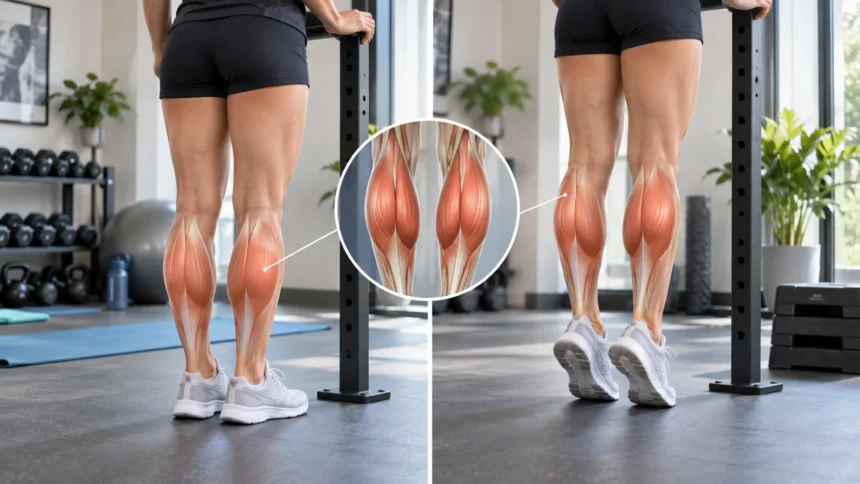
The calf is primarily made up of two major muscles called the gastrocnemius and soleus. The gastrocnemius is the larger, more visible muscle that forms much of the shape at the back of the lower leg. It crosses both the knee and ankle joints, helping with ankle movement while also contributing slightly to bending the knee.
The soleus sits underneath the gastrocnemius and plays an important role in plantar flexion, which is the movement used when you point your toes or raise your heels. Unlike the gastrocnemius, the soleus does not cross the knee joint. This difference explains why bent-knee calf exercises can emphasize the soleus more than straight-leg variations.
Smaller muscles and tendons surrounding the ankle also contribute to lower-leg stability and movement. The Achilles tendon connects the calf muscles to the heel bone and transfers force during walking, running, and jumping. Training the calves therefore supports not only muscular strength but also coordinated movement throughout the ankle and foot.
Why Are Calf Muscle Exercises Important?
Calf muscles help push your body forward every time you walk or run. They create force as the heel lifts from the ground and contribute to controlling your body as your foot lands. Strong calves can therefore support efficient movement during everyday tasks as well as more demanding athletic activities.
Calf strength also plays an important role in ankle stability. The lower leg must control forces when you change direction, climb stairs, balance on one leg, or move across uneven surfaces. Strengthening the muscles around the ankle can improve your ability to manage these demands, particularly when exercises are performed through a comfortable and controlled range.
Training the calves can also improve muscular endurance. People who stand for long periods, walk frequently, hike, or participate in running sports repeatedly use these muscles throughout the day. Gradually increasing calf strength and endurance can help the lower legs tolerate repeated loading without becoming fatigued as quickly during normal activity.
How to Do a Standing Calf Raise Correctly
Begin a standing calf raise with your feet around hip-width apart and your weight distributed evenly across both feet. Keep your knees straight without aggressively locking them, and maintain an upright posture. You can lightly hold a wall, chair, or stable surface for balance so that your attention remains on the calf muscles rather than preventing yourself from falling.
Slowly press through the front of your feet and lift your heels as high as you comfortably can. Pause briefly at the top while keeping your ankles controlled instead of allowing them to roll outward. Lower your heels gradually until they return to the starting position, maintaining control throughout the lowering phase rather than dropping quickly.
Focus on moving through the ankle instead of bouncing your whole body up and down. A slower repetition usually creates more muscular tension than using momentum to complete a larger number of repetitions. Beginners can start with bodyweight calf raises before progressing to dumbbells, resistance machines, or single-leg variations as strength improves.
How to Do Seated Calf Raises
Seated calf raises are useful because bending the knees changes how the calf muscles contribute to the movement. Sit on a stable chair or bench with your knees bent and your feet flat on the floor. Keep your toes pointing comfortably forward and position your feet so that you can raise your heels without losing balance.
Press through the balls of your feet and slowly lift both heels from the floor. Pause near the top of the movement, then lower your heels under control until they return to the starting position. Avoid rapidly bouncing through the repetitions because slower movement helps you maintain tension and focus on the muscles you are trying to train.
Resistance can be increased by placing a weight carefully across the thighs above the knees or by using a seated calf raise machine. Start conservatively and make sure you can perform the full movement comfortably before adding heavier resistance. Bent-knee calf raises are particularly useful for strengthening the soleus as part of a balanced lower-leg routine.
Best Calf Exercises for Beginners
Bodyweight standing calf raises are one of the easiest places to begin. They require no special equipment and allow you to practice ankle control before increasing resistance. Hold a stable surface for balance, rise onto your toes slowly, and lower your heels with control while keeping your feet and ankles aligned throughout every repetition.
Seated calf raises are another beginner-friendly option because they are easy to control and can be performed at home. They provide a different training angle from standing raises by placing greater emphasis on the soleus. Combining both variations helps strengthen the calf muscles in straight-knee and bent-knee positions without requiring complicated equipment.
Beginners can also try supported single-leg calf raises once standard repetitions become comfortable. Place one hand against a wall and raise one foot slightly from the floor, then perform the movement with the supporting leg. Single-leg training increases difficulty without requiring heavy weights and can help reveal noticeable strength differences between the right and left sides.
Single-Leg Calf Raises for More Strength
Single-leg calf raises increase the amount of body weight each calf must control. Begin by standing close to a wall or sturdy object for balance and lift one foot away from the floor. Keep the supporting leg stable, then raise the heel slowly while pressing through the front of the foot.
Pause briefly at the top before lowering the heel with control. Try to keep the ankle aligned instead of allowing it to collapse inward or roll excessively outward. Because one leg is supporting your full body weight, this exercise can become challenging quickly even if regular two-leg calf raises feel relatively easy.
Once you can perform controlled repetitions through a comfortable range, you can gradually add resistance by holding a dumbbell. Progress should come from better control and appropriate loading rather than simply performing faster repetitions. If your balance fails before the calf becomes tired, continue using light support so stability does not limit the strength exercise.
How Many Calf Raises Should You Do?
The appropriate number of repetitions depends on your goal, current strength, and the resistance being used. Beginners might start with two or three sets of approximately 10 to 15 controlled repetitions. If this feels very easy and your technique remains consistent, resistance or exercise difficulty can gradually increase instead of endlessly adding more repetitions.
Calf muscles are used frequently during everyday activities, so many people tolerate moderately higher repetition ranges well. However, that does not mean every set needs dozens of repetitions. Using enough resistance that the final repetitions feel challenging while remaining controlled can be an effective way to build strength and muscular endurance.
You also do not need to train calves intensely every day. Like other muscles, they benefit from an appropriate balance between training and recovery. Two or three focused sessions per week may work well for many people, although total activity, running volume, sports participation, and individual recovery should influence the final training schedule.
Common Calf Exercise Mistakes
One of the most common mistakes is performing calf raises too quickly. Bouncing through the movement uses momentum and may reduce the amount of controlled muscular work taking place. Slowing the upward and downward phases makes it easier to feel the calves working while keeping the ankle position stable throughout each repetition.
Another mistake is using a very small range of motion when a fuller comfortable range is available. Some people lift their heels only slightly before dropping them back down. Moving through a controlled range can help train the muscle more effectively, although you should never force the heel into a painful stretch simply to make the movement appear larger.
Foot position is another area worth monitoring. Allowing the ankles to roll dramatically inward or outward can shift stress away from the intended movement pattern. Keep pressure distributed through the front of the foot and focus on lifting the heel vertically, adjusting stance width slightly if necessary to find a comfortable and stable position.
How to Progress Calf Exercises Safely
Progressive overload means gradually increasing the challenge placed on the calf muscles as they become stronger. You can progress by adding resistance, performing more controlled repetitions, increasing range of motion, or moving from two-leg to single-leg exercises. Changing one variable at a time makes it easier to understand how your body responds.
Avoid making sudden jumps in weight or training volume, especially if you are also running, hiking, or participating in sports. Calves and the Achilles tendon already experience repeated loading during many daily activities. Increasing exercise demands too rapidly can leave the area unusually sore or irritated rather than producing steady, manageable progress.
People with existing back or joint conditions may also need to choose exercise positions carefully. A broader rehabilitation program may involve modified lower-body work alongside condition-specific movements such as spondylolisthesis exercises when professionally appropriate. Your calf routine should fit comfortably within your overall movement needs rather than aggravating another existing condition.
Calf Exercises for Runners and Active People
Runners place repeated demands on the calves because these muscles help absorb and generate force during every stride. Strengthening them may improve their ability to tolerate repeated loading during training. Straight-knee and bent-knee calf exercises can both be useful because running requires contribution from the gastrocnemius and soleus across many steps.
Single-leg calf raises are especially relevant for runners because running repeatedly involves supporting the body on one leg. Controlled repetitions can build calf strength while also challenging ankle stability. More advanced athletes may eventually use heavier resistance or carefully programmed explosive movements, but basic strength and control should be established before progressing to higher-impact exercises.
Calf training should be balanced with overall running volume. Adding a demanding lower-leg session immediately before a hard run may leave the muscles fatigued and affect movement quality. Placing strength sessions thoughtfully within the week allows enough recovery while still providing the progressive loading needed to improve lower-leg capacity.
Should You Stretch Your Calves?
Calf stretching can be useful when limited ankle mobility or muscular stiffness makes certain movements uncomfortable. A basic straight-knee wall stretch tends to target the gastrocnemius, while slightly bending the back knee can shift more emphasis toward the soleus. Both should create gentle tension rather than sharp pain or aggressive pulling.
Stretching alone does not replace strength training. A muscle needs the ability to produce and control force throughout the range of motion used during everyday activity. Combining appropriate mobility work with progressive calf exercises can therefore provide a more complete approach than relying exclusively on stretching whenever the lower legs feel tight.
Mobility requirements also vary between individuals and activities. Someone who performs deep squats may need greater ankle dorsiflexion than someone whose primary activity is casual walking. Rather than forcing flexibility for its own sake, focus on developing enough comfortable movement for the tasks, sports, and exercises you regularly perform.
What to Do if Calf Exercises Cause Pain
Normal muscular fatigue or mild post-exercise soreness can occur when you begin a new calf routine. However, sharp pain, sudden pulling sensations, or pain that significantly changes how you walk should not simply be ignored. Stop the aggravating exercise and give the area time to settle instead of repeatedly testing the same painful movement.
Pain can come from different structures, including the calf muscles, Achilles tendon, ankle, or other nearby tissues. Because these problems can feel similar, self-diagnosing persistent symptoms can be difficult. Pain accompanied by substantial swelling, bruising, weakness, or an inability to bear weight may require more prompt professional assessment.
Sudden calf swelling, warmth, redness, or unexplained significant pain can sometimes indicate a problem that needs urgent medical attention rather than ordinary exercise soreness. Seek appropriate medical evaluation when symptoms appear unusual or severe. Exercise advice should not replace professional assessment when warning signs suggest something more significant than temporary muscular fatigue.
How to Build an Effective Calf Workout
A balanced calf workout can include both straight-knee and bent-knee exercises. For example, standing calf raises can be paired with seated calf raises so that both the gastrocnemius and soleus receive focused training. You can then add single-leg work when appropriate to increase difficulty and improve side-to-side strength.
Start each session with manageable resistance and prioritize smooth repetitions. A simple routine might include two or three calf exercises performed for two or three sets each, depending on your experience and existing training schedule. More exercises are not automatically better, especially if your calves already receive substantial work from running, sports, or lower-body strength sessions.
Track progression over several weeks rather than judging results from one workout. Improvements may appear as additional repetitions, heavier resistance, better control, or less fatigue during everyday activities. Consistency is more valuable than constantly changing exercises, so keep the basic movement patterns long enough to gradually improve your ability to perform them.
Conclusion
Calf muscle exercises can strengthen the gastrocnemius and soleus while supporting ankle stability, walking, running, balance, and other lower-body movements. Standing calf raises, seated variations, and single-leg exercises provide simple ways to train these muscles. The most effective exercise depends on your current ability, goals, and overall activity level.
Proper form should remain the priority as resistance increases. Use a controlled range of motion, avoid bouncing, maintain stable ankle alignment, and progress gradually instead of making sudden increases in training volume. Training both straight-knee and bent-knee positions can help create a more complete calf-strengthening routine.
Calves respond best to consistent training combined with appropriate recovery and overall lower-body exercise. You do not need complicated equipment to begin, and bodyweight movements can provide plenty of challenge when performed correctly. If pain, swelling, or unusual symptoms develop, modify the activity and seek professional guidance when needed.
FAQs
What is the best exercise for calf muscles?
Standing calf raises are one of the simplest and most effective calf exercises. Combining them with seated calf raises helps train both the gastrocnemius and soleus through different knee positions.
Can I train my calves every day?
Daily intense calf training is usually unnecessary. Many people can make progress with two or three focused sessions per week while allowing recovery between workouts, especially if they also walk, run, or play sports regularly.
How many calf raises should a beginner do?
Beginners can start with approximately two or three sets of 10 to 15 controlled repetitions. Increase difficulty gradually once you can complete the exercise comfortably while maintaining good ankle alignment and movement control.
Do calf raises strengthen the ankles?
Calf raises strengthen muscles that cross and support the ankle, which can contribute to better lower-leg strength and stability. However, complete ankle training may also include balance, mobility, and other strengthening exercises.
Why do my calves hurt after calf raises?
Mild muscular soreness can occur after unfamiliar or challenging exercise, particularly when training volume increases. Sharp, severe, persistent, or unusually swollen calf pain should not be treated as ordinary soreness and may require medical evaluation.