
Spondylolisthesis can cause lower-back discomfort, stiffness, muscle tightness, or symptoms that travel into the buttocks and legs. Exercise is often used as part of conservative management because stronger supporting muscles and better movement control can reduce unnecessary stress around the lumbar spine. The most suitable exercises, however, depend on the type and severity of the condition.
A good spondylolisthesis exercise routine usually emphasizes core stability, hip strength, gentle mobility, and controlled movement rather than aggressive bending or loading. Exercises should feel manageable and should not significantly increase back or leg symptoms. Anyone with persistent pain, numbness, weakness, or a confirmed spinal condition should discuss an exercise plan with a qualified healthcare professional.
What Is Spondylolisthesis and Why Does Exercise Matter?
Spondylolisthesis occurs when one vertebra moves forward relative to the vertebra below it. It may develop for different reasons, including age-related spinal changes, stress injuries, congenital differences, or previous trauma. Symptoms vary widely, with some people experiencing little discomfort while others develop lower-back pain, tight hamstrings, or nerve-related symptoms.
Exercise does not simply push a slipped vertebra back into position. Instead, rehabilitation usually focuses on improving the way muscles around the spine, abdomen, pelvis, and hips support everyday movement. Better muscular control can help reduce unnecessary strain while making walking, sitting, lifting, and other daily activities feel more manageable.
The safest exercise approach depends on individual symptoms and the specific form of spondylolisthesis. Certain movements may feel comfortable for one person yet aggravate another, particularly when significant spinal extension is involved. Starting with low-impact exercises and gradually increasing difficulty is generally more practical than immediately attempting demanding workouts.
Benefits of Spondylolisthesis Exercises
One important benefit of exercise is improved core stability. The abdominal muscles, deeper trunk muscles, pelvic muscles, and back muscles work together to control the position of the spine during movement. Training these areas with controlled exercises can improve stability without requiring heavy weights or large ranges of spinal motion.
Exercise can also improve hip and lower-body strength, which helps distribute movement demands more efficiently. Weak glutes and poor hip control may cause a person to rely excessively on the lower back during walking, standing, or lifting. Strengthening surrounding muscles can therefore support more balanced movement patterns during everyday activities.
Regular movement may also help reduce stiffness and maintain confidence with physical activity. People with back pain sometimes begin avoiding movement because they fear making the condition worse, which can contribute to weakness and reduced mobility. Appropriate exercises provide a structured way to stay active while monitoring how the back responds.
Pelvic Tilts for Gentle Core Control
Pelvic tilts are a simple exercise that can help you learn how to control the pelvis and engage the abdominal muscles without using large spinal movements. Lie on your back with your knees bent and feet resting comfortably on the floor. Keep your shoulders relaxed and allow your lower back to begin in a natural position.
Gently tighten your abdominal muscles and slightly rotate the pelvis so the lower back moves closer toward the floor. The movement should be small and controlled rather than forceful. Hold briefly while breathing normally, then return to the starting position without excessively arching the lower back.
Start with a small number of comfortable repetitions and focus on control instead of speed. Pelvic tilts should not create sharp back pain, increased leg pain, numbness, or tingling. Once the movement becomes easier, the same abdominal control can be incorporated into more advanced stability exercises such as dead bugs and bridges.
Dead Bug Exercise for Core Stability
The dead bug exercise trains the trunk to remain stable while the arms and legs move. Begin lying on your back with your hips and knees bent comfortably and your abdominal muscles gently engaged. Depending on your current ability, you can start with only arm movements or heel taps before progressing further.
Maintain a comfortable neutral or slightly supported lower-back position while slowly moving one limb away from the body. Avoid allowing the lower back to arch noticeably as the leg moves downward. Return to the starting position and alternate sides while maintaining steady breathing and controlled movement throughout each repetition.
The goal is not to lower the leg as far as possible. Use only the range where you can maintain good trunk control without increasing symptoms. If extending the leg creates back discomfort, shorten the movement, keep the knee more bent, or work with a physical therapist on an easier variation.
Bird Dog Exercise for Spinal Control
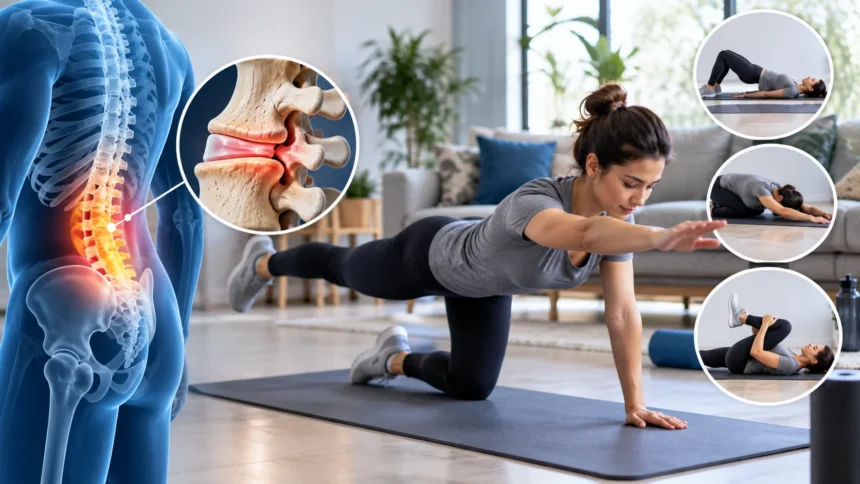
Bird dog exercises develop coordination between the core, hips, shoulders, and back while keeping the spine relatively stable. Begin on your hands and knees with your hands positioned beneath your shoulders and knees under your hips. Gently engage your abdominal muscles without holding your breath or forcing your spine into an uncomfortable position.
Start by sliding or lifting one leg backward while keeping your pelvis relatively level. As your control improves, you may combine the leg movement with raising the opposite arm. Think about reaching outward rather than lifting the arm or leg high, because excessive height can create unnecessary extension through the lower back.
Move slowly and stop if you notice sharp pain or increasing symptoms down the leg. People who find the full bird dog difficult can practice lifting only one arm or one leg at a time. Proper form is more important than completing a large number of repetitions or using an exaggerated range.
Glute Bridges for Hip and Pelvic Strength
Glute bridges strengthen the muscles around the hips and pelvis while allowing the trunk to practice controlled stability. Lie on your back with your knees bent and feet about hip-width apart. Gently tighten your abdominal muscles and squeeze the glutes before beginning the upward movement.
Lift your hips only as high as you can comfortably manage without excessively arching the lower back. The movement should come primarily from the hips rather than forcing the lumbar spine into extension. Pause briefly at a comfortable height, then lower the pelvis slowly back toward the floor.
If a standard bridge causes discomfort, decrease the lifting height or temporarily choose another exercise. As strength improves, repetitions can be increased gradually before considering harder variations. Avoid immediately progressing to heavy resistance or single-leg bridges if basic movements are still difficult to control comfortably.
Gentle Hamstring and Hip Mobility
Tight hamstrings are commonly reported by people with certain forms of spondylolisthesis, and gentle flexibility work may make movement feel easier. A simple hamstring stretch can be performed while lying down with a strap around the foot. Slowly raise the leg until a mild stretch is felt without forcing the knee completely straight.
The sensation should feel like gentle muscle tension rather than sharp pain, burning, or pulling through the lower back. Hold the stretch comfortably while continuing to breathe normally. Avoid aggressive toe touching or repeated bouncing because these approaches may place unnecessary stress on already sensitive tissues.
Hip mobility is also worth maintaining because stiff hips can encourage extra movement through the lumbar spine. Gentle hip stretches can be useful when performed within a comfortable range and without forcing the back into excessive extension. A healthcare professional can help choose specific stretches if your symptoms change significantly with different spinal positions.
Strengthen the Hips and Protect the Lower Body
Strong hip muscles help control the pelvis and lower extremities during walking, climbing stairs, and standing. Side-lying leg raises, supported hip abduction, and carefully performed resistance-band exercises can strengthen these muscles without requiring large movements through the spine. Keep your trunk stable and avoid rotating your pelvis simply to lift the leg higher.
Lower-body joint comfort also matters because knee or hip pain can change the way you walk and place additional demands on the back. Someone dealing with multiple musculoskeletal issues may find it useful to understand conditions such as knee bone spurs when adjusting activity levels. Exercises should be selected according to the whole movement pattern rather than focusing only on the spine.
Start lower-body strengthening with manageable resistance and controlled repetitions. Squats, step-ups, or similar exercises may be appropriate for some people when performed with good technique, but they should be modified if they trigger back or leg symptoms. A stable support or reduced range can make these movements easier during the early stages of training.
Walking and Low-Impact Cardio
Walking is one of the simplest ways to maintain cardiovascular fitness while managing many forms of lower-back discomfort. Start with a distance and pace that do not noticeably increase symptoms during or after the activity. Several shorter walks may be more comfortable than one long session when you are initially rebuilding activity tolerance.
Keep your posture relaxed rather than deliberately holding your back rigid. Comfortable shoes and reasonably level walking surfaces may make movement easier, particularly if lower-body joints are also sensitive. If symptoms become worse after a predictable amount of time, shorten the walking duration and increase it progressively as tolerance improves.
Other low-impact options may include stationary cycling, swimming, or water-based exercise depending on individual symptoms. The best activity is one that allows you to move consistently without repeatedly provoking pain. Avoid assuming that an exercise is automatically safe simply because it is described as low impact; your personal response still matters.
Exercises and Movements to Modify or Avoid
Movements involving repeated or excessive lower-back extension may aggravate symptoms in some people with spondylolisthesis. Deep backbends, aggressive cobra-style positions, and certain gymnastics movements can place the lumbar spine into substantial extension. Whether these movements are appropriate depends on the individual, so painful exercises should not be forced simply to increase flexibility.
Heavy lifting with poor spinal control can also increase stress through the lower back. Exercises such as heavily loaded squats, deadlifts, overhead presses, or back-extension machines may require modification when symptoms are active. This does not mean every person with spondylolisthesis must permanently avoid resistance training, but loading should be progressed carefully.
High-impact activities such as repeated jumping or intense running may also need temporary adjustment if they consistently worsen symptoms. The goal is not to become afraid of movement but to identify which activities your body currently tolerates. Gradually reintroducing demanding movements under professional guidance may be appropriate when strength and symptom control improve.
Best Practices for Exercising Safely
Start every exercise at a level you can control comfortably. Using fewer repetitions, a shorter range of motion, or an easier variation allows you to evaluate how your back responds before adding more difficulty. Progressing slowly is particularly important when returning to exercise after a period of pain or inactivity.
Pay attention to symptoms during the exercise and for several hours afterward. Mild muscular effort is expected, but sharp pain, increasing leg symptoms, numbness, or noticeable weakness are signs to stop and reassess the movement. Exercise quality should be judged by control and symptom response rather than by how intense the workout feels.
Consistency is usually more useful than occasionally performing a very demanding session. A short routine completed several times per week can gradually improve strength, coordination, and activity tolerance. A physical therapist can help individualize exercise selection, repetitions, resistance, and progression when spondylolisthesis causes ongoing functional limitations.
When to Seek Professional Help
Persistent back pain that does not improve with activity modification and gentle exercise should be evaluated by a healthcare professional. An assessment can help determine whether symptoms are actually related to spondylolisthesis or another spinal, muscular, or joint condition. This is especially important when pain significantly affects walking, sleeping, working, or everyday activities.
Seek prompt medical attention if you develop new or worsening leg weakness, substantial numbness, difficulty controlling your legs, or rapidly progressing neurological symptoms. Changes involving bladder or bowel control or numbness around the saddle region require urgent medical assessment. These symptoms should not be managed simply by trying different home exercises.
Professional guidance is also useful when you are unsure how much exercise is appropriate or when every attempt at activity increases symptoms. A clinician or physical therapist can examine movement patterns and provide modifications based on your specific condition. Individualized advice is often more effective than copying a generic routine when symptoms are persistent or complex.
Conclusion
Spondylolisthesis exercises are generally designed to improve core stability, hip strength, movement control, and overall activity tolerance. Pelvic tilts, dead bugs, bird dogs, glute bridges, gentle stretching, and low-impact cardiovascular activity can all be useful components of a carefully structured routine. Exercises should remain controlled and should not significantly worsen back or leg symptoms.
The most effective routine is not necessarily the most difficult one. Starting with simple movements, monitoring your symptoms, and increasing repetitions or resistance gradually can help you build strength without placing unnecessary stress on the spine. Maintaining hip and lower-body function can also support more efficient movement during everyday activities.
Because spondylolisthesis varies from person to person, exercise recommendations should be adjusted to your diagnosis, symptoms, and physical abilities. Persistent pain, weakness, numbness, or neurological changes require professional assessment. When exercise is appropriately selected and progressed, it can become a valuable part of maintaining movement and functional strength.
FAQs
What are the best exercises for spondylolisthesis?
Core-stability exercises such as pelvic tilts, dead bugs, bird dogs, and controlled bridges are commonly used. The best routine depends on your symptoms, spinal condition, strength level, and professional recommendations.
Can I exercise if I have spondylolisthesis?
Many people can remain physically active with spondylolisthesis using appropriately selected exercises. Begin with controlled, low-impact movements and reduce or stop exercises that cause increasing back pain, leg pain, numbness, or weakness.
Are squats safe with spondylolisthesis?
Squats may be appropriate for some people when performed with good control and suitable resistance. Technique, depth, loading, and symptoms matter, so persistent discomfort should be discussed with a physical therapist or clinician.
Should I avoid back extension exercises?
Some people with spondylolisthesis find repeated or excessive lumbar extension uncomfortable. Avoid forcing painful backbends or extension exercises, and seek individualized guidance if you are uncertain about which spinal movements are appropriate.
How often should I do spondylolisthesis exercises?
Frequency depends on the exercise, symptoms, and individual treatment plan. Gentle mobility or stability work may be performed regularly, while strengthening sessions usually need enough recovery time between workouts to maintain comfortable technique.