
The clam shell exercise is a simple hip-strengthening movement that mainly targets the muscles on the outside of the hips. You perform it while lying on your side with your knees bent and feet together, then lift the top knee while keeping the feet in contact. The movement resembles a clam opening and closing, which is where the exercise gets its name.
Although the exercise looks easy, it can be very effective when performed with control. It is commonly used in strength training, rehabilitation, warm-ups, and mobility routines because it helps train the gluteus medius and other hip stabilizers. These muscles play an important role in walking, running, balancing, and keeping the pelvis controlled during lower-body movement.
The clam shell is especially useful because it does not require much equipment or space. Beginners can perform it with body weight, while more experienced exercisers can add a resistance band around the thighs. Its simplicity also makes it a practical exercise for home workouts, gym sessions, and targeted hip-strengthening programs.
Muscles Worked During Clam Shells
The gluteus medius is one of the main muscles worked during clam shells. This muscle sits on the outer side of the hip and helps move the leg away from the body while also stabilizing the pelvis. Strong gluteus medius muscles can improve control during walking, running, stairs, and single-leg activities.
The gluteus minimus and deep hip rotators also contribute to the movement. These smaller muscles assist with hip stability and rotation, helping the upper leg move without the pelvis rolling backward. Although the clam shell is not a heavy strength exercise, it can be very useful for improving muscle activation and control.
The core also contributes indirectly by helping keep the trunk and pelvis stable. If the body rolls backward during the movement, the exercise becomes less focused on the intended hip muscles. Maintaining a steady torso allows the glutes and deep hip stabilizers to do more of the work instead of relying on momentum.
How to Do the Clam Shell Exercise Correctly
Start by lying on one side with your hips and knees bent comfortably. Stack your legs on top of each other and keep your feet together while resting your head on your lower arm or a pillow. Position your hips so they stay aligned rather than rolling backward or forward.
Gently engage your core and keep your feet touching as you lift the top knee upward. Move only as far as you can without allowing your pelvis to rotate backward. Pause briefly at the top, then lower the knee slowly to the starting position while maintaining control through the entire movement.
Your range of motion does not need to be large. The goal is to feel the outer hip muscles working rather than lifting the knee as high as possible. A smaller movement with good pelvic control is usually more effective than a large movement that causes your entire body to roll backward.
Common Clam Shell Exercise Mistakes
One common mistake is rotating the pelvis backward as the top knee rises. This creates a larger-looking movement but reduces the amount of work performed by the target hip muscles. Keep your hips stacked and imagine your top hip staying directly above the lower hip throughout each repetition.
Another mistake is lifting the knee too high. Once the pelvis begins to move, the exercise becomes less specific to the glutes. Stop at the point where you can maintain control and gradually improve range as your hip strength and coordination increase.
Rushing the movement is also a common problem. Fast repetitions often rely on momentum and make it harder to feel the correct muscles working. Slow down the lifting and lowering phases so you can control the resistance and maintain the same body position from the first repetition to the last.
Benefits of the Clam Shell Exercise
One of the biggest benefits of clam shells is improved hip stability. Stronger gluteal muscles can help control the pelvis during walking, running, stairs, and other single-leg activities. Better hip control may also improve movement quality during squats, lunges, and step-ups.
Clam shells can also improve awareness of how your hips move. Because the exercise is performed slowly and in a simple position, it is easier to notice whether one side feels weaker or less coordinated. This can help identify side-to-side differences that may not be obvious during larger compound exercises.
Another advantage is accessibility. The exercise can be performed almost anywhere and requires no equipment unless you want extra resistance. It can also be adapted for beginners, older adults, athletes, and people returning to activity, making it a versatile addition to many lower-body programs.
Clam Shells for Hip Stability
Hip stability is important because the pelvis needs to remain controlled as your legs move underneath you. During walking and running, one leg repeatedly supports your body while the opposite leg swings forward. The gluteus medius helps prevent excessive pelvic dropping and contributes to smooth, efficient movement.
Clam shells strengthen some of the muscles responsible for this lateral stability. The exercise can be particularly useful when combined with weight-bearing movements such as step-ups, split squats, and lateral walks. These exercises challenge the same muscles in different positions and can help build more functional strength.
However, clam shells should not be treated as the only hip exercise you need. They work best as part of a broader routine that includes both isolated and compound movements. Strengthening the hips in several directions can provide better overall support than relying on a single exercise alone.
Clam Shells for Runners and Walkers
Runners use the gluteus medius and other hip stabilizers repeatedly with every stride. If these muscles fatigue quickly, the pelvis and leg may become harder to control as distance or speed increases. Clam shells can be used as accessory exercises to improve hip endurance and support lower-body movement.
Walkers can benefit for similar reasons. Strong hip muscles contribute to balance, step control, and stability when walking on uneven surfaces or climbing hills. Older adults may also find the exercise useful because it strengthens the hips without requiring standing balance during the movement.
For best results, combine clam shells with other exercises that train the legs through weight-bearing movement. Walking, step-ups, bridges, squats, and controlled lunges can help transfer hip strength into everyday activity. The clam shell is useful, but it should support rather than replace broader lower-body training.
Adding Resistance to Clam Shells
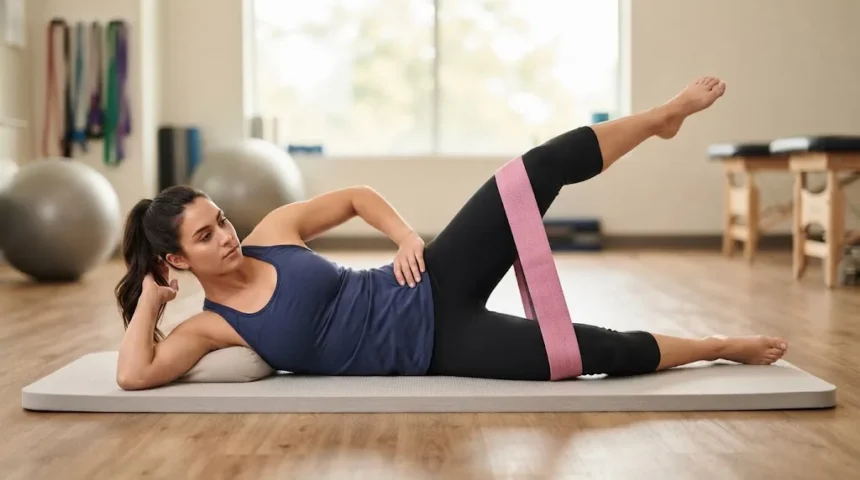
Once body-weight clam shells feel easy, a resistance band can make the exercise more challenging. Place a loop band around the thighs just above the knees before getting into position. The band creates additional resistance as the top knee lifts away from the bottom knee.
Choose a light or moderate band at first. If the resistance is too strong, you may compensate by rotating your pelvis or shortening the range excessively. The best band allows you to maintain the same controlled form while making the outer hip muscles work harder.
You can progress by increasing band resistance, adding repetitions, or pausing longer at the top. Avoid changing everything at once because large jumps in difficulty can reduce technique quality. Small, consistent progress usually leads to better strength gains and makes the exercise easier to control.
How Many Clam Shells Should You Do?
Beginners can start with two or three sets of around 10 to 15 controlled repetitions on each side. The final few repetitions should feel challenging while your technique remains consistent. If you can easily perform many repetitions without fatigue, it may be time to add light resistance.
More experienced exercisers can increase the number of repetitions or use stronger bands. However, very high repetition counts are not always necessary if the movement is performed slowly with enough resistance. Quality and control are usually more important than trying to complete the largest possible number of repetitions.
Training two or three times per week is often enough for general hip strengthening. You can also use a lighter version as part of a warm-up before lower-body workouts. Allow enough recovery if the outer hips feel significantly sore or tired after more challenging sessions.
Clam Shells and Lower-Body Mobility
Clam shells primarily strengthen the hips, but they can also complement mobility work. When the hips are stronger, it may become easier to control movement through squats, lunges, and walking. Strength and mobility often work best together rather than being treated as completely separate goals.
Tightness in the back of the thighs can also affect how lower-body movement feels. If you are working on mobility alongside hip strength, these hamstring stretches can complement clam shells by addressing another major muscle group around the hips and knees. Use gentle stretches rather than forcing range.
A balanced lower-body routine can include hip strengthening, hamstring mobility, calf work, and controlled knee exercises. This broader approach supports movement across several joints rather than focusing on one area. It can also help you identify whether stiffness, weakness, or coordination is the main factor limiting your movement.
Clam Shell Exercise Variations
One simple variation is the banded clam shell. Adding a resistance band around the thighs increases difficulty without changing the basic movement. This is a good next step once you can perform body-weight repetitions with consistent pelvic control.
Another variation is the elevated clam shell. Keep your knees together while slightly lifting the feet off the floor, then open the top knee. This increases the challenge because your hip muscles must control both leg position and rotation at the same time.
You can also progress toward side-lying hip abduction, lateral band walks, or standing hip exercises. These movements train similar muscles in more demanding positions. Moving from isolated clam shells to weight-bearing exercises can help develop strength that transfers more directly to walking, sports, and everyday movement.
When Clam Shells Should Be Modified
Clam shells should feel like controlled muscle work rather than sharp pain. If you feel pinching in the front of the hip, reduce the hip bend or move through a smaller range. A slightly different setup can often make the exercise more comfortable without removing the strengthening benefit.
Pain on the outside of the hip may also require adjustment, especially if lying directly on the area is uncomfortable. Use a soft mat or pillow for support, or choose a standing hip exercise instead. Persistent pain should not be ignored or repeatedly pushed through simply because the exercise is considered low impact.
If you are recovering from surgery, a fracture, or a significant hip injury, follow individualized rehabilitation advice. Clam shells may be appropriate at certain stages, but the timing depends on your condition. A physical therapist or other qualified clinician can help determine whether the exercise fits your recovery plan.
Conclusion
The clam shell exercise is a simple and effective way to strengthen the gluteus medius, gluteus minimus, and other hip stabilizing muscles. It requires little space, can be performed without equipment, and is easy to modify with resistance bands. Its main value comes from improving hip control and supporting lower-body movement.
Good form is essential for getting the most benefit. Keep your hips stacked, move slowly, and stop lifting the knee before the pelvis begins to roll backward. A small, controlled range usually targets the intended muscles better than a larger movement performed with poor technique.
Clam shells work best as part of a broader lower-body program. Combine them with bridges, squats, step-ups, walking, and mobility exercises to build more complete hip strength and function. With consistent practice and gradual progression, the exercise can become a useful tool for improving stability, balance, and everyday movement.
FAQs
What muscles does the clam shell exercise work?
Clam shells mainly target the gluteus medius, gluteus minimus, and deep hip rotator muscles. These muscles help stabilize the pelvis and control the position of the upper leg.
How many clam shells should I do?
A practical starting point is two or three sets of 10 to 15 controlled repetitions per side. Increase resistance or repetitions gradually as the exercise becomes easier.
Are clam shells good for hip pain?
They may help some people by strengthening hip stabilizers, but they are not appropriate for every type of hip pain. Modify or stop the exercise if it causes sharp or worsening symptoms.
Can I do clam shells every day?
Light clam shells may be comfortable for some people, but harder resistance sessions usually need recovery. Avoid daily heavy training if your hips remain significantly sore or fatigued.
Should I use a resistance band for clam shells?
A resistance band is useful once body-weight repetitions become easy. Start with light resistance and choose a band that allows you to keep your pelvis stable throughout the movement.