
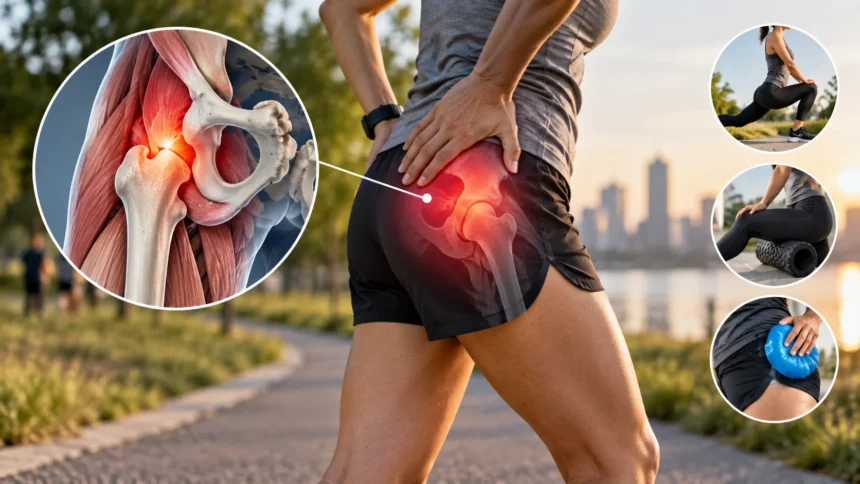
Hip pain after running can range from a mild ache that disappears after rest to persistent discomfort that interferes with walking, training, or sleep. Because the hip is surrounded by muscles, tendons, bursae, joints, and connective tissues, several different problems can produce similar symptoms. Where the pain appears and when it starts can provide useful clues about the likely cause.
Running places repeated load through the hips every time your foot strikes the ground. Training errors, muscle weakness, reduced mobility, unsuitable footwear, or suddenly increasing mileage can sometimes make those tissues work harder than they are prepared to handle. In other cases, pain may relate to tendon irritation, bursitis, joint problems, or another condition that needs professional assessment.
Most mild running-related hip discomfort improves when you reduce aggravating activity and address the factors contributing to overload. However, persistent or severe pain should not simply be ignored or trained through. Understanding common causes, relief strategies, and warning signs can help you make safer decisions about recovery and returning to running.
Why Does Your Hip Hurt After Running?
Running repeatedly loads the muscles, tendons, and joints surrounding the hip. Your glutes, hip flexors, hamstrings, adductors, and core help control the pelvis with every stride. When training demands increase faster than these tissues can adapt, irritation may develop during a run or become noticeable several hours afterward.
Pain can also occur when certain muscles are doing more work because other areas are weak, stiff, or fatigued. Limited ankle movement, reduced hip strength, or poor control of the pelvis may alter how force travels through the leg. These factors do not always cause pain by themselves, but they can contribute when combined with high training loads.
The location of your discomfort matters. Pain at the front of the hip may involve different structures than pain on the outside, deep in the groin, or near the buttock. Paying attention to location, severity, duration, and activities that worsen symptoms can help guide appropriate modifications and professional evaluation when needed.
Training Too Much or Increasing Mileage Too Quickly
One of the most common reasons runners develop hip pain is doing too much before the body has adapted. Increasing weekly mileage, adding hills, introducing speed sessions, or running more days can significantly raise training load. Even experienced runners may develop symptoms when several changes occur within the same short period.
The body needs time to adapt to repeated impact and muscular demand. Muscles, tendons, bones, and connective tissues respond gradually rather than immediately. If training volume rises too quickly, recovery between sessions may become insufficient, increasing the likelihood of soreness, tendon irritation, or other overuse-related problems around the hip.
Reducing training temporarily does not necessarily mean stopping all movement. You may be able to replace painful runs with lower-impact activities such as easy cycling, swimming, or walking if these are comfortable. When symptoms improve, increase running volume gradually rather than returning immediately to the mileage or intensity that triggered the problem.
Hip Flexor Strain or Irritation
The hip flexors are located at the front of the hip and help bring your thigh forward during running. They work repeatedly through every stride, particularly during faster running, uphill sessions, or sprinting. Overuse, fatigue, or sudden force can irritate these muscles and sometimes cause pain near the front of the hip or upper thigh.
A mild hip flexor problem may feel like tightness, soreness, or pulling when lifting the knee. More noticeable irritation can make stairs, running, or rising from a seated position uncomfortable. Stretching aggressively is not always helpful, especially when the muscle or tendon is already sensitive from recent overload.
Early management often involves reducing activities that reproduce pain and allowing irritated tissues to settle. Gentle movement may be better tolerated than complete inactivity, depending on the severity. Once pain decreases, gradually restoring hip strength and movement can help prepare the area for the repeated demands of running again.
Gluteal Tendon Pain and Outer Hip Discomfort
Pain on the outside of the hip may involve the gluteal tendons, which connect important hip muscles to the upper part of the thigh bone. These tendons help stabilize the pelvis during walking and running. Repetitive loading, sudden training increases, and reduced hip strength can contribute to irritation in some runners.
Tendon-related pain often behaves differently from ordinary muscle soreness. It may hurt during running, when climbing stairs, or when lying on the affected side at night. Tendons can become sensitive when training demands repeatedly exceed their current capacity, and recovery generally requires gradual load management rather than simply stretching harder.
Tendon irritation can occur in many regions of the body when repetitive load exceeds tissue tolerance. Learning how conditions such as tendonitis symptoms develop can provide useful background on overuse patterns, although hip symptoms should still be assessed according to their specific location and cause.
Greater Trochanteric Pain and Bursitis
Another possible source of pain around the outside of the hip is greater trochanteric pain syndrome, which can involve tendons and nearby bursae. A bursa is a small fluid-filled structure that reduces friction between tissues. Irritation in this region can make running, walking, stairs, or lying on one side uncomfortable.
The pain is often felt over the bony prominence on the outer hip and may spread slightly down the side of the thigh. Symptoms can become worse after long runs or when repeatedly crossing the legs or standing with the body weight shifted heavily onto one hip.
Treatment depends on the tissues involved and how severe the symptoms are. Reducing painful loads, improving hip strength, and modifying training may help some runners. Persistent pain deserves professional assessment because what people commonly call “hip bursitis” may actually involve several structures rather than inflammation of the bursa alone.
IT Band and Lateral Hip Tension
The iliotibial band, or IT band, is a strong band of connective tissue that runs along the outside of the thigh. It works with nearby muscles to help stabilize the hip and knee during movement. Runners sometimes describe tightness around the outer hip or thigh and assume the IT band itself needs aggressive stretching.
However, the IT band is not a muscle that can be lengthened easily through ordinary stretching. Symptoms around this area may be influenced by training load, hip strength, movement control, or irritation of nearby tissues. Foam rolling may provide temporary relief for some people, but it does not necessarily address the underlying cause.
A better approach often involves looking at the entire movement pattern. Strengthening the glutes, adjusting running volume, and allowing irritated tissues time to recover may be more useful than repeatedly forcing deep stretches. If outer hip pain persists, an assessment can help determine whether the issue involves the IT band region, tendons, or another structure.
Hip Impingement and Deep Groin Pain
Some runners experience deep pain in the front of the hip or groin rather than soreness in the surrounding muscles. One possible explanation is femoroacetabular impingement, often shortened to FAI, where the shape and movement of the hip joint can create irritation during certain positions. Not everyone with these structural features develops symptoms.
Pain may be more noticeable when the hip is deeply bent, such as during squatting, sitting low, or bringing the knee toward the chest. Running may aggravate symptoms depending on stride mechanics, training volume, and joint sensitivity. Clicking or stiffness can sometimes occur, although these symptoms alone do not confirm a diagnosis.
Because several problems can create groin or deep hip pain, self-diagnosis is difficult. Persistent symptoms should be assessed by an appropriate healthcare professional, particularly if mobility is decreasing or everyday activities become painful. Treatment may involve activity modification, targeted strengthening, mobility work, and other individualized strategies.
Muscle Weakness and Poor Hip Stability
The gluteal muscles help control the pelvis and thigh every time you land on one leg while running. If these muscles fatigue quickly or lack sufficient strength, other structures may have to manage more load. This can contribute to inefficient movement and increased strain around the hip, knee, or lower leg.
Hip stability involves more than simply having strong glutes. Core control, balance, coordination, and strength through the entire lower body all contribute to how well you absorb and transfer force. A runner may have strong muscles in the gym but still need better endurance or control during repetitive single-leg movement.
Strength exercises such as bridges, split squats, step-ups, side steps, and controlled single-leg movements may help improve capacity. The best program depends on your symptoms and current ability. Strength training should be introduced gradually and should not significantly worsen hip pain during or after the session.
Tight Muscles and Limited Mobility
Restricted movement around the hips, ankles, or lower back can sometimes influence running mechanics. Tight hip flexors, adductors, calves, or other tissues may change how comfortably you move through your stride. However, feeling “tight” does not always mean that a muscle is physically short or needs aggressive stretching.
Muscles can also feel tight when they are tired, weak, irritated, or protecting a sensitive area. Stretching intensely into pain can make certain conditions worse rather than improving mobility. Gentle range-of-motion exercises are usually more appropriate when symptoms are recent, especially until the exact source of pain becomes clearer.
Mobility work should support comfortable movement rather than becoming a competition to achieve extreme flexibility. Focus on areas that genuinely feel restricted and use controlled stretches or mobility drills. Combining mobility with appropriate strength work often provides a more balanced approach than relying only on passive stretching.
Running Form, Footwear, and Surface Changes
Running form can influence how forces move through the hip, but there is no single perfect running technique for everyone. Stride length, cadence, foot placement, trunk position, and pelvic control vary naturally among runners. Major technique changes should usually be introduced gradually because suddenly altering your stride can shift load to unfamiliar tissues.
Footwear can also affect comfort, particularly when shoes are worn out or dramatically different from what your body is accustomed to. Switching from highly cushioned shoes to minimalist footwear, for example, changes how forces are distributed. That does not automatically cause hip pain, but sudden changes combined with high mileage can increase overall training stress.
Surface changes matter for the same reason. Hills, trails, tracks, treadmills, and hard roads each create slightly different demands. If hip pain started shortly after changing shoes, terrain, or running style, consider whether that change occurred too quickly and reduce exposure while your body adapts.
How to Relieve Hip Pain After Running
Start by reducing or temporarily stopping the activity that clearly worsens your pain. Mild soreness may settle with a few easier days, while more noticeable symptoms may require a longer reduction in running. Continuing to push through increasing pain can prolong irritation and make it harder to determine which activities your hip currently tolerates.
Cold or heat may provide short-term comfort depending on personal preference and the type of symptoms. Gentle walking and comfortable mobility can also help prevent unnecessary stiffness. Avoid repeatedly testing painful movements every few hours, because irritated tissues often need a period of reduced load before you can accurately judge improvement.
As symptoms settle, gradually rebuild activity rather than jumping directly back into your previous training plan. Begin with shorter, easier runs and monitor how the hip feels during the session and over the following day. A small amount of discomfort may be acceptable in some rehabilitation plans, but worsening or persistent pain should prompt reassessment.
Strength Exercises That May Help Runners
Strengthening can improve the ability of the hips and legs to tolerate repetitive running loads. Exercises such as glute bridges, squats, step-ups, side-lying leg raises, and split squats are common starting points. The goal is not simply to make the muscles tired but to build controlled strength that transfers to walking, running, and single-leg stability.
Single-leg exercises are particularly relevant because running repeatedly places the body on one leg at a time. Controlled step-downs, lunges, and single-leg balance drills can expose side-to-side differences and improve coordination. Begin with body weight and add resistance gradually once you can maintain good alignment without increasing symptoms.
Strength work should fit around your running rather than overwhelm your recovery. Two or three well-planned sessions per week may be sufficient for many recreational runners. If an exercise produces sharp hip or groin pain, reduce the range, lower the resistance, choose another movement, or seek professional advice.
When Should You See a Doctor?
Seek medical attention if hip pain is severe, began after a significant fall or injury, or makes it difficult to bear weight. Sudden swelling, deformity, fever, or inability to move the leg normally also deserves prompt evaluation. These symptoms may indicate something more serious than routine post-running soreness.
Persistent pain that does not improve with reasonable training modifications should also be assessed. Deep groin pain, night pain, progressive weakness, numbness, or repeated symptoms every time you run can suggest a problem that needs a clearer diagnosis. Stress injuries are particularly important to rule out in runners with increasing bone-related pain.
An appropriate healthcare professional can examine movement, strength, joint function, and symptom patterns to identify likely causes. Depending on the situation, they may recommend rehabilitation, temporary training restrictions, imaging, or further evaluation. Getting an accurate assessment early can help prevent a minor problem from becoming a longer interruption to running.
Conclusion
Hip pain after running can develop from several causes, including training overload, muscle strain, tendon irritation, reduced hip stability, mobility limitations, and joint-related problems. The location and behavior of the pain can offer useful clues, but similar symptoms may come from different tissues. Avoid assuming every ache is simply muscle tightness.
For mild symptoms, reducing running load, using comfortable movement, and gradually rebuilding strength may help. Review recent changes in mileage, speed, hills, footwear, and terrain because sudden increases often contribute to overuse problems. Returning to running should be gradual and based on how your hip responds during and after activity.
Persistent, worsening, or severe pain deserves professional evaluation rather than repeated self-treatment. A qualified clinician can help identify the likely source and recommend appropriate modifications or rehabilitation. Addressing the problem early gives you a better chance of returning to comfortable, consistent running without repeatedly triggering the same symptoms.
FAQs
Is it normal for your hips to hurt after running?
Mild temporary muscle soreness can occur after a harder or unfamiliar run. Pain that is sharp, persistent, worsening, or repeatedly returns with running is less typical and may require training changes or assessment.
Should I run with hip pain?
Avoid running if pain changes your gait, becomes progressively worse, or continues after training. Mild symptoms may sometimes allow modified activity, but the safest approach depends on the cause and severity of the pain.
How long does running-related hip pain take to heal?
Recovery can range from a few days for mild muscular soreness to several weeks or longer for tendon, joint, or bone-related problems. The timeline depends on the diagnosis, training load, and rehabilitation approach.
What stretches are good for hip pain after running?
Gentle hip flexor, glute, and adductor stretches may feel comfortable for some runners. Avoid forcing stretches into pain, because certain tendon or joint problems can become more irritated with aggressive stretching.
Can weak glutes cause hip pain while running?
Weakness or poor endurance in the gluteal muscles can contribute to reduced hip and pelvic control during running. However, hip pain has multiple possible causes, so glute weakness should not automatically be assumed to be the only problem.