

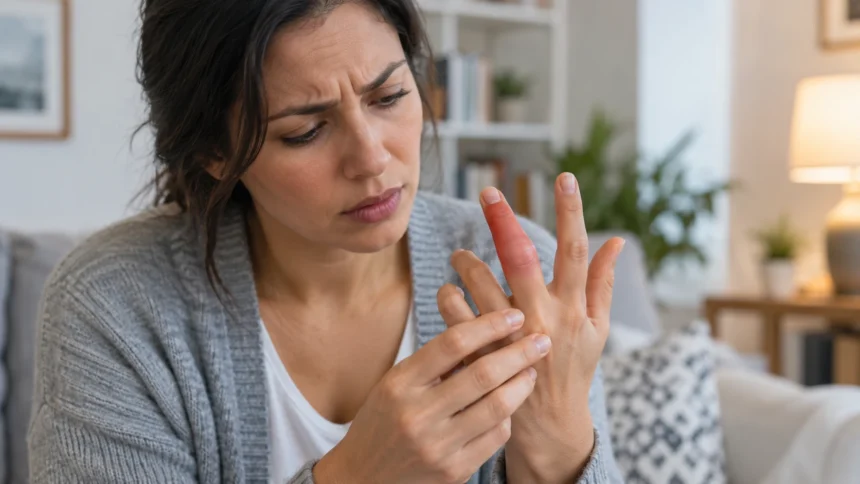
A swollen finger that hurts to bend can make everyday activities such as typing, gripping, cooking, or getting dressed surprisingly difficult. The problem may appear suddenly after an injury or develop gradually without an obvious cause. Swelling can involve the entire finger, one joint, the fingertip, or the tissues surrounding a tendon.
Common causes range from sprains and overuse to arthritis, infection, gout, and tendon problems. The location of the swelling, whether the finger feels warm or red, and whether there was a recent injury can provide useful clues. However, similar symptoms can develop from several different conditions, so appearance alone may not identify the exact cause.
Mild swelling sometimes improves with rest and simple self-care, but severe pain, increasing redness, numbness, or difficulty moving the finger deserves closer attention. Infections and significant injuries can worsen if treatment is delayed. The sections below explain common reasons a finger may become swollen and painful to bend and when medical care may be appropriate.
A Finger Sprain or Minor Injury
A sprain is one of the most common reasons a finger becomes swollen and painful after being bent, twisted, or pushed beyond its normal range. The ligaments supporting the finger joints can become stretched or partially injured during sports, falls, or everyday accidents. Swelling and tenderness may develop quickly around the affected joint.
You may still be able to move a mildly sprained finger, but bending or straightening it can feel uncomfortable. Bruising may appear over the following hours, and gripping objects may aggravate the pain. The finger should generally remain aligned normally, although swelling can make the joint look larger than the same joint on the opposite hand.
Resting the finger and avoiding activities that repeatedly provoke pain can help during the early period after a minor injury. Cold packs wrapped in cloth may temporarily reduce swelling and discomfort. Significant deformity, severe bruising, or inability to move the finger normally should be evaluated because fractures and ligament injuries can resemble simple sprains.
Could the Finger Be Broken?
A finger fracture can occur after a fall, sports injury, crush accident, or direct impact. Pain and swelling often begin quickly, and the finger may become bruised or difficult to bend. Some fractures produce obvious deformity, while others leave the finger looking relatively normal despite considerable pain.
A broken finger may feel especially painful when you press over the injured bone or try to grip something. Swelling can limit movement, making it difficult to determine whether stiffness comes from the fracture itself or surrounding tissue irritation. You should not assume that being able to move the finger means the bone is definitely intact.
Medical assessment is important when a fracture is possible because proper alignment affects long-term movement and hand function. An X-ray may be needed to determine whether a bone is broken and whether treatment requires splinting or another approach. Seek prompt care if the finger looks crooked, feels numb, or has an open wound.
Trigger Finger Can Make Bending Painful
Trigger finger develops when a tendon that bends the finger has difficulty moving smoothly through its surrounding sheath. The finger may feel stiff, tender, or swollen near the base, particularly in the morning. Some people notice catching, clicking, or a sensation that the finger briefly becomes stuck before releasing.
The condition can affect the thumb as well as other fingers. In more noticeable cases, the finger may lock in a bent position and require additional effort to straighten. Repetitive gripping and certain health conditions can be associated with trigger finger, although it can also develop without a clear repetitive activity.
Reducing aggravating activities may help mild symptoms, but persistent locking or increasing pain should be evaluated. Treatment depends on severity and may include activity modification, splinting, medication, injection, or other medical approaches. Forcing a locked or painful finger repeatedly is unlikely to solve the underlying tendon irritation.
Arthritis Can Cause Finger Joint Swelling
Arthritis can cause swollen, stiff, and painful finger joints that become harder to move. Osteoarthritis often develops gradually as joint cartilage changes over time, while inflammatory forms of arthritis can involve several joints and may create more noticeable warmth, prolonged morning stiffness, or swelling in both hands.
Pain related to osteoarthritis may become more noticeable after repetitive use and can affect joints near the fingertips or middle of the fingers. Inflammatory arthritis may behave differently, sometimes producing significant stiffness after rest that improves somewhat with movement. The pattern of affected joints can help a clinician decide what type of arthritis may be involved.
Persistent joint swelling should not automatically be blamed on age or overuse. A healthcare professional may consider your symptom pattern, medical history, examination, and sometimes blood tests or imaging. Early assessment is especially useful when several joints become swollen or when morning stiffness lasts for a prolonged period.
Gout Can Affect a Finger Joint
Gout is an inflammatory form of arthritis caused by crystals forming within a joint. It is best known for affecting the big toe, but other joints, including those in the fingers, can sometimes become involved. A gout flare may produce sudden severe pain, swelling, warmth, redness, and marked tenderness.
The affected joint can become so sensitive that even relatively light contact feels uncomfortable. Symptoms often develop rapidly rather than gradually over several months. People with a previous history of gout may recognize the pattern, although a first episode involving a finger can be difficult to distinguish from infection or another inflammatory condition.
Because infection and gout can produce similar redness and swelling, severe sudden finger inflammation should be evaluated rather than diagnosed at home. Treatment for gout differs from treatment for an infection. A clinician can assess your symptoms and medical history and determine whether additional testing is needed before recommending treatment.
Finger Infections Need Prompt Attention
An infection can cause a finger to become swollen, red, warm, and painful to bend. Bacteria may enter through a cut, puncture, bite, hangnail, or other small break in the skin. Sometimes the original injury seems minor, making it easy to overlook until inflammation becomes more noticeable.
Infections around the nail may cause localized swelling and tenderness, while deeper infections can affect tendons, joints, or other tissues. Increasing pain, spreading redness, pus, fever, or red streaks moving up the hand or arm are warning signs that require medical attention. Deep infections may make movement extremely painful.
Do not repeatedly squeeze or puncture a swollen finger in an attempt to drain it yourself. Infection can spread or involve structures important for hand function. Prompt treatment may involve antibiotics, drainage, or specialist care depending on the location and severity, so worsening redness or pain should not be ignored.
Tendon Irritation and Overuse
The tendons that move your fingers can become irritated after repetitive gripping, lifting, typing, tool use, sports, or other repeated hand activities. Overuse does not always cause visible injury, but the tissues can become sore and mildly swollen. Bending or straightening the affected finger may then feel stiff or painful.
Symptoms may be worse during the specific activity that originally irritated the finger. For example, gripping equipment or repeatedly pressing with one finger can reproduce discomfort. Unlike a major acute injury, overuse pain often develops gradually and may temporarily improve when the activity is reduced.
Resting from the aggravating movement can be useful, but prolonged complete immobilization is not always necessary for mild irritation. Gradually returning to comfortable movement can help maintain flexibility. If swelling persists, strength decreases, or the finger repeatedly becomes painful despite reducing the activity, professional assessment can help identify the affected tendon or joint.
Insect Bites and Allergic Swelling
An insect bite or sting can sometimes cause one finger to swell noticeably, particularly if the reaction is concentrated around the hand. The area may itch, burn, or feel tender, and swelling can make bending difficult even when the finger joint itself is not injured. A visible bite mark may or may not be obvious.
Mild localized reactions often improve gradually, although swelling in fingers can appear dramatic because there is limited space for tissues to expand comfortably. Remove rings immediately if the hand or finger begins swelling because jewelry can become dangerously tight. Avoid scratching the skin, which can increase irritation and introduce bacteria.
Emergency care is necessary if swelling occurs with difficulty breathing, swelling of the lips or tongue, widespread hives, faintness, or another severe allergic reaction. Local swelling that becomes increasingly hot, painful, or produces pus may instead suggest infection and should also be medically assessed.
When Swelling Involves More Than One Area
Sometimes finger swelling is part of a broader pattern rather than an isolated hand problem. Fluid retention, inflammatory conditions, certain medications, and systemic illnesses can cause swelling in more than one finger or hand. Looking at whether other joints, feet, or body areas are also affected can provide useful context.
Pain elsewhere in the body can also help clinicians understand whether symptoms represent separate mechanical problems or part of a wider condition. For example, someone researching unrelated issues such as buttock pain when sitting may notice that several joints or areas have become painful at the same time, which is worth mentioning during a medical evaluation.
One swollen finger after a minor injury is very different from repeated swelling in several joints accompanied by fatigue, prolonged stiffness, or other symptoms. Keep track of patterns rather than focusing only on the most painful location. This information can help a healthcare professional decide whether local injury, inflammation, or another health issue needs investigation.
What You Can Do for Mild Finger Swelling
For a mild injury without deformity or other warning signs, temporarily reduce activities that increase pain. Elevating the hand can sometimes help limit swelling, particularly soon after an injury. A wrapped cold pack may also provide short-term relief, but avoid placing ice directly against the skin or leaving it on continuously.
Remove rings or tight jewelry early because swelling can make them increasingly difficult to take off. Trying to force a swollen finger repeatedly through painful bending may aggravate irritated tissues. Gentle movement within a comfortable range can be reasonable when there is no suspected fracture or serious injury, but stop if pain sharply increases.
Do not rely on home care indefinitely when symptoms are not improving. A finger contains small joints, tendons, ligaments, nerves, and bones packed into a limited space, so problems can affect function quickly. Persistent swelling or restricted movement deserves evaluation, especially when you depend heavily on your hands for work or daily activities.
When to See a Doctor for a Swollen Finger
Seek medical attention after a significant injury if the finger is visibly deformed, cannot move normally, becomes very bruised, or produces severe pain. Numbness, unusual color changes, or a finger that feels unusually cold can indicate circulation or nerve problems and should also be assessed promptly.
Increasing redness, warmth, pus, fever, or severe tenderness may indicate infection and requires timely care. You should also arrange an evaluation when swelling continues without an obvious injury, repeatedly returns, or affects several joints. Persistent morning stiffness can be particularly relevant when an inflammatory form of arthritis is possible.
Emergency care may be needed for a severe crush injury, uncontrolled bleeding, exposed bone, loss of sensation, or severe allergic symptoms. When in doubt, protecting hand function is more important than waiting several days to see whether a potentially serious injury or infection resolves without treatment.
Conclusion
A finger that is swollen and painful to bend can have many causes, including a sprain, fracture, tendon irritation, trigger finger, arthritis, gout, infection, or an allergic reaction. The timing of symptoms and whether there was an injury can help narrow the possibilities, but similar conditions can look alike.
Mild swelling after a minor strain may improve with activity modification, elevation, and careful short-term self-care. However, persistent swelling or limited movement should not be repeatedly ignored. Small structures inside the finger contribute significantly to grip and hand function, so appropriate treatment can matter for long-term mobility.
Seek medical attention promptly when the finger is deformed, severely painful, numb, increasingly red or warm, or associated with pus or fever. A healthcare professional can determine whether imaging, medication, splinting, drainage, or another form of treatment is needed based on the underlying cause.
FAQs
Why is my finger swollen even though I did not injure it?
Swelling without an obvious injury can occur with arthritis, gout, infection, tendon inflammation, fluid retention, or an insect bite. Persistent or unexplained swelling should be medically assessed, especially when redness or warmth is present.
Why does my swollen finger hurt when I bend it?
Bending places pressure on swollen joints, tendons, ligaments, and surrounding tissues. Pain may occur with a sprain, tendon problem, arthritis, fracture, or infection depending on the location and accompanying symptoms.
How do I know if my swollen finger is infected?
Possible signs include increasing redness, warmth, throbbing pain, pus, worsening swelling, fever, or red streaking. Finger infections can involve deeper tissues, so rapidly worsening symptoms should receive prompt medical attention.
Can arthritis make one finger suddenly swell?
Yes, some forms of arthritis can produce noticeable swelling in individual finger joints, although the pattern varies. Sudden severe redness and warmth can also occur with gout or infection and should be properly evaluated.
When is a swollen finger an emergency?
Seek urgent care for severe deformity, loss of sensation, circulation changes, major trauma, spreading infection, or severe allergic symptoms. A rapidly worsening finger with fever or intense pain also warrants prompt medical assessment.