

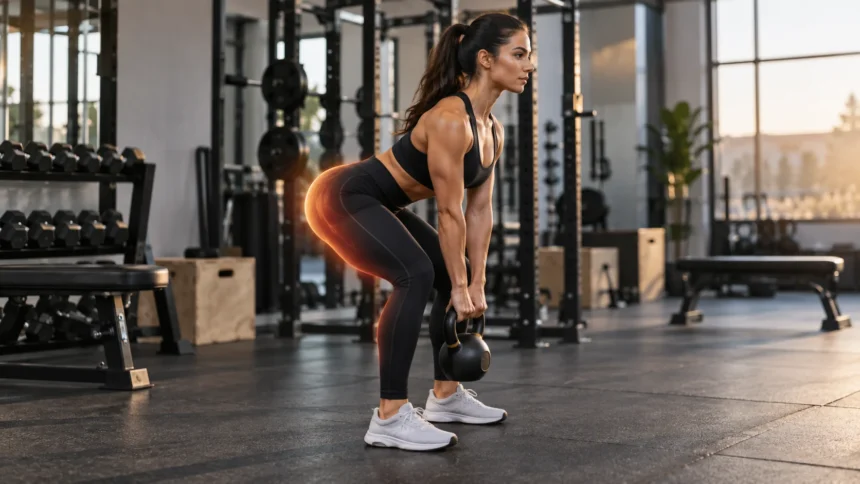
The hip hinge is a fundamental movement pattern used in strength training, sports, lifting, and everyday activities. It teaches you to move primarily through the hips while keeping the spine controlled, allowing muscles such as the glutes and hamstrings to do more of the work. Learning the movement correctly can improve exercise technique and make many lower-body movements feel more natural.
You can see the hip hinge in exercises such as deadlifts, Romanian deadlifts, kettlebell swings, and good mornings. It also appears when you bend to pick something up while keeping your hips back. Understanding proper hip hinge form can help you train more effectively without turning the movement into an uncontrolled squat or rounded-back bend.
What Is a Hip Hinge?
A hip hinge is a movement where the hips travel backward while the torso leans forward and the spine stays relatively neutral. The knees bend slightly, but the movement comes mainly from the hip joints rather than from dropping straight down. This pattern helps load the muscles along the back of the body.
The glutes, hamstrings, and muscles supporting the spine all contribute during a well-executed hinge. Your abdominal muscles also help stabilize the trunk while the hips move backward and forward. Because several major muscle groups work together, the hip hinge is important for both strength training and everyday movement.
The easiest way to think about a hip hinge is “hips back, then hips forward.” Instead of trying to reach the floor with your hands, imagine pushing your hips toward a wall behind you. This cue can make it easier to understand how the movement differs from bending mainly through the spine.
Hip Hinge vs Squat: What Is the Difference?
The hip hinge and squat both involve the hips and knees, but they emphasize movement differently. During a squat, the knees generally bend more and the hips move downward. During a hinge, the hips move backward more strongly while the knees remain comparatively softer and less deeply bent.
Squats usually place greater emphasis on the quadriceps because the knees move through a larger range. Hip hinges tend to involve the glutes and hamstrings more heavily because the hips travel backward and the posterior chain is loaded. Both movements are valuable and should not be treated as competing exercises.
A common mistake is turning a hip hinge into a squat by bending the knees too much. This shifts the movement downward instead of backward and reduces tension through the hamstrings. Practicing both patterns separately can help you understand how each should feel before using heavier resistance.
Main Benefits of the Hip Hinge
One major benefit of the hip hinge is that it strengthens the posterior chain, particularly the glutes and hamstrings. These muscles play important roles in walking, running, jumping, lifting, and maintaining control during athletic movements. Training them can improve overall lower-body strength and help create better balance between the front and back of the legs.
The hinge also teaches useful body mechanics for picking objects up from lower positions. Instead of relying entirely on spinal bending, you learn to involve the hips and stronger lower-body muscles. This does not mean the spine should never move, but learning controlled hip movement gives you another efficient option when lifting.
Another benefit is exercise transfer. Once you understand the hip hinge, movements such as Romanian deadlifts, kettlebell swings, barbell deadlifts, and cable pull-throughs become easier to learn. The basic movement pattern stays similar even though the load, speed, and equipment may change.
Muscles Worked During a Hip Hinge
The gluteus maximus is one of the primary muscles involved in extending the hips as you return to standing. It works together with the hamstrings to move the hips forward after they have traveled backward. Strong glutes are especially important when the hinge is performed with additional resistance.
The hamstrings lengthen under tension as the hips move backward and then help extend the hips during the return phase. Many people notice a stretching sensation along the back of the thighs during a controlled hinge. That tension is expected as long as it feels muscular rather than sharp, burning, or electrical.
The lower back and abdominal muscles mainly help stabilize the trunk. They should not be doing all the movement themselves, but they remain active to support a controlled torso position. The upper back, grip, and shoulder muscles may also contribute when holding dumbbells, kettlebells, or a barbell.
How to Perform a Hip Hinge Correctly
Stand with your feet around hip to shoulder width apart and keep your weight balanced through the feet. Soften the knees slightly rather than locking them completely. Brace your midsection gently, keep your chest relaxed, and begin pushing your hips backward as though trying to touch a wall behind you.
As the hips move back, allow the torso to lean forward naturally while maintaining control through the spine. Continue until you feel noticeable tension through the hamstrings or reach the limit of comfortable hip movement. You do not need to lower your torso to a specific angle if doing so causes your back position to change significantly.
To return, drive the hips forward and stand tall without leaning backward at the top. Think about squeezing the glutes rather than pulling with the lower back. Move slowly while learning the pattern so you can notice whether the motion is coming from the hips instead of excessive knee bending or spinal rounding.
Best Cues for Learning the Hip Hinge
One of the easiest cues is “close a car door with your hips.” This encourages you to move backward instead of simply bending down. Visual cues like this can make the movement easier to understand than thinking about individual joint angles, especially for beginners learning the pattern for the first time.
Another useful method is standing a short distance in front of a wall and reaching your hips backward until they touch it. Gradually move farther away as your control improves. This drill teaches the hips to travel backward while discouraging excessive knee movement and can be practiced without any equipment.
You can also hold a light stick along your back so it touches the head, upper back, and pelvis. Try to maintain those contact points while hinging. If the stick loses contact significantly, you may be moving too much through the spine instead of keeping the torso controlled.
Common Hip Hinge Mistakes
Rounding the back excessively is one of the most common mistakes. This often happens when people focus on reaching the weights toward the floor instead of moving the hips backward. The correct depth should be determined by your hip mobility and control rather than by how low your hands can travel.
Another mistake is bending the knees too much and turning the movement into a squat. Some knee bend is normal, but the hips should still travel backward noticeably. If you mainly feel the exercise in the front of your thighs, review your position and try reducing unnecessary knee movement.
Overextending the lower back at the top is also common. Standing tall should finish the repetition, so you do not need to thrust the hips far forward or lean backward. Excessive extension does not increase glute activation meaningfully and may simply create unnecessary discomfort in the lower back.
Hip Hinge Exercises for Beginners
The wall hinge is one of the best beginner drills because it gives you a clear target. Stand several inches from a wall with your back facing it, then push your hips backward until they lightly touch the wall. Return to standing and gradually increase the distance as the movement becomes easier.
A dowel hip hinge is another useful option because it provides feedback about spinal position. Hold a stick vertically against your back and maintain contact at the head, upper back, and pelvis as you move. The drill encourages controlled torso movement without requiring you to think about too many details at once.
Once bodyweight practice feels comfortable, you can add a light kettlebell or dumbbell. Hold the weight close to your body and move slowly through the same hinge pattern. If the added resistance changes your technique significantly, reduce the weight and continue practicing until the movement feels consistent.
Progressing to Weighted Hip Hinge Exercises
Romanian deadlifts are a common progression because they load the hip hinge through a controlled range. Hold dumbbells or a barbell close to the legs, move the hips backward, and lower until you reach comfortable hamstring tension. Keep the weight close to your body instead of allowing it to drift far forward.
Kettlebell deadlifts can also help bridge the gap between bodyweight practice and more advanced exercises. The weight starts from the floor, but the movement should still emphasize pushing the hips backward and driving them forward. Use a load that allows you to maintain control rather than choosing weight based purely on strength.
Your hands and grip also need to tolerate the load comfortably. If you have a swollen finger or another painful hand issue, avoid forcing a heavy grip until the cause is understood. You can continue practicing unloaded hinge mechanics while reducing unnecessary stress on the affected hand.
Hip Hinge for Deadlifts and Kettlebell Swings
The deadlift uses the hip hinge as one of its central movement patterns, although different deadlift variations also involve varying amounts of knee movement. Learning the hinge first can help you understand how to load the hips and maintain a controlled torso before progressing to heavier barbell training.
Kettlebell swings use the same general hip hinge pattern but add speed and momentum. The kettlebell should move because the hips extend forcefully rather than because you lift it primarily with the arms. Beginners should usually become comfortable with slower hinge exercises before trying fast, repetitive swing movements.
Good mornings are another hinge-based exercise, but the load sits higher on the body. This creates different leverage and can make the movement feel more demanding even with lighter weight. Start conservatively and prioritize control, especially if you are still learning how to maintain your torso position throughout the hinge.
How Deep Should You Hip Hinge?
There is no single correct depth for everyone because hip mobility, hamstring flexibility, limb proportions, and exercise choice all affect range. A useful stopping point is when you feel strong hamstring tension while maintaining control through the spine. Going lower is not automatically better if your position begins to break down.
In Romanian deadlifts, some people may lower the weights to mid-shin, while others stop closer to the knees. Both can be appropriate depending on anatomy and mobility. Instead of copying someone else’s depth, focus on maintaining tension through the hips and hamstrings without forcing extra range.
Mobility may gradually improve as you practice. However, you should not aggressively stretch into the bottom position under heavy load just to increase depth. Progress the range slowly and let your body adapt while keeping the movement controlled, especially when adding more resistance over time.
Hip Hinge Best Practices
Practice the movement without heavy weight before turning it into a strength exercise. Bodyweight hinges, wall drills, and dowel drills can help you develop the pattern without the distraction of holding a heavy load. Once the motion feels consistent, resistance can be added gradually.
Keep repetitions controlled when learning. Slower practice makes it easier to notice whether your knees are bending excessively, your back is rounding, or the weights are drifting away from your body. Quality matters more than performing a large number of repetitions with inconsistent technique.
Build strength gradually and allow enough recovery between demanding hinge sessions. Exercises such as deadlifts and Romanian deadlifts can create significant fatigue through the hamstrings, glutes, and back. Increasing load too quickly may make technique harder to maintain and can reduce the quality of later repetitions.
When to Stop or Modify the Hip Hinge
Normal muscle tension through the hamstrings and glutes is expected during a hinge, but sharp pain is not. Stop the exercise if you feel sudden pain, significant weakness, or symptoms that worsen with each repetition. Reducing the load or range may help if the issue comes from pushing beyond your current capacity.
Back discomfort during a hinge can have several causes, including technique, fatigue, excessive load, or an unrelated condition. Do not assume every uncomfortable sensation can be fixed by simply forcing your spine straighter. Persistent or increasing pain deserves evaluation if basic modifications do not help.
Numbness, tingling, pain traveling down the leg, or major weakness should be treated differently from normal muscle tightness. These symptoms may involve nerves or another issue that needs professional assessment. A physical therapist or qualified healthcare professional can help determine whether hip hinge training should be modified temporarily.
Conclusion
The hip hinge is a fundamental movement pattern that teaches you to move through the hips while maintaining a controlled torso. It strengthens the glutes, hamstrings, and supporting muscles and forms the foundation of exercises such as deadlifts, Romanian deadlifts, kettlebell swings, and good mornings.
Proper technique starts with pushing the hips backward instead of simply bending down. A small knee bend, controlled spine position, and strong hip extension help keep the movement focused on the posterior chain. Wall drills and dowel exercises can make the pattern much easier to learn before adding external weight.
Progress slowly and allow your range of motion to develop naturally. You do not need to hinge as deeply or lift as heavily as someone else to benefit from the movement. Consistent technique, gradual resistance, and attention to pain signals provide a more useful foundation for long-term strength and movement quality.
FAQs
What is a hip hinge in simple terms?
A hip hinge is a movement where you push your hips backward while your torso leans forward. The knees bend slightly, but most of the movement happens through the hip joints.
What muscles does the hip hinge work?
The hip hinge primarily works the glutes and hamstrings while the core and back muscles stabilize the torso. Grip and upper-back muscles may also contribute during weighted variations.
Is a hip hinge the same as a deadlift?
No. The hip hinge is a movement pattern, while the deadlift is an exercise that uses that pattern. Romanian deadlifts, kettlebell swings, and good mornings also involve hip hinging.
Should I feel a hip hinge in my lower back?
Your back muscles may work to stabilize the torso, but they should not feel like they are doing all the work. Strong hamstring and glute tension is usually more characteristic of a controlled hinge.
How can beginners learn the hip hinge?
Beginners can practice wall hinges and dowel drills before adding weight. These exercises provide feedback about hip movement and spinal control, making the basic pattern easier to understand.